Updated: May 19, 2025
U.S. deficit dynamics: Economic and investor implications
Feb 20, 2025 Fixed Income
Key takeaways
- U.S. government bonds, or Treasuries, are the primary way the federal government borrows money and one of the world’s most widely traded financial instruments.1
- America’s rising deficit and potential changes in U.S. policy have contributed to rising U.S. Treasury bond yields.2
- U.S. Treasury bonds play a unique role in financial markets and investors’ portfolios. iShares offers 35 U.S. Treasury bond ETFs3, including the iShares 0-3 Month Treasury Bond ETF (SGOV), designed to enable investors access to this asset class.
Understanding the U.S. deficit: Key fiscal challenges
U.S. government bonds are a way the federal government borrows money to pay for infrastructure projects, the military and other services. Also known as Treasuries, U.S. government bonds play a unique role in the global financial system and are often referred to as “risk free” investments. This concept refers to investors’ confidence in the U.S. government’s ability and willingness to repay its creditors, aka bondholders.
But there’s really no such thing as a “risk free” investment and major independent credit rating agencies have downgraded America’s credit rating.4
On May 16th, Moody’s ratings lowered the U.S. long-term issuer rating from Aaa to Aa1, based on the increase in “government debt and interest payment ratios to levels that are significantly higher than similarly rated sovereigns.”5.
Let’s review how we believe investors should consider the current fiscal situation and how investors can use U.S. Treasury bonds in portfolios.
What is the U.S. deficit?
America’s debt is the total amount of money the nation has borrowed from the bond market, approximately $36.2 trillion.6 U.S. Congress has authorized the government to borrow up to $31.4 trillion to meet its obligations, including the military, and programs such as Social Security. The cap on the amount of government debt that can be issued is known as the debt ceiling. The cap was suspended from June 2023 to January 2025.
As of January 1, 2025, the current debt ceiling has been raised to the current amount of U.S. Treasury securities outstanding or approximately $36 trillion. Treasury Secretary Janet Yellen explained in a letter to Congress that the current debt ceiling will be reached between January 14 and 23, 2025.7 After that, the U.S. Treasury Department will rely on “extraordinary measures” to keep the government solvent.
On May 9th, Treasury Secretary Scott Bessent informed Congress that based on tax collection revenue that the extraordinary measures will be exhausted by August 2025, while Congress will be in recess. Secretary Bessent asked Congress to increase the debt ceiling by mid-July to protect the full faith and credit of the United States.8
The 119th Congress will need to decide whether to raise the debt ceiling again. Since 1960, Congress has raised the debt ceiling 78 separate times.9
The U.S. deficit, over $1.8 trillion in fiscal year 2024 (which ended on 9/30/2024)10, is the difference between the amount of money the country spends vs. how much it brings in revenue via taxes and other sources. All else equal, if the federal government runs a deficit, then the cumulative U.S. debt would be expected to increase. The last government surplus was in 2001.11
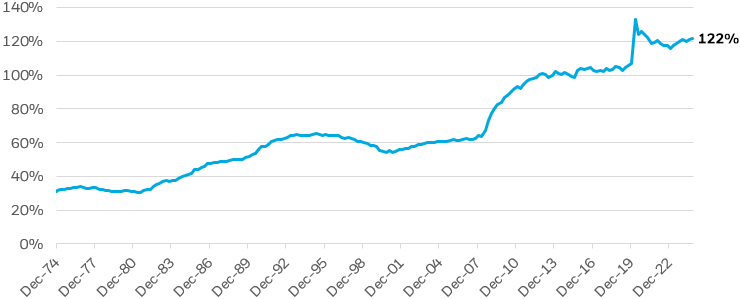
One way to view the national debt and deficit is as a percentage of gross domestic product (GDP), which is a measure of the total economic output of the country. As of October 31, the total U.S. federal debt as a percentage of GDP was over 120%.10
U.S. Federal Debt as % of GDP
Source: U.S. Treasury Department, as of 4/30/2025.
Chart description: The time series chart displays the U.S. federal debt as a percentage of gross domestic.
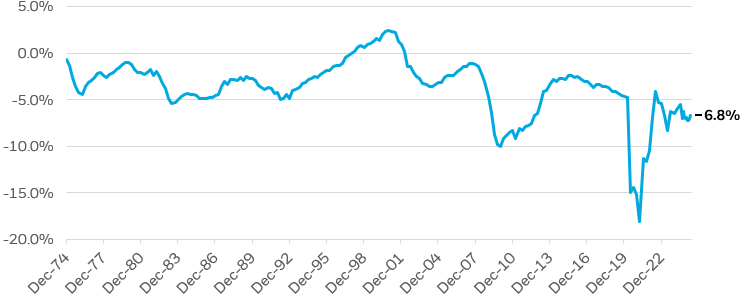
As of April 30, 2025, the U.S. federal budget deficit was 6.8% of GDP compared to the 50-year average of 3.8%.12 Rising debt burden may contribute to a higher cost of borrowing over time, if investors demand higher yields to compensate them for any perceived credit risk.
U.S. Federal Budget Deficit as % of GDP
Source: U.S. Treasury Department, as of 4/30/2025.
Chart description: The time series chart displays the U.S. federal budget deficit as a percentage of U.S. gross domestic product (GDP).
The role of treasuries in global markets
Despite concerns about America’s debt and deficit, the United States is still considered a very high-quality borrower based on its current credit ratings. Moody’s even noted the U.S. retains “exceptional credit strength based on size, resilience and dynamism of its economy and role as a global reserve currency.5 America’s credit rating is influenced by many factors — including the size and trajectory of the deficit — and is particularly important to global investors. That’s because Treasuries play a central role in the financial markets, including the following applications:
- Foreign exchange reserve management: Global central banks can seek to govern the value of local currencies by buying or selling U.S. dollars via Treasuries. Because they are priced in dollars, buying or selling large amounts of Treasuries may influence the dollar’s value vs. other major currencies.
- Implement monetary policy: The U.S. Federal Reserve may buy or sell Treasury bonds to manage America’s money supply, and to implement policies such as quantitative tightening or easing, wherein the central bank reduces or expands its balance sheet in an effort to influence long-term interest rates.
- Collateral for derivative contracts: Treasury bills and notes are commonly used to settle trades between institutional investors, known as counterparties, or to mark-to-market swaps, futures and options. “Mark to market” is an accounting practice used to assess the value of financial securities if they were to be sold at prevailing market prices.
- Reference rate for corporate bonds and other securities: When bonds or other fixed-income securities are issued, the market may demand additional yield above U.S. Treasuries with a similar maturity to determine the coupon rate. This yield difference compared to U.S. Treasuries is known as a “credit spread.”
Meet the team: Types of U.S. treasuries
U.S. Treasury debt that can be purchased by the general public is known as marketable securities, which can be sold or transferred before they mature. Marketable securities can be classified into the following security types.
- Bills: Securities that mature between two days and 52 weeks, issued at a discount to face value (such as a price of $99 and will mature at $100).
- Notes: Securities with original maturities of 2, 3, 5, 7, and 10 years that make interest payments semi-annually, known as coupons.
- Bonds: Securities with an original maturity of 20 and 30 years that pay semi-annual coupons.
- Treasury Inflation Protection Securities (TIPS): Securities with original maturities of 5, 10 and 30 years that pay semi-annual coupons with the principal amount that adjust at the rate of inflation, as measured by the Consumer Price Index.
- Floating Rate Notes (FRN) or Floaters: A security that pays a quarterly coupon at a fixed spread to 13-week Treasury bills. (Learn more about floating rate bond ETFs.)
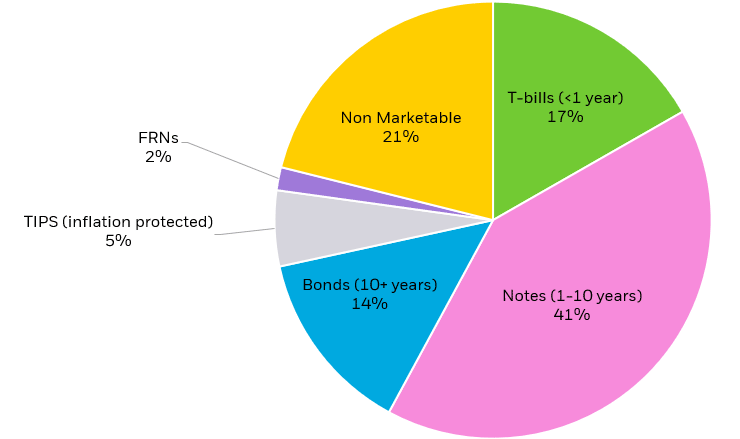
The total U.S. Treasury debt of $35.9 trillion13 also includes non-marketable securities, meaning bonds not available for public purchase as well as intragovernmental holdings. Intergovernmental debt records a transfer from one part of the government to another.
Composition of Total U.S. Treasury Debt
Source: U.S. Treasury Department, as of 4/30/2025, using the Monthly Statement of the Public Debt.
Chart description: Pie chart showing the types of U.S. government debt by market value.
What drives U.S. treasury rates?
U.S. Treasuries are issued via an auction process that includes both institutional and retail investors. In 2024, the U.S. Treasury Department held 440 public auctions and issued $28.5 trillion in marketable securities.14 Coupons, or the yields on the securities being auctioned is determined by competitive bids. All competitive bidders will get the same yield. The Treasury department publishes a quarterly refunding statement and a schedule of upcoming Treasury auctions to communicate to the market its anticipated borrowing needs and which types of bills, bonds and notes that it expects to issue.
U.S. Treasury bonds also trade in the secondary market, where investors trade securities with each other rather than directly with the issuer. The supply and demand for government bonds on the secondary market impacts the level of interest rates.
Supply and demand, including from money market funds, along with Federal Reserve policy — and market expectations of future Fed decisions - are among the primary drivers of short-term U.S. Treasury yields.
Longer-term U.S. Treasury yields are driven by myriad factors, including but not limited to:
- The growth of the U.S. economy.
- Inflation rates.
- Supply and demand from investors, including insurance companies, pension plans and other liability driven investors.
The difference in short– and longer-term interest rates is known as the yield curve. Investors typically demand additional yield for investing over longer periods of time, also known as term premium.
In addition to the factors listed above, other technical factors such as supply and demand from both U.S. and global investors, daily balance sheet management of banks and broker-dealers, pricing of on-the run (the most recently issued bond) vs off-the run (all remaining previously issued bonds) bonds, derivatives settlement dates, central bank policy actions and month-end or quarter-end reporting periods can impact the interest rates on U.S. Treasury bonds.
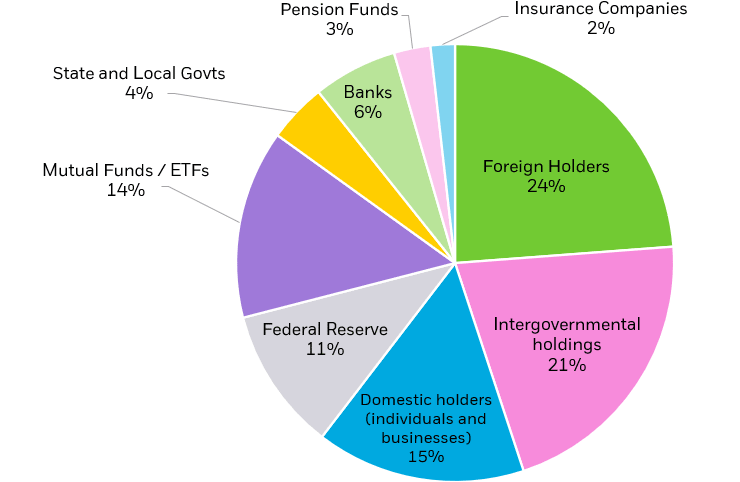
U.S. Treasury debt is purchased by a wide range of domestic and foreign holders, from individuals, businesses, mutual funds, exchanged-traded funds (ETFs), global central banks, state and local governments, banks, pension plans, and insurance companies.
Current holders of U.S. Treasury Debt
Source: U.S. Treasury Department, as of March 2025.
Chart description: Pie chart showing the holders of U.S. government debt.
How do government deficits impact the U.S. treasury market?
To pay for expenses above the revenue it brings in — known as deficit spending — the government may issue more Treasuries, increasing the supply. More supply typically results in lower prices — assuming the market operates freely, and demand remains stable. Since bond prices and yields historically have been inversely related, more issuance of U.S. Treasuries could lead to higher yields. Higher yields, in turn, can increase the costs consumers pay for loans — such as for cars and homes — as well as the cost for the government to service its outstanding debts.
In 2024, the U.S. government spent 33% more than the year prior paying off its debts (interest expense).15 Since U.S. Treasuries play such a unique and central role in the global financial system, the impact of America’s deficits are uncertain in the short-term.
Over time the deficit can be reduced by:
- Reduce government spending.
- Increase taxes,
- Grow the overall economy, which BlackRock Chairman and Chief Executive Officer Larry Fink believes is a path to reducing the impact of America’s debt.16
The role of U.S. bonds in your portfolio
U.S. Treasuries are a core component of the global financial system. As a result, concerns about the path of U.S. deficit may not dramatically impact the bond market over the near term. U.S. Treasuries can be potentially used in portfolios to put cash to work, to help diversify equity holdings and aid in managing interest rate risk in a portfolio. (Learn more about investing in iShares bond ETFs.)
Role in a portfolio / Ways to get started
U.S. Treasuries can be used to put cash to work and as an equity market diversifier. Treasury bonds are the largest and most liquid part of the bond market17. Bond ETFs can be an efficient, low-cost way to access Treasury securities. iShares offers a broad range of Treasury bond ETFs.
Equity Market Diversifier
U.S. Treasuries tend to increase in price when risky assets decrease in value18, which is known as the flight-to quality. Put another way, these bonds have historically had negative correlations to stocks and could add diversification to portfolios. (Learn more about Demystifying Bond Duration.)
Access the Entire Yield Curve
Investors who want access to the U.S. Treasury bond markets can consider adding exposure with bonds from 1-to-30 years via the iShares U.S. Treasury Bond ETF (GOVT).
Manage interest rate risk
For those investors that want to manage interest rate risk at the part of the yield curve they are exposed to, iShares offers a range of bond ETFs that track specific maturity ranges:
- The iShares 0-3 Month Treasury Bond ETF (SGOV), iShares Short Treasury Bond ETF (SHV) and iShares 1-3 Year Treasury Bond ETF (SHY) can give investors exposure to short-term Treasury securities.
- The iShares 3-7 Year Treasury Bond ETF (IEI) offers investors exposure to the so-called belly — or intermediate-term — of the yield curve, which the iShares strategy team favors in its 2025 Investment Directions for “core” fixed-income allocations.
- Investors seeking longer duration can get exposure to the long end of the Treasury curve via the iShares 20+ Year Treasury Bond ETF (TLT).
Yield curve maturity segments

Chart description: A list of the iShares U.S. Treasury bond ETFs by ticker with the maturity ranges for each fund.
Put cash to work with T-bills or Floating Rate
Investor looking to put cash to work may consider investing in the iShares 0-3 Month Treasury Bond ETF (SGOV) or the iShares Treasury Floating Rate Bond ETF (TFLO), which access ultra-short term government bonds.
Add Inflation protection with TIPS
Treasury inflation protection securities can help to add inflation protection into portfolios with the iShares TIPS Bond ETF (TIP) or the iShares 0-5 Year TIPS Bond ETF (STIP). The principal on these bonds adjusts monthly with changes in the consumer price index.
Build Bonds Ladders
Bond ladders can be used to help manage interest rate risk or to invest over a specific time horizon. Treasury iBonds range in maturity dates from 2025 to 2054 and TIPS iBonds ranges from 2025-2035. (Learn more about building bond ladders with iShares® iBonds® ETFs.)