Harness the power of compounding

Amy Jenkins Dec 19, 2025

A simple way to optimize your finances and help build wealth exponentially over time.

Key takeaways

  • Compounding is an economic principle that describes how your money can grow more and more over time.
  • There are a number of simple ways you can harness the power of compounding to help your money grow faster.
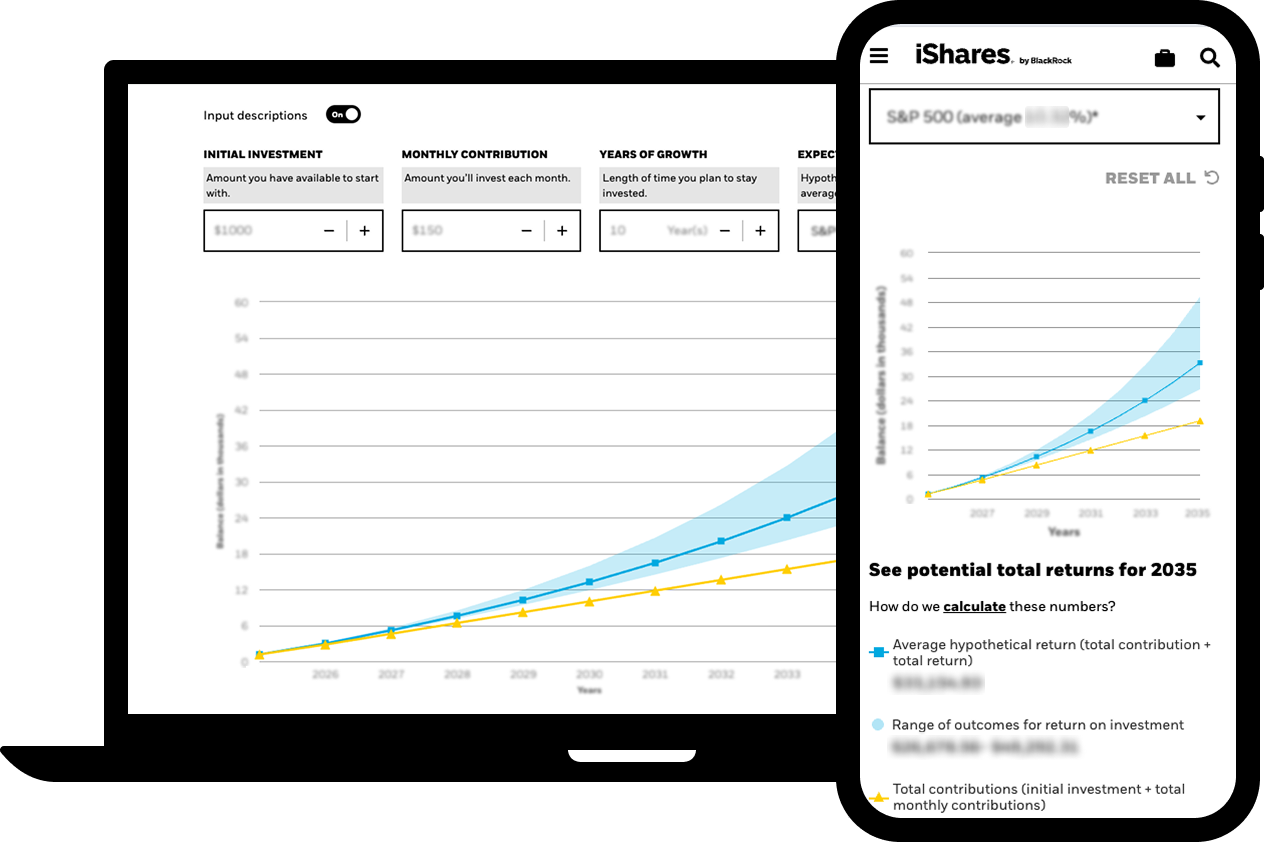
  • The iShares Investment Growth Calculator allows you to visualize how your money can potentially benefit from the power of compounding.

What is compound interest?

Compound interest, in the simplest terms, is interest earning interest. Your money earns interest, and then that interest earns interest. It’s a math concept that essentially describes a snowball effect where growth accelerates exponentially, especially over the long term.

Even if you don’t have a lot to start with, making regular contributions over time helps you get the most from compound interest.

Potential benefits of compounding for building wealth

Accelerated growth
Your earnings can generate their own earnings, growing exponentially each year.

Rewards long-term thinking
The sooner you start saving or investing, the more time compounding has to work.

How does compound interest work?

Here's a simple example of how $1,000 could become over $1,600 after 10 years:

  • In the first year, you would earn interest on your initial investment (starting amount). With 5% interest on $1,000 (1,000 X 0.05), you would earn $50.
  • Year two, if you kept that $50 in your account, you would earn interest on your initial investment plus last year’s interest. So, you would earn 5% on $1,050 (1,050 X 0.05). At the end of that year, you would have $1,102.50.
  • Year three, you would earn interest on $1,102.50 (1,102.50 X 0.05) and end the year with $1,157.63.

And it would continue like that year after year, building momentum over time, eventually reaching $1,600 after the 10th year, assuming no withdrawals were made.

Compounding in investing

Want to kick it up a notch or two? The concept of compounding applies to investing too.

Investing involves buying assets that you believe will become more valuable in the future. Your money can grow not just from interest earned on bonds, but from reinvested dividends and capital gains, and appreciation of the investments themselves. (Learn about how to get started investing.)

But investing is not without risk- there’s always the chance you could lose some or all the money you started with. By contrast, there’s very low risk of losing your principal with traditional savings accounts, which have FDIC insurance, a government program that protects up to $250,000 per person for each account at an FDIC-insured bank.

While there’s no way to know for sure what your investments will earn because the markets are not predictable and past performance doesn’t guarantee future results, that $1,000 could have become more than $1,600 if you had invested it.

Just for illustrative purposes, if you had invested $1,000 in an S&P 500 index fund 10 years ago, your money could have grown to nearly $4,000 today, depending on exactly when you invested and what fund you invested in.1

Explore how investing can help your money grow

The potential for higher returns is one of the main advantages of investing. The iShares Investment Growth Calculator demonstrates what you could potentially earn from recurring investing in just a few steps.

The calculator allows you to visualize how your money could grow in different scenarios.

You can play around with the contribution amount and years you plan to stay invested until you find the combination that works best for you and your financial goals.

How to seek the benefits of compounding

Automatic investing plans
A automatic (recurring) investing plan is an easy way to get started with investing. It allows you to buy fractional shares of a security, including ETFs, on a regular basis, starting from just $1 per month, with the flexibility to make changes any time. It’s that simple.

High-yield savings accounts
A high-yield savings account pays you more interest than a regular savings account. Essentially, the bank is paying you a small fee for keeping your money there.

Retirement accounts (401(k), IRA)
Retirement accounts come in several forms and are meant to help you save money for the future, while getting tax benefits along the way. You put money in while you’re working and generally only pay taxes when you take the money out for retirement.

Dividend reinvestment
Sometimes called a DRIP (dividend reinvestment plan), a dividend reinvestment account helps your money grow automatically. Instead of taking dividends as cash, they’re automatically used to buy more shares of the same investment. Over time, those extra shares can earn their own dividends.

Certificate of deposit (CDs)
A CD is a type of savings account where you agree to keep your money for a set amount of time in exchange for a higher interest rate than a regular savings account. When the CD “matures,” you get your original deposit back plus all the interest you earned.

Start early, contribute regularly

There’s an old Chinese proverb that went something like: “The best time to plant a tree was 10 years ago; the second best time is now.” Time is your biggest advantage in building wealth. The longer your money is saved or invested, the more opportunities it has to compound. Even small amounts can grow dramatically over time, since each year builds on the last.

Also, regular contributions keep your money growing steadily. If you add money each month, or even each quarter or just once a year, you’re giving compounding a steady stream of fresh funds. Each new contribution will start its own compounding cycle, adding more and more to the long-term growth.

Starting early can give you more time, and regular contributions give you more momentum. Together, they can create powerful, exponential growth potential for your money. So even if you start small, compounding can help your money grow steadily and even dramatically over the years.

Top questions about compounding

With compound interest, you earn interest on your original amount plus any interest earned in previous periods. Your money will grow faster over time because each period builds on a bigger total. With simple interest, you only earn interest on your starting amount (the principal).

Interest is compounded at different intervals depending on the type of account or investment. Compounding schedules could be yearly, semi-annually, quarterly, monthly, or even daily.

First, you need to know your starting amount, interest rate, and how often interest will be compounded. You add the interest for that period to your total, and the next period, you calculate interest on the new total. And repeat for each period.

It’s almost always better to start investing early rather than waiting until you can save up a large amount. Time is your biggest advantage, and the earlier you invest, the longer your money has to compound. In the past, people may have been discouraged from investing smaller amounts of money because of high fees that could eat up a big chunk of their investment. But now, with fractional shares, you can get started investing for as little as $1.

Some ETFs hold dividend-paying stocks or income-generating bonds. Those distributions can be reinvested to buy more shares, which can then earn more dividends or interest payments in the future, creating the opportunity for compounding.

The bottom line

Compounding is one of the simplest and most powerful tools you have for building wealth. Compounding can also help your investments grow over time. Start sooner rather than later, stay consistent, and let your earnings grow themselves, and you can turn small, regular contributions into long-term financial growth.

Set your goals on autopilot

A recurring investment plan allows you to buy fractional shares (or slices) of an investment, including ETFs, on a regular basis, starting from just $1 per month. It’s that simple.

Photo: Amy Jenkins

Amy Jenkins

Head of U.S. Direct Investing at BlackRock