Are AI stocks in a bubble? Why this isn’t a dot-com redux

KEY TAKEAWAYS

  • Tech stocks have surged amid growing excitement over artificial intelligence, but valuations have remained well below dot-com bubble era levels.
  • Unlike the speculative excesses of the late 1990s, today’s AI spending has been largely funded by profits, grounded in real demand and supported by strong balance sheets from established tech leaders.
  • We believe investors should stay selective but engaged in the AI theme — focusing on companies with durable cash flow, pricing power, and real user demand.

Listen to Gargi Pal Chaudhuri, Chief Investment and Portfolio Strategist for the Americas at BlackRock, speak about AI on The Bid podcast: Will The Equity Markets Broaden Out Beyond AI? | The Bid investing podcast - YouTube

BAI

iSHARES A.I. INNOVATION AND TECH ACTIVE ETF

An active approach to artificial intelligence (AI) and tech, which seeks to maximize total return.

ARTY

iSHARES FUTURE AI & TECH ETF

Target the generative AI market with exposure to the full AI value chain.

ARE AI STOCKS IN A BUBBLE?

Strength in a handful of mega-cap tech stocks, plus widespread excitement about artificial intelligence broadly, has many investors asking: Is the market in a bubble?

Comparisons to the late-1990s dot-com era are easy to draw. Circular revenue streams, big spending on hardware, and rising valuations all have echoes of the dot-com era.

But we see key differences between today’s environment and the late 1990s:

  • AI datacenters are building for real demand, today. Demand for AI compute is growing exponentially1 with no observed slowdown.
  • The AI datacenter build-out is primarily being funded by established tech giants with massive balance sheets and cash flow.
  • Valuations, while elevated, are far below dot-com extremes.

The AI rally has been grounded in strong fundamentals

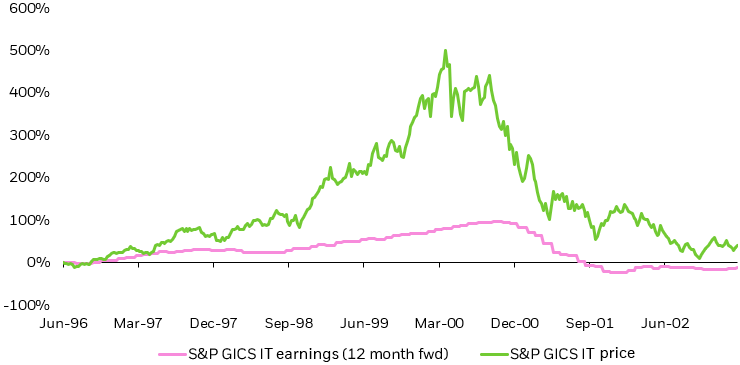
Then: S&P GICS IT sector price vs earnings (indexed to 1996)

Line chart comparing the 12 month forward earnings and price for the S&P GICS Information Technology sector from June 1996 to June 2002 (indexed to 1996).

Chart description: Line chart comparing the 12 month forward earnings and price for the S&P GICS Information Technology sector from June 1996 to June 2002 (indexed to 1996).


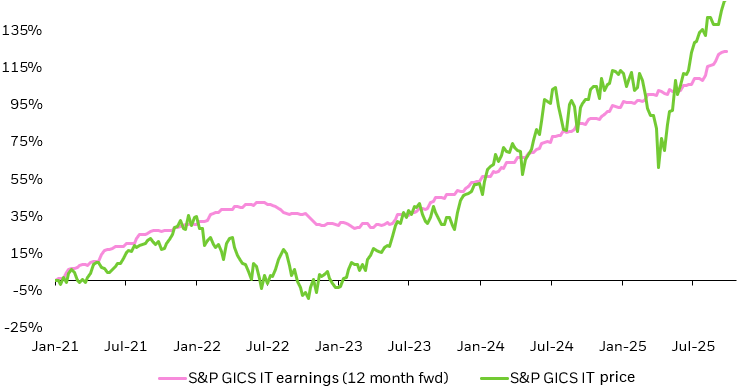
Now: S&P GICS IT sector price vs earnings (indexed to 2021)

Line chart comparing the 12 month forward earnings and price for the S&P GICS Information Technology sector from January 2021 to July 2025 (indexed to 2021).

Source: Refinitiv Datastream, as of October 2025.

Index performance is for illustrative purposes only. Index performance does not reflect any management fees or expenses. Indexes are unmanaged and one cannot invest directly in an index. Past performance does not guarantee future results. Forward looking estimates may not come to pass.

Chart description: Line chart comparing the 12 month forward earnings and price for the S&P GICS Information Technology sector from January 2021 to July 2025 (indexed to 2021).


AI VALUATIONS: NOT CHEAP BUT FAR FROM DOT-COM EXTREMES

Today’s tech valuations are not cheap, but we believe they’re far from bubble territory.

  • At the peak of the dot.com bubble, the top four tech leaders of early 2000 (MSFT, CSCO, INTC, ORCL) traded near 70 times 2-year forward earnings.2
  • Today, the average 2-year forward Price/Earnings (P/E) is about 26 times for the biggest AI datacenter spenders — Microsoft, Alphabet, Amazon and Meta — also known as the hyperscalers.3

Concentration risk is real, just as it was at the start of the AI rally in early 2023. The so-called Magnificent 7 stocks — Apple, Nvidia, Microsoft, Amazon, Tesla, Alphabet, and Meta Platforms — comprise about 35% of the market cap of the S&P 500.4

But concentration may not always equal a bubble. We feel it raises portfolio risk if a few names stumble, but it isn’t proof of mispricing when those names are producing the bulk of the earnings growth.

In 2001, the tech leaders of the dot-com era saw their annual net income drop by 65%, whereas median Wall Street consensus now expects the hyperscalers to grow earnings by 17% over the next year.5

CIRCULAR FUNDING ISN’T NEW, AND TODAY IT’S ANCHORED TO DEMAND

Recent reports of deals where a supplier helps finance a customer who then spends money back with that supplier (either directly or via a partner) have raised concerns about the dot.com-era practice known as circular financing. Circular financing can be risky when it hides weak end‑demand. During the dot-com boom, equipment vendors boosted sales to mask a demand gap that later imploded.6

In our opinion, though, that’s not the case today. AI usage is already large and growing very quickly. OpenAI’s revenue is running around $13 billion a year7, and Anthropic is targeting $9B in 2025 run‑rate with a plan to more than double again in 2026.8

Notably, industries with big, long‑lived assets have tended to blend sales and financing. Boeing, for example, has long provided asset‑backed financing so airlines can take delivery of new planes.  Energy and heavy‑equipment vendors typically arrange leases or loans so customers can afford multi‑year projects, with the asset and future revenue as collateral.9

The same logic has been showing up in AI: an AI lab needs compute for years, a cloud provider needs to lock in supply, and a chip vendor wants reliable end‑demand. In our view, it’s a classic way to line up customers, financing, and capacity.

AI datacenter capacity is constrained, driving multi-year, prepaid commitments to lock in scarce AI chip and datacenter supply. The demand curve has no clear cap: every leap in capability has been creating appetite for more compute.10

AI-RELATED DEBT: CONTAINED, NOT SYSTEMIC

Most AI-related capital investment to date comes from retained earnings and corporate cash, rather than debt.11 The largest platforms have generated immense operating cash flow and retained substantial net cash. Many haven’t needed to lean heavily on debt to build datacenters.12

Yes, there’s debt in the system, mainly around newer, specialist AI clouds and specific large projects. But these look more like project-finance structures: lenders underwrite long-term customer contracts and the underlying hardware, rather than swinging at blue-sky forecasts.13

In our view if we see stress, it’s likely to be local, not systemic. Smaller providers that grow ahead of demand, or whose contracts don’t hold, could face refinancing pressure. But they represent a small slice of total capacity, and GPUs are highly redeployable assets if demand shifts.

In short, we believe the credit channels that could transmit a system-wide shock look far narrower today than in 1999 – 2001.

WHAT COULD CHALLENGE THE AI GROWTH STORY?

As AI models train, practice, and then think across multi-step tasks, they consume far more compute at every stage. That’s why the industry must build capacity ahead of revenue, and why financing structures that look “circular” are being employed. Meanwhile, debt has been low and at the edges rather than at the system’s core and valuations, while not cheap, are nowhere near dot-com extremes.

Put together, we don’t see recent financing loops or project-level debt as a reason to back away from the AI theme. The spending has been largely powered by profits, the risk looks local rather than systemic, and the demand story has been anchored in real, expanding usage.14

Still, our optimistic thesis could be challenged by any of the following scenarios:

  • Power constraints. If AI builders can’t secure consistent, 24/7 power, then our constructive view may weaken. Interconnection queues and transmission bottlenecks in hubs like Northern Virginia and Texas already suggest power constraints could slow the AI datacenter build-out.15
  • Rising idle capacity or sustained utilization slippage. Evidence that new datacenters aren’t filling, or that booked capacity is being canceled, would challenge the “insatiable” view.
  • Capability plateaus. If new training cycles stop delivering meaningful capability gains, we believe the value case for stepping up compute would erode.

None of these are flashing red today, but they’re potential tripwires we’re watching. For the foreseeable future, we continue to believe the AI investment cycle is rooted in genuine, accelerating demand and sustained by the financial strength of today’s leading technology companies.

CONCLUSION

While vigilance is warranted as the landscape evolves, we feel that current evidence points to a growth story that is fundamentally distinct from past bubbles. Investors willing to remain disciplined and discerning may find the AI theme remains one of the most compelling opportunities of the decade.

Investors interested in AI’s potential may consider:

  • The iShares A.I. Innovation and Tech Active ETF (BAI). This actively managed fund selects a concentrated portfolio of global AI and technology equities across all market capitalizations, chosen through bottom-up, research-driven fundamental investing.
  • The iShares Future AI & Tech ETF (ARTY), which seeks to provide targeted exposure to the full value chain of companies at the forefront of AI innovation in areas including generative AI, AI data & infrastructure, AI software, and AI services.

FEATURED FUNDS

  • iShares ETFs are available to purchase through a brokerage account or with a financial advisor.

    Buy through your brokerage

    iShares funds are available through online brokerage firms. All iShares ETFs and ETPs trade commission free online through Fidelity.

    By clicking on the button below, you will leave BlackRock’s website.

    Buy now on Fidelity

    Contact your advisor

    Contact a financial professional to discuss how iShares ETFs and ETPs can fit in your investment portfolio.

    Carefully consider the Funds' investment objectives, risk factors, and charges and expenses before investing. This and other information can be found in the Funds' prospectuses or, if available, the summary prospectuses, which may be obtained by visiting the iShares ETF and BlackRock Fund prospectus pages. Read the prospectus carefully before investing. Investing involves risk, including possible loss of principal.

    Any links to third-party websites are provided for use at your own discretion. Each third party is solely responsible for the content presented and availability of its website. BlackRock does not control, monitor or maintain third-party websites, their content or the products/services they offer. Content may change without notice. When you leave BlackRock’s website and enter a third-party website, you will be subject to that site’s terms, policies and/or notices, including those related to privacy and security, as applicable. Please review those policies and notices on the third-party website.

    Before engaging Fidelity or any broker-dealer, you should evaluate the overall fees and charges of the firm as well as the services provided. Free commission offer applies to online purchases of select iShares ETFs in a Fidelity account. The sale of ETFs is subject to an activity assessment fee (from $0.01 to $0.03 per $1,000 of principal). For iShares ETFs, Fidelity receives compensation from the ETF sponsor and/or its affiliates in connection with an exclusive long-term marketing program that includes promotion of iShares ETFs and inclusion of iShares funds in certain Fidelity Brokerage Services platforms and investment programs. Please note, this security will not be marginable for 30 days from the settlement date, at which time it will automatically become eligible for margin collateral. Additional information about the sources, amounts, and terms of compensation can be found in the ETF’s prospectus and related documents. Fidelity may add or waive commissions on ETFs without prior notice.

    The Funds are distributed by BlackRock Investments, LLC (together with its affiliates, “BlackRock”).

    ©2024 BlackRock, Inc or its affiliates. All Rights Reserved. BLACKROCK, iSHARES, iBONDS, LIFEPATH, ALADDIN and the iShares Core Graphic are trademarks of BlackRock, Inc. or its affiliates. All other trademarks are those of their respective owners.

    iCRMH1124U/S-3985892

  • iShares ETFs are available to purchase through a brokerage account or with a financial advisor.

    Buy through your brokerage

    iShares funds are available through online brokerage firms. All iShares ETFs and ETPs trade commission free online through Fidelity.

    By clicking on the button below, you will leave BlackRock’s website.

    Buy now on Fidelity

    Contact your advisor

    Contact a financial professional to discuss how iShares ETFs and ETPs can fit in your investment portfolio.

    Carefully consider the Funds' investment objectives, risk factors, and charges and expenses before investing. This and other information can be found in the Funds' prospectuses or, if available, the summary prospectuses, which may be obtained by visiting the iShares ETF and BlackRock Fund prospectus pages. Read the prospectus carefully before investing. Investing involves risk, including possible loss of principal.

    Any links to third-party websites are provided for use at your own discretion. Each third party is solely responsible for the content presented and availability of its website. BlackRock does not control, monitor or maintain third-party websites, their content or the products/services they offer. Content may change without notice. When you leave BlackRock’s website and enter a third-party website, you will be subject to that site’s terms, policies and/or notices, including those related to privacy and security, as applicable. Please review those policies and notices on the third-party website.

    Before engaging Fidelity or any broker-dealer, you should evaluate the overall fees and charges of the firm as well as the services provided. Free commission offer applies to online purchases of select iShares ETFs in a Fidelity account. The sale of ETFs is subject to an activity assessment fee (from $0.01 to $0.03 per $1,000 of principal). For iShares ETFs, Fidelity receives compensation from the ETF sponsor and/or its affiliates in connection with an exclusive long-term marketing program that includes promotion of iShares ETFs and inclusion of iShares funds in certain Fidelity Brokerage Services platforms and investment programs. Please note, this security will not be marginable for 30 days from the settlement date, at which time it will automatically become eligible for margin collateral. Additional information about the sources, amounts, and terms of compensation can be found in the ETF’s prospectus and related documents. Fidelity may add or waive commissions on ETFs without prior notice.

    The Funds are distributed by BlackRock Investments, LLC (together with its affiliates, “BlackRock”).

    ©2024 BlackRock, Inc or its affiliates. All Rights Reserved. BLACKROCK, iSHARES, iBONDS, LIFEPATH, ALADDIN and the iShares Core Graphic are trademarks of BlackRock, Inc. or its affiliates. All other trademarks are those of their respective owners.

    iCRMH1124U/S-3985892

Photo: Kristy Akullian, CFA

Kristy Akullian, CFA

Head of iShares Investment Strategy for the Americas

Samuel McClellan, CFA

Investment Strategist

Contributor

Annie Khanna

Investment Strategist

Contributor

John Huebner

Investment Strategist

Contributor

Aaron Task

Content Specialist

Contributor

Anna Nerys

Thematic Product Strategist

Contributor