FROM SAVING TO SPENDING: RETIREMENT PLANNING WITH ETFs

KEY TAKEAWAYS

  • 40% of independent savers feel off-track for retirement1, not saving enough money to retire on their terms.
  • ETF innovation has made it easier than ever to access sophisticated investment solutions that can simplify the retirement journey.
  • iShares ETFs can help build and manage savings through the accumulation phase and manage spending through the decumulation phase.

INVESTING OPTIONS FOR RETIREMENT

Retirement is a dream for most workers. It may look like getting out of the 9-to-5 grind to sit on the beach, travel the world, dedicate yourself to a cause, or just take time to spend with loved ones. To make this dream a reality requires a plan — and time to execute the plan.

Whether you’re saving for retirement, known as the accumulation phase, or looking to manage your assets in retirement (decumulation), ETF innovation has made accessing sophisticated investment solutions easier than ever. Here’s a breakdown of various ways to plan for retirement and manage your money during those “golden years.”

SEEK TAX EFFICIENT WAYS TO SAVE FOR RETIREMENT

If possible, use tax deferred accounts to build those retirement dollars.

  • Max out your 401(k) — The IRS allows employees to contribute $23,500 to their 401(k) plan and an additional $7,500 per year for workers over 50. Many employers also provide a company match and some may even offer a Roth 401(k) option. Getting the company match and a curated investment menu can help many workers get started with retirement planning.
  • Consider an IRA - If you’re one of the millions of Americans without access to a workplace retirement plan, consider contributing to an Individual Retirement account (IRA). This account type requires you to set it up and make investment choices yourself. IRAs are also subject to contribution limits. For example, the 2025 calendar year has a $7,000 limit if you are under age 50. For those over age 50, you can contribute $8,000 per year. Roth accounts are subject to income limits.

LEARN MORE: How to Plan For Retirement If You’re Self-Employed.

Once you have contributed to these accounts, you can boost your savings in a taxable brokerage account. The advantage of saving for retirement within a taxable brokerage account is that there are no contribution limits. However, the income and gains are subject to taxes.

HOW CAN I INVEST MY RETIREMENT SAVINGS?

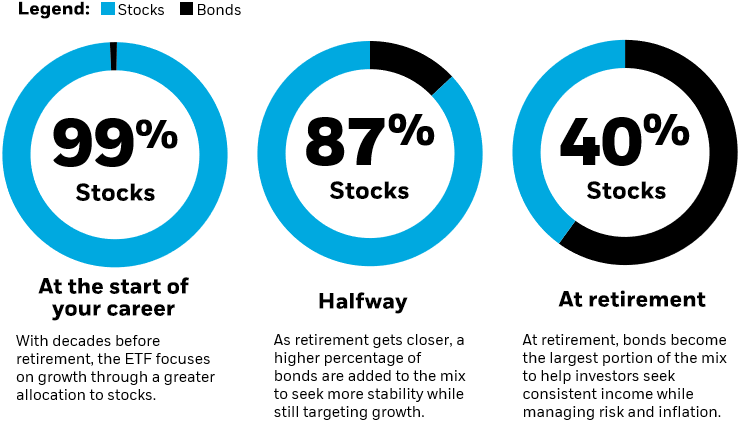
iShares Lifepath Target Date ETFs are designed to seek the right risk at the right time. LifePath ETFs are managed by professionals who adjust the underlying fund holdings over time to navigate market changes such as inflation and volatility so that the investments reflect the goals, from saving for retirement to receiving retirement income. Decades before retirement, the ETF focuses on growth through a greater allocation to stocks. As retirement gets closer, more bonds are added to the mix to seek extra stability while still targeting growth.

LEARN MORE: How to select the right target date ETF.

How LifePath Target Date ETF asset allocation adjusts over time

Donut charts showing asset allocation of target date funds

Asset allocations may periodically adjust based on an assessment of current market conditions. See the funds' prospectus for more information on each fund’s intended asset allocation mix over time. The principal value of the funds is not guaranteed at any time, including at the target date.

Chart description: Donut chart 1 shows the asset allocation of a target date fund that is 99% stocks and 1% bonds at the start of a person’s career in an effort to maximize growth. Donut chart 2 shows the asset allocation of a target date fund that is 87% stocks and 13% bonds at the halfway point of a person’s career where a higher percentage of bonds are added to the mix to seek more stability while still targeting growth. Donut chart 3 shows the asset allocation of a target date fund that is 40% stocks and 60% bonds at retirement where the ETF asset allocation is mostly a conservative mix of stocks and bonds seek consistent income while keeping up with inflation.


HOW CAN I SEEK TO PREVENT DRAWDOWNS ON MY RETIREMENT SAVINGS?

One challenge for many investors approaching retirement is the potential of a large drawdown in the stock or bond markets. For example, 2008 resulted in over a 30% loss on stocks and 2022 saw some bond funds draw down by 13%.2

iShares Outcome ETFs are innovative, options-based strategies designed to help investors meet specific investing goals. These products can play a powerful role in portfolios offering benefits such as enhanced yield potential and sophisticated risk management.

The search for protection doesn’t have to mean giving up equity market exposure. iShares Buffer ETFs reduce the impact of market volatility by offering built-in protection against losses, which is critical for pre-retirees avoiding sequence of returns risk.

BUFFER ETFs

These ETFs are designed to allow for some market participation with a targeted level of downside protection.

MARKET PARTICIPATION

Guards against drawdowns while still maintaining some upside potential, up to a pre-determined cap.

DOWNSIDE PROTECTION

Seeks to mitigate drawdowns and dampen volatility within a downside buffer range.

SEEKING INCOME IN RETIREMENT

When it comes time to start spending your retirement savings, most investors are looking for steady income. Remember, you’re not just investing for retirement but through it.

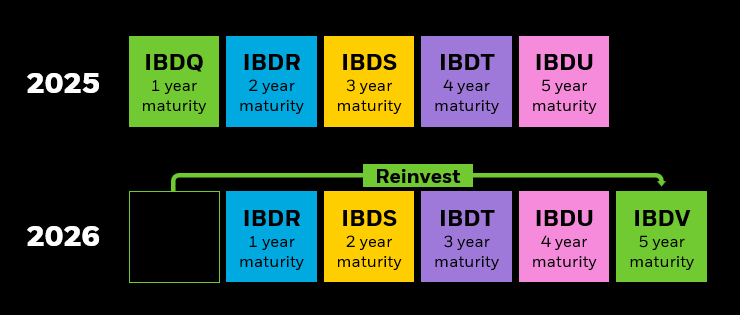
IShares iBonds ETFs are term maturity ETFs that hold a diversified portfolio of bonds with similar maturity dates. iBonds are designed to mature like a bond, trade like a stock and diversify your portfolio like a fund. They can provide a simple solution for those looking to put their spending needs on autopilot.

You can build a bond ladder with the amount of money that you need for the following calendar year. For example, if you need $50,000 in retirement each year and have saved $1.25 million, you can invest about $500,000 ($50,000 each year for 10 years) in a series of iBonds ETFs that will mature in 2025 to 2035 to help meet your spending needs. The rest of your savings can then remain invested for potential long-term growth. Offered in U.S. Treasuries, U.S. TIPS, municipals, investment grade and high yield corporates, iBonds ETFs can help address spending needs.

5-year corporate bond ladder

Chart: 5-year corporate bond ladder

Source: BlackRock. This information should not be relied upon as research, investment advice or a recommendation regarding the funds or any security in particular. This information is strictly for illustrative and educational purposes and is subject to change.

Chart description: A visualization of how iShares iBonds can be used to create bond ladders, which can help investors manage interest rate risk and seek a steadier income stream.


iBonds ETFs can also be helpful in managing your Required Minimum Distributions (RMDs) or in creating a bridge for those who want to delay applying for Social Security benefits, as detailed below.

Required minimum distributions (RMDs). Investors must take a withdrawal from their retirement account when the account holder turns 72 (73 if they reach age 72 after 12/31/2022). The Internal Revenue Service (IRS) requires a minimum amount to be withdrawn each year thereafter, known as the RMD. From ages 72 to 82, investors will need to withdraw almost 45% of the account value.3

As shown as a hypothetical example in the table below, a single retiree turning 72-years old in 2025 has $100,000 invested in an IRA. This investor must withdraw RMDs according to the IRS Uniform Lifetime Tables, by dividing the account size by the distribution period for each year. iBonds ETFs can potentially be used to ladder out the first 10 years of RMDs and any remaining assets in the account can be invested in other assets. Since iBonds ETFs mature in mid-October or December, investors will have cash in their accounts to help meet these IRS-mandated withdrawals before year-end.

Using iBonds ETFs to ladder out the first 10 years of RMDs

Caption:

iBonds ETFs can help investors plan to meet IRS-mandated withdrawals before year-end.

AgeRMDiBonds ETF maturity year% of bond ladder
72$3,65020258.4%
73$3,77420268.7%
74$3,92220279.0%
75$4,06520289.4%
76$4,21920299.7%
77$4,367203010.1%
78$4,545203110.5%
79$4,739203210.9%
80$4,950203311.4%
81$5,155203411.9%

Source: BlackRock, IRS.gov. For illustrative purposes only. Please consult your tax advisor. Based on illustrative example of a $100,00 portfolio and assumes no change in the value of the portfolio over time.

Social Security payments can increase as retirees wait to collect their benefits. For most U.S. citizens, full retirement age is between 65 to 67 years old. Social Security benefits increase by 8% per year if the retiree waits until age 70 to begin collecting the funds.4

However, most investors retire sooner with average retirement age of 61 years, according to a 2022 Gallup survey.5 Stopping work at age 61 could result in a 4 — to 9-year gap before collecting the maximum Social Security benefits. iBonds ETFs can be used as a decumulation strategy to help fill the gap — known as a Social Security bridge. When the iBonds ETF matures, the proceeds can be used for the following year.

CONCLUSION

With the wide range of ETFs available today, investors have more access to sophisticated investment solutions that can simplify saving for and spending in retirement.

Photo: Daniel Prince, CFA

Daniel Prince, CFA

U.S. Head of iShares Product

Photo: Karen Veraa-Perry, CFA

Karen Veraa-Perry, CFA

Head of U.S. iShares Fixed Income Strategy

Anna Day

iShares Business Strategist

Contributor

Aaron Task

Content Specialist

Contributor