Equity Market Outlook: Seeking opportunity beyond AI

Carrie King Jul 02, 2026 Equity

Key takeaways

  • We maintain a constructive outlook for equities in 2026 as earnings growth expands across sectors and regions.
  • Artificial intelligence (AI) remains a powerful long-term investment theme, but leadership in equities may broaden beyond mega-cap technology.
  • We see potentially underappreciated opportunities in energy, materials and healthcare, where valuations and free cash flow yields may appear more attractive than many AI beneficiaries.
BLCR

iShares Large Cap Core Active ETF

Pursue long-term growth through a high-conviction, actively managed core U.S. large-cap equity allocation.

Equity Market Outlook: What’s driving the stock market today?

Equities displayed resilience in the first half of 2026, ultimately pushing past geopolitical uncertainty and periodic questions around the pace and trajectory of AI-related investment.

We remain constructive on the long-term AI opportunity and continue to identify potential beneficiaries across what we see as a multi-year investment cycle.

At the same time, we recognize the importance of diversification. We see value in broadening our focus to other areas of the global markets and note potentially underappreciated opportunities in sectors such as energy, materials and infrastructure.

Globally, emerging markets are among the strongest-performing regions year-to-date. Their contribution to the global AI buildout is a key part of the story, helping to power earnings growth, particularly in Asia, a trend we expect to persist.

Overall, we maintain a constructive outlook for equities in 2026. Earnings trends have been strong across sectors and geographies, reinforcing the case for exploring a larger cross-section of investment themes.

And yet, geopolitical uncertainty and elevated investor expectations are likely to contribute to bouts of market volatility. While challenging, volatility may also create opportunities. And we continue to see scope for ample opportunity ― in both the AI theme and in areas well beyond it across global equity markets.

What is free cash flow? Where to find it?

Our search for equity diversifiers has us looking at free cash flow (FCF) as an important signal of business strength. FCF is the cash a company has remaining after operating expenses and capital expenditures. Free cash flow essentially represents the financial flexibility that enables all forms of value creation, from M&A to paying dividends.

The current FCF yield on the S&P 500 Index, at 2.65%, is the lowest in 25 years1, suggesting investors are paying a high price for the FCF they’re receiving.

The mega-cap companies that are spending big on the AI buildout are seeing their FCF draw down toward zero, with some now issuing debt to fund AI-related capex.2

This is not a flaw, in our view, but a strategy. Growth companies such as these may be expected to produce much higher cash flows in the future from the investments they are making today. In fact, aggregate S&P 500 FCF margins, which measure how well companies convert revenue into cash flow, are still near 15-year highs.3

Ultimately, the calculus is one of valuation and profitability, and it leads us to some other interesting and potentially overlooked portions of the equity market. Among them:

Energy: The current energy cycle could be elongated given two major developments:

  • Massive demand for power from the AI data center buildout.
  • A reshaping of the global supply chain amid recent geopolitical events in Venezuela and the Middle East.

In our view, the end of the Iran conflict is unlikely to quickly return energy supply to pre-war levels. Infrastructure damage, inventory depletion, slow reservoir ramp-up and shipping delays are likely to create a longer-term supply shock, resulting in structurally tighter supply and higher prices.

In a market in transition, global oil majors may use elevated FCF to pay down debt rather than increase drilling. Applying their financial flexibility in this way has a dual benefit: Paying down debt accrues directly to equity holders, and keeping supply in check as demand surges could support energy prices.

And yet, global energy stocks’ current FCF yield of 8% sits well above tech and the long-term average of both, as shown below.4 This attractive valuation, combined with potentially higher-for-longer oil prices, suggests to us that the investment case for the sector may be more durable than the market expects.

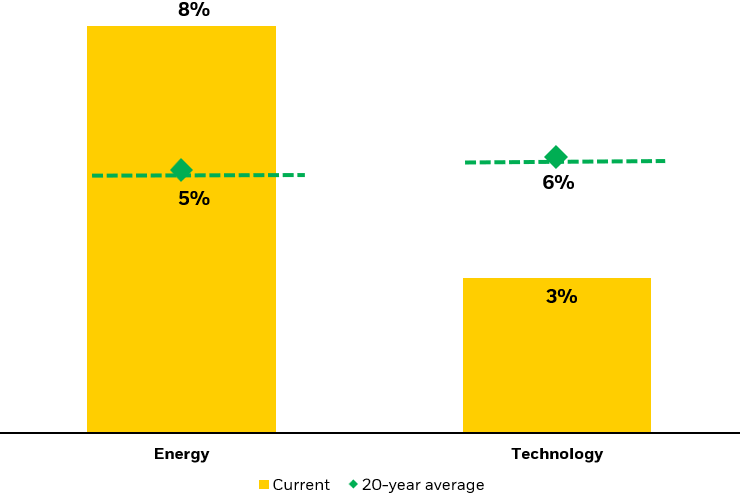
Where are the free cash flows?

Energy vs. tech FCF yields, current and 20-year average

Bar chart showing the forward 12-month free cash flow yield of the energy and technology sectors in the MSCI World Index as of May 28 relative to the average over the past 20 years.

Source: BlackRock Fundamental Equities with data from FactSet, May 28, 2026.

Bar chart showing the forward 12-month free cash flow yield of the energy and technology sectors in the MSCI World Index as of May 28 relative to the average over the past 20 years. Indexes are shown for illustrative purposes only. It is not possible to invest directly in an index.


Materials: We see similarities to energy in the materials cycle. These physical assets also are central to AI infrastructure development. This, alongside years of underinvestment in sourcing critical resources, sets up what could be a long-duration and well-heeled cycle.

Metals and mining stocks currently show FCF yields over 7%, well above their historical premium to the market.5

Reshoring and a global desire to keep essential resources close to home is also setting up a highly competitive landscape for an acutely short supply of materials.

Healthcare: Healthcare has been a persistent underperformer in recent years, as sectors prized for stability have taken a back seat to momentum. Yet we see historically high FCF margins today, particularly in pharmaceuticals and healthcare equipment.6

The latter has been plagued by headwinds in the form of tariffs and rising input costs. Yet the subsector’s competitive FCF yield (at 5%) and low correlation to AI could make it a potential diversifier, in our view.

Valuations in the health equipment space are compelling, currently sitting at a 16% discount to the market compared to a 20% premium over the past 10 years.7

Conclusion: Top takeaways for investors

We are AI optimists and see the AI mega force continuing to underpin markets. Yet even structurally anchored investment themes face inevitable stumbles along their growth trajectory. And the sharp rise in valuations of many AI winners could leave them particularly vulnerable to profit taking on any cooling in investor conviction.

After nearly four years of blistering gains in AI and related sectors, we believe it is reasonable to explore some of the relatively overlooked corners of the stock market for investments with risk/reward characteristics that could hedge AI exposures.

BlackRock’s Fundamental Equities and Systematic Active Equities teams explore these themes in greater detail in our latest Equity Market Outlook, highlighting the opportunities and risks we see across regions and sectors.

Carrie King

Global CIO, BlackRock Fundamental Equities

Raffaele Savvi

Global Head of BlackRock Systematic

Contributor

Aaron Task

Content Specialist

Contributor