AI mega-IPOs are coming: What investors should know in 2026

Key takeaways

  • An uptick in expected mega IPOs reflects demand for the capital needed to fund the AI build out. The history of long-term IPO performance has been mixed, but large moves in either direction are common features of early trading.
  • IPOs are not automatically added to indexes. Instead, each index provider has established rules around the inclusion, timing and weight of newly listed shares. Even mega IPOs will likely represent only a small weight in many indexes, as these are set based on freely traded shares rather than total market cap.
  • ETFs are transparent tools that allow investors to monitor what they own. iShares offers a range of index and active ETFs that provide investors choice in how and when to access newly listed companies.
BAI

iShares A.I. Innovation and Tech Active ETF

An active approach to artificial intelligence (AI) and tech, which seeks to maximize total return.

IYZ

iShares U.S. Telecommunications ETF

Seek exposure to U.S. equities in the telecommunications sector.

OEF

iShares S&P 100 ETF

Seeks to track the investment results of an index composed of 100 large-capitalization U.S. equities.

1. Why are so many mega IPOs expected this cycle?

Mega IPOs are initial public offerings (IPOs) are initial public offerings by companies valued in the hundreds of billions — or potentially trillions — of dollars. After several muted years, IPO activity is expected to rebound in 2026 — likely making it the largest IPO year on record. This burst of IPO activity is driven by a pipeline of large, high-profile companies related to Artificial Intelligence (AI) and its buildout, such as SpaceX, Anthropic and OpenAI.

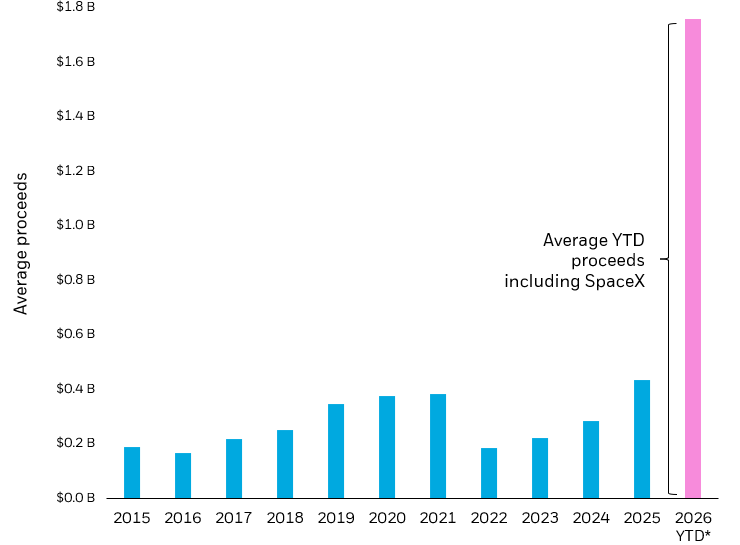
Technology and AI-related companies dominate the current IPO landscape, accounting for about 25-35% of global IPO proceeds and an even larger share of the biggest listings.1 As Figure 1 shows, the average IPO valuation in 2026 is three times the size of last year’s average and nearly 10x the average from 2022.

Historically, IPO activity has risen when macro fundamentals are solid and equity market performance is strong. So this expected surge in activity likely also reflects investor confidence in the overall health of the economy. (Read our Spring Investment Directions for more of our views on markets.)

Figure 1: IPO deal size has picked up in 2026

Bar chart showing average IPO proceeds since 2015

Source: SEC, IPOs: Number and Proceeds (average IPO proceeds by calendar year, 2015–2025); Bloomberg, 2026 year-to-date IPO proceeds data, including SpaceX. Average proceeds calculated as total IPO proceeds divided by number of IPOs. Data as of June 9, 2026.

Chart description: Bar chart of average IPO proceeds since 2015.


2. How do these IPOs compare to the past?

The existing group of ‘Magnificent 7’ mega cap stocks went public through offerings that ranged from under $500 million in the 1980s and 1990s to multi-billion-dollar listings by the 2010s.2 Today, the largest private companies are reaching even greater scale before entering public markets, with the top private-market valuation this year projected to exceed $1 trillion.3

Access to pools of private capital from venture capital, private equity, and sovereign wealth funds has meant that many companies are now remaining private for longer, often entering public markets at a more advanced stage. The extended timeline also gives companies more time to strengthen financial reporting, governance, and operational infrastructure before entering the public markets, all of which can translate to larger deal sizes.

3. How have IPOs performed in the past?

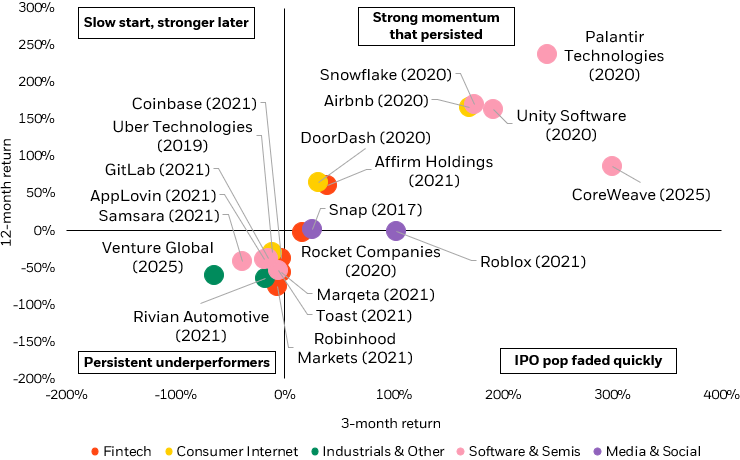
History is mixed on IPO performance. While many IPOs have experienced strong trading activity in their early days, short-term price movements have not always been indicative of long-term value creation.

In part, that is because newly public stocks are often influenced by evolving supply and demand dynamics, with variable timing around index inclusion, lock-up expirations, and more. Each of these factors can differ from one IPO to another, but together they contribute to a complex price discovery process and a wide range of potential outcomes. What is clear is that newly listed shares have historically exhibited greater volatility than more established public companies, particularly during the early stages of trading, as Figure 2 shows, though the trend toward larger and more mature companies coming to market could alter that dynamic.

For example, 13 of the 20 largest U.S. IPOs and direct listings generated negative returns at both three and 12 months following their public debut. Just six of 20 generated positive returns at both three and 12 months.

Figure 2: Not every blockbuster IPO becomes a blockbuster stock

Scatterplot chart showing top 20 largest IPOs in the past 10 years.

Source: BlackRock, Bloomberg. Universe consists of the 20 largest U.S.-domiciled IPOs and direct listings from 2016 – 2025 ranked by equity market value at the time of listing (offer valuation for IPOs; reference valuation for direct listings). Returns are measured from the first day open to the 3-month and 12-month forward close. Data as of June 4, 2026.

Chart description: Scatterplot of top 20 largest IPOs in the past 10 years.


4. How do IPOs get added to an index?

IPOs are not automatically included in an index. Instead, each index provider will apply their own eligibility rules and reviews before adding newly public companies to indexes that can underpin thousands of investment funds. These rules are designed to ensure companies meet standards around liquidity, trading history, and investability before entering major benchmarks.

In addition to having a “seasoning” period, which refers to the minimum amount of time a company must trade publicly before becoming eligible for inclusion, criteria can also include:

  • Financial viability or profitability screens
  • Trading volume requirements
  • Market capitalization screens
  • Post-IPO lock-up considerations

That said, index methodologies evolve alongside markets, including how newly public companies are added to indices. As IPOs are expected to grow in size and significance, index providers are reassessing rules around inclusion timing, sizing, and eligibility criteria.

5. When do IPOs get added to an index?

Indexes follow pre-determined rebalance schedules, but many have existing exceptions around when to add newly listed companies, particularly those that come to market as large or mega cap stocks.

Given the potential impact of mega cap IPOs on public markets this year, some index providers are actively evolving their inclusion frameworks, introducing or expanding “fast entry” mechanisms, which could allow certain large, highly liquid companies to enter indexes more quickly following their listing. Variants of these rules already exist, but index providers are reevaluating them in response to larger, more systemically significant IPOs, balancing timely market representation with liquidity and investability.

Approaches to index inclusion by provider

Caption:

A table of index inclusion by provider

S&P 500Russell 1000Nasdaq 100MSCI USA
Seasoning period **12 months 5 Trading days15 Trading days10 Trading days
Weighting schemeFree-float market capFree-float market capFree-float < 20%: 3x

Free-float > 20%: Listed market cap
Free-float market cap
Fast track eligibleNo Yes YesYes
Profitability screenYesNoNoNo

Source: Index providers S&P Dow Jones Indices, MSCI, FTSE Russell, Nasdaq, as of June 5, 2026.

** Seasoning period reflects fast-entry timeline for those that are eligible. See FAQ section below for definitions.

6. Will mega IPOs mean mega weights in common benchmarks?

Most indices are constructed using free-float-adjusted market capitalization. This means only shares available for public trading are counted when determining index weight, while insider and restricted holdings are excluded. In practice, this often results in only modest initial index weights for newly listed companies relative to their outsized market valuations.

For example, a hypothetical company with a $2 trillion valuation and $50 billion free float at IPO would result in just a 0.08% weighting in the Russell 1000 Index based on current index composition.4

7. How will IPOs impact iShares ETFs?

IPO exposure will vary across iShares ETFs based on the management style of the fund, the index provider for the underlying benchmark, and the fund’s specific investment focus on sector, style or factor.

Index tracking ETFs will follow pre-defined rules and methodologies established by the index provider, while actively managed ETFs may add or avoid select IPO exposure at the fund manager’s discretion. In some instances, active ETFs may have the ability to invest in private companies before their shares are available in public markets.

BlackRock believes it is crucial for investors to understand what they own. iShares ETFs are highly transparent investment vehicles that provide daily holdings disclosures, enabling investors to closely monitor portfolio exposures and track how new companies are represented within their investments.

Most importantly, we believe in investor choice. The breadth of the iShares platform provides investors with the ability to seek rapid access to emerging opportunities or opt for a more measured approach while newly public companies establish a track record in public markets. Investors can leverage the ETF Fund Finder tool to search for funds based on stock holdings, compare weights across funds, and select the ETF that best aligns with their investment objectives.

Focus on funds


What funds should I consider if I want potential exposure to mega IPOs?

Certain active ETFs may provide investors with access to pre-IPO shares of companies in the private stage. The iShares A.I. Innovation and Tech Active ETF (BAI) offers targeted and actively managed exposure to the potential growth of the AI and technology revolution, including private allocations to Anthropic and Open AI.5

While index inclusion of newly public companies is typically gradual, reflecting seasoning requirements and free-float methodologies, sector, industry and theme focused ETFs, such as the iShares U.S. Telecommunications ETF (IYZ), could potentially offer investors a larger share of certain mega IPOs compared to broader market index approaches. Select index providers such as Russell, MSCI and Nasdaq, have implemented fast-track inclusion. Fund suites such as the iShares style box, factor and sector exposures tracking those indexes may provide earlier access to newly listed companies.

What funds should I consider if I want to limit exposure to mega IPOs?

Investors who want to limit increased portfolio exposure to large IPOs can consider a range of iShares index ETFs that provide differentiated exposure across the market-cap spectrum. Small-cap, value, and capped strategies may help reduce concentration in mega-cap exposures, allowing investors to choose an approach that aligns with their portfolio objectives and desired level of exposure to newly public companies. In addition, products linked to indexes from providers such as S&P, which have opted not to implement fast-track inclusion while incorporating profitability screening criteria, may help investors moderate exposure to mega IPOs in the initial stage.

Six IPO terms investors should know

Fast entry: A rules-based mechanism allowing qualifying IPOs to be added to an index shortly after listing rather than waiting for the next scheduled rebalance or reconstitution.

Free float: The percentage or number of shares available for public trading, excluding restricted shares held by founders, insiders, governments, strategic investors, or other controlling shareholders.

Index weight: The share of an index that one company makes up.

Lockup period: This is a set period after an IPO in which shares cannot be sold. This can limit the number of shares available on the market at one time.

Seasoning period: The minimum amount of time a newly public company must trade before becoming eligible for index inclusion under a particular methodology.

Total market capitalization: The total value of all outstanding shares of a company, calculated as share price multiplied by total shares outstanding, regardless of whether those shares are publicly tradable.

FAQs on IPOs

An IPO, or initial public offering, is when a private company offers its shares to the public for the first time, becoming a publicly traded company.

Usually not right away. An IPO often needs to trade for a while and meet index rules before it can be added, so it may take weeks or months.

A methodology that allows eligible securities to be added to an index sooner than a regularly scheduled rebalance or reconstitution. Often used interchangeably with "Fast Entry," though specific rules vary by index provider.

A company's total market value adjusted to reflect only shares considered freely available for public trading. Most major equity indexes use float-adjusted market capitalization rather than total market capitalization.

A formal process through which an index provider seeks market feedback on proposed methodology changes before determining whether to adopt them.

A comprehensive review of index membership that may result in additions, deletions, or other changes to the index universe.

The extent to which a security can be efficiently purchased, held, and traded by investors at scale. Investability considerations often include liquidity, free float, market accessibility, and trading costs.

The market value of a company after applying free-float adjustments and other investability screens required by an index provider.

A company with an exceptionally large market capitalization. Definitions vary by provider and methodology, but generally refer to the largest publicly traded companies in the market.

Featured funds

Photo of Kristy Akullian, CFA

Kristy Akullian, CFA

Head of iShares Investment Strategy

Photo of Jay Jacobs

Jay Jacobs

Head of U.S. Equity ETFs

Contributor

Jasmine Fan, CFA

Investment Strategist

Contributor

Annie Khanna

Investment Strategist

Contributor

Emily Fredrix Goodman

Editor

Contributor

Kevin Wong

Product Strategist

Contributor

Aaron Task

Content Specialist

Contributor