AI adoption is reshaping growth opportunities beyond the Magnificent 7

Jay Jacobs Apr 28, 2026 Equity

Key takeaways

  • While the Magnificent Seven1 drove equity index returns in recent years, earnings growth has been broadening beyond mega-cap tech as AI adoption expands across industries.
  • In our view, AI adoption is increasingly influencing the next phase of earnings growth across industries such as infrastructure, healthcare, and even gaming. But varying AI adoption rates may create winners and losers.
  • An actively managed ETF like the iShares Large Cap Core Active ETF (BLCR) seeks to identify companies benefiting from AI adoption among the “best of the rest” beyond the Mag 7.
BLCR

iShares Large Cap Core Active ETF

Seeks to maximize total return by investing primarily in large capitalization U.S. equities identified through fundamental and quantitative insights.

Beyond the Magnificent 7: AI fuels broader earnings growth

The U.S. equity market has reached historic levels of concentration. The top 10 companies now represent 37.92% of the S&P 5002, and in 2023 & 2024 the Magnificent Seven (the largest U.S. tech stocks) delivered over 30% annual earnings growth.3

But that dynamic has begun to shift.

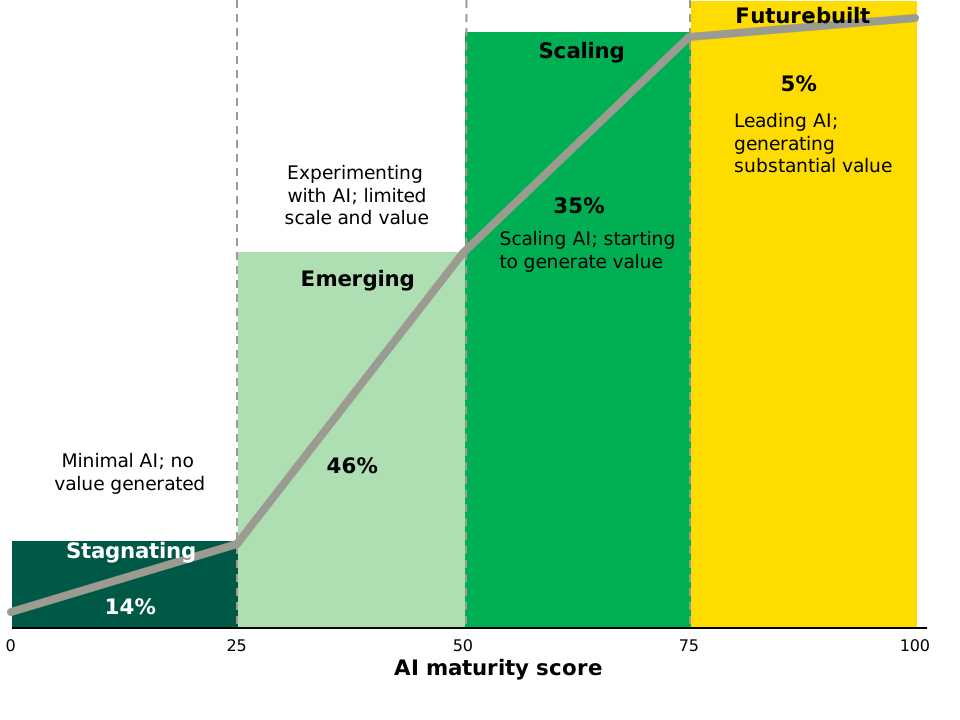
5% of companies are found to be systematically deploying AI at scale to reshape their economics, while 60% are bucketed as “laggards”

Source: BCG Build for the Future 2025 Global Study (1,250 companies), as of 9/30/2025. Subject to change. The AI maturity score assesses company integration and effective use of AI across 41 dimensions.

Chart description: Chart shows that 5% of companies are systematically deploying AI at scale to reshape their economics, while 35% are starting to generate value and 60% are bucketed as 'laggards.'


In 2025, earnings growth for the Mag 7 dropped to 22% and growth expectations for the largest companies has moderated, while earnings across the rest of the market have improved from negative in 2023 to ~ 9% in 2025.⁴ Growth beyond the mega-caps may continue accelerating in 2026, at attractive valuations, as companies increasingly implement AI. However, diversification will be key as concentration risk still remains a factor and differing rates of AI adoption may increase competition, potentially creating dispersion as clear “winners” and “losers” emerge.

Against this backdrop, the iShares Large Cap Core Active ETF (BLCR) seeks to identify the “best of the rest” beyond the Mag 7 — companies benefiting from AI adoption could emerge from earnings slowdowns at more attractive valuations. The fund has 34% overlap with the S&P 5005, maintaining core U.S. large-cap exposure while providing differentiated portfolio exposures from companies potentially benefiting from reindustrialization, AI-related infrastructure demand, and possibly overlooked defensive trends. Below, we highlight four companies held in BLCR that may illustrate this approach.

How are industrial and infrastructure companies enabling AI growth?

Wesco: powering AI’s physical backbone

Investing in AI goes beyond the digital level. BlackRock has identified the AI “tech stack” which consists of agents, data, and infrastructure. Industrial components, machinery, and power infrastructure lay the foundation for the proliferation of advanced AI models.

As a provider of business-to-business distribution of electrical, communications & security, and utility & broadband solutions, Wesco (2.64% in BLCR6) sits at the heart of critical supply chains and increasing spending on data center infrastructure. With over 700 sites across 50 countries7, Wesco has a diversified business model across a deep network of suppliers and customers. Additionally, Wesco has shown a significant shift in focus in its main growth engine, communication & security solutions services, with revenue seeing an 18% year-over-year increase. Within that segment, data center sales were up over 50% while also seeing data center related order backlog jump 40%, highlighting the structural demand trends in this segment.8

Why is connectivity critical to scaling AI adoption?

Ciena: enabling faster AI ecosystems

Investments in AI infrastructure build the foundation of delivering power to energy intensive compute, but to deploy this capacity, there needs to be connectivity in the data. Many GPUs9 are currently running below full capacity because of throughput constraints.10

Ciena (3.95% in BLCR11) provides high-speed connectivity and builds out networks to enable data centers and enterprises to handle massive data demands. The data flowing through GPUs is advanced, but lacks the infrastructure to support it and we believe Ciena is positioned to benefit from this challenge. Ciena’s optical transceivers can convert data into light and pipe the data through optical fiber with speed and at high bandwidth. Optical networking revenue at the firm grew over 21% from 2024 to 202512, reflective of the demand for greater chip efficiency, and is only expected to grow as model training becomes more complex.

How is AI transforming healthcare and distribution models?

Cardinal Health: optimizing logistics with AI

In our view, healthcare stands out as an attractive, currently undervalued sector offering differentiated return potential. Supported by the structural tailwind of an aging population, the industry also benefits from implementing AI, with 85% of healthcare organizations either exploring or already adopting generative AI.13

Within healthcare, pharmaceutical distributors may offer differentiated, AI-driven exposure without the patent cliff risks that large drug manufacturers might face — emphasizing the importance of selectivity.

As one of the top three pharmaceutical distributors in the U.S.14, Cardinal Health (3.58% in BLCR15 ) connects manufacturers with healthcare providers, including 90% of U.S. hospitals and CVS Pharmacy.16 The company is leveraging AI to build the industry’s first automated distribution center using robotic storage and retrieval systems, forecast demand, and streamline platforms like Vantus HQ, their proprietary ecommerce platform for retail pharmacists to search for products, track orders and access analytics.17

Can AI unlock innovation in unexpected sectors like gaming?

Hasbro: embracing AI-assisted design

We believe the toy industry may offer potential upside from more efficient product innovation driven by AI adoption. At the same time, the industry has remained relatively undervalued despite improving inventory levels, updated guidance, and ongoing cost reductions.18

Hasbro (3.51% exposure in BLCR19) is a 100+ year old consumer products and entertainment brand that may be evolving beyond its traditional toy roots by leveraging AI.

For example, Hasbro is using AI to prototype toys 10x faster and at more than 90% lower cost.20 The company is refocusing from lower-return entertainment assets toward its high-return digital games business: Hasbro saw 14% revenue growth in 2025, driven by 45% growth in the Wizards of the Coast and Digital Gaming segment.21

How can investors seek AI-driven growth beyond the Magnificent 7?

As AI implementation expands across industries, companies embedding AI into infrastructure, logistics, connectivity, and product innovation are increasingly focused on improving operations and scalability. An actively managed ETF like the iShares Large Cap Core Active ETF (BLCR) provides research-driven, high-conviction exposure to companies beyond the Mag 7 with differentiated earnings and growth-potential supported by AI adoption. The fund has generated 90% of its alpha from outside of the Mag 7 and holds about 40% of the portfolio outside of the top 100 U.S. publicly traded stocks by market cap.22

BLCR‘s “best of the rest” approach may help investors to diversify within the traditional large cap core of their portfolios.

FAQs

AI adoption across industries could expand earnings growth beyond mega-cap tech, potentially in infrastructure, healthcare, and industrial sectors.

Companies adopting AI effectively may improve efficiency and growth, while slower adopters risk falling behind, increasing performance dispersion.

Investors may consider diversified strategies, including actively managed ETFs like BLCR that seek companies potentially benefiting from AI adoption.

We believe key sectors include infrastructure, connectivity, healthcare, and industrials, where AI is improving operations and driving demand.

Active strategies can help identify companies with differentiated earnings potential as AI adoption varies across industries.

Holdings as of 3/26/2026 and subject to change. There is no guarantee that the companies discussed remain in the fund. For a complete list of most recent holdings, click on the fund card below. This is not meant as a guarantee of any future result or experience. This information should not be relied upon as research, investment advice or a recommendation regarding the Funds or any security in particular. Specific companies or issuers are mentioned for educational purposes only and should not be deemed as a recommendation to buy or sell any securities.

Featured funds

Photo of Jay Jacobs

Jay Jacobs

Head of U.S. Equity ETFs

Ashley Doll

ETF Product Strategist

Contributor

Brendan Easter

ETF Product Strategist

Contributor

Clairey Yang

ETF Product Strategist

Contributor