Ethereum staking explained: risks, rewards, and how it works

Jay Jacobs, Robbie Mitchnick Mar 12, 2026 Commoditiy

Key takeaways

  • Cryptocurrency staking is the process of participating in a blockchain’s decentralized record-keeping and presents an opportunity to earn rewards.
  • Ethereum staking offers the potential to earn modest rewards on the network’s native token, ether (ETH), but should only be considered after deciding to add exposure to ETH.
  • Exchange-traded products such as the iShares Staked Ethereum Trust ETF (ETHB) are designed to provide exposure to the price return of ETH plus potential staking rewards, while reducing the operational, tax, and custody complexities associated with holding and staking ETH directly.
ETHB

iShares Staked Ethereum Trust ETF

Seek exposure to ether plus potential staking rewards.

IBIT

iShares Bitcoin Trust ETF

Gain exposure to bitcoin with the liquidity of an ETP.

The iShares Trusts are not investment companies registered under the Investment Company Act of 1940, and therefore are not subject to the same regulatory requirements as mutual funds or ETFs registered under the Investment Company Act of 1940.

What is cryptocurrency staking?

Cryptocurrency staking is a way for people to help maintain a blockchain network and potentially earn rewards for doing so. Staking plays a crucial role in how transactions are recorded and how the blockchain is designed to operate securely without a central authority overseeing it. Participants who stake may receive rewards paid in the network’s native token for taking part in this process and are commonly referred to as stakers or validators. (See below for a refresher on blockchains and consensus mechanisms.)

What is Ethereum staking?

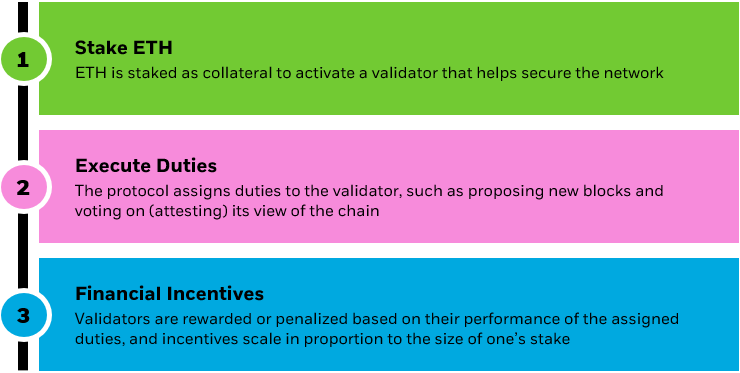
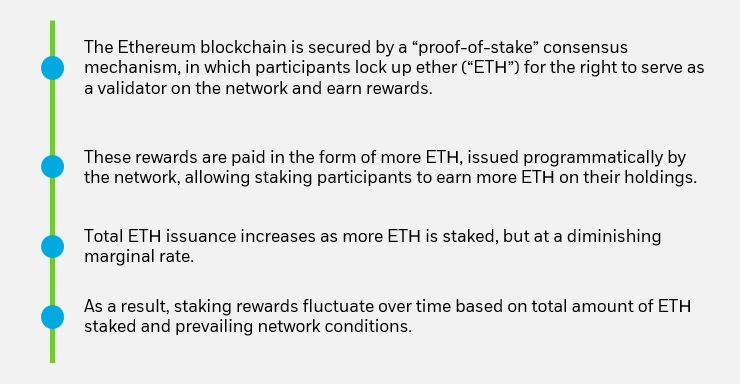
Infographic explaining Ethereum staking rewards.

Source: BlackRock. For illustrative purposes only.

Chart description: Infographic explaining Ethereum staking rewards.


Ethereum staking is a prominent example of proof-of-stake consensus. Think of Ethereum as an open-source app store that generates revenue as more users interact with applications on Ethereum, including tokenized assets, like stablecoins, or decentralized financial services. Ethereum’s native token, ether (ETH), is used to pay transaction fees for activity on the platform. Ether is the world’s second-largest cryptocurrency by market capitalization after bitcoin.1

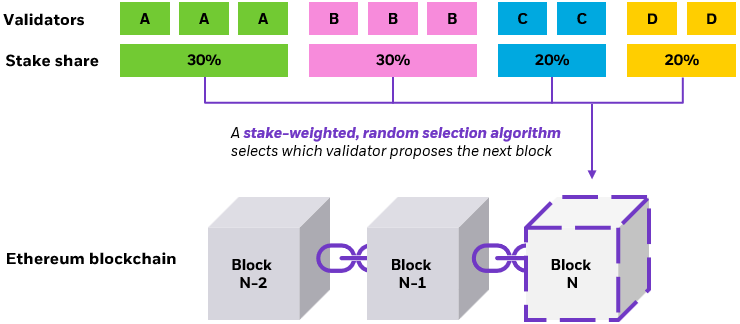
Unlike bitcoin — a “proof-of-work” network where miners compete using computational power to propose the next block of transactions — Ethereum’s proof-of-stake network assigns these same block proposal duties to stakers in proportion to their staked collateral; i.e., if a validator has 1% of all staked ETH, they’d have a 1% chance of being selected to propose any given block.

In other words, bitcoin’s security is dependent on the direct and ongoing cost of energy expenditure by miners, while Ethereum’s security is dependent on financial value in the form of ETH that’s locked in the protocol and can become a potential cost if seized. Staking seeks to financially incentivize participants to follow the protocol rules and discourage malicious behavior, as validators risk losing staked assets if they violate the rules.

Staking currently offers validators the potential to earn rewards of 2.5% to 3%2 annually on ETH, but introduces incremental risks, most notably liquidity constraints and the potential for financial penalties if rules are violated. This article examines the mechanics of Ethereum staking and the potential advantages of exposure to staking via an exchange-traded product such as the iShares Staked Ethereum Trust (ETHB).

Ethereum staking explained

Infographic further explaining the steps involved in staking.

Source: BlackRock. For illustrative purposes only.

Chart description: Infographic further explaining the steps involved in staking.


How does Ethereum staking work?

Ethereum is secured by a proof-of-stake consensus mechanism that determines who is eligible to propose the next block of transactions to the blockchain.

Validators are individuals or entities that pledge (stake) ETH as collateral to directly participate in Ethereum’s consensus process. Validators are required to run Ethereum client software to connect with other network participants and vote (attest) on their view of the blockchain.

The core responsibilities of a validator are to validate transactions, attest to the state of the blockchain, and to directly propose new blocks when selected to do so. Validators are compensated for timely performance of these responsibilities through a mix of new ETH issuance and transaction fees.

Each validator’s influence in the voting process is proportional to its share of staked ETH. As a result, the integrity of Ethereum’s transaction history depends on a broadly distributed validator set where no malicious group has the majority of the network’s stake. Ethereum’s security can strengthen as its validator set grows and stake becomes more decentralized.

The mechanics of Ethereum staking

Illustration of how validators validate transactions on the Ethereum Blockchain.

Source: BlackRock. For illustrative purposes only.

Chart description: Illustration of how validators validate transactions on the Ethereum Blockchain.


Potential benefits of Ethereum staking

Validators are incentivized with staking rewards for contributing to Ethereum’s security.

Staking allows validators to earn additional return through rewards, which can vary over time. Staking rewards are paid in ETH and come from two primary sources: (1) new ETH issuance and (2) transaction fees.3

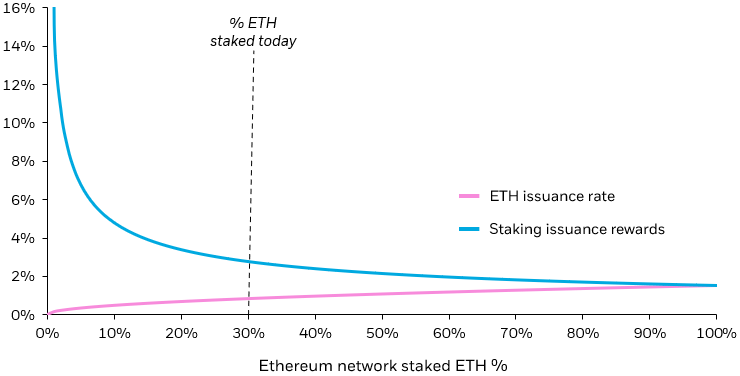
Issuance Rewards: New ETH is issued programmatically by the network and paid to validators as compensation for securing the network. The amount of new ETH issuance is designed to grow as more ETH is staked, but it does so at a diminishing marginal rate, meaning that the staking rewards earned per validator falls as more ETH is staked. With ~30% of all ETH currently staked4 , a well-functioning validator is currently earning about 2.75%5 per year from issuance rewards today.

Importantly, issuance rewards should not be confused with Ethereum’s overall issuance rate, which is currently around 0.8%6 per year. This dislocation is because all new ETH issuance is paid to stakers but only a portion of the total ETH supply is staked. As a result, issuance rewards are much higher than Ethereum’s overall issuance rate as unstaked ETH holders experience modest dilution over time to compensate stakers for helping secure the network.

Staking issuance and rewards

Line chart showing the issuance rates of ETH and staking rewards against the % of ETH staked today.

Source: Ethereum Consensus Specification; calculations conducted by BlackRock based on Ethereum protocol-defined issuance formulas. Note that ETH’s issuance rate equals staking issuance rewards if all ETH is staked. As of March 2026

Chart description: Line chart showing the issuance rates of ETH and staking rewards against the % of ETH staked today.


Transaction Fees: Validators also receive additional rewards in the form of transaction fees when they are selected to propose a block. Transaction fees have historically comprised a meaningful percentage of staking rewards, particularly in more volatile environments, but they’ve been declining and are less proportionally relevant today. Transaction fees have added about 0.1%7 to staking rewards over the past month, on average.

The majority of rewards are driven by new ETH issuance and a smaller, more variable contribution from transaction fees.

What are the risks of Ethereum staking?

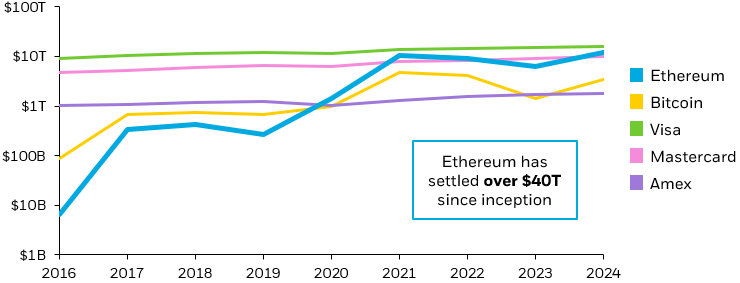
Before considering the risks specific to staking, investors should first evaluate and underwrite the value proposition of Ethereum. For many investors, Ethereum is a desirable network because of its flexibility and ability to support more sophisticated applications beyond simple value transfers. These applications include supporting decentralized financial services (DeFi), stablecoins (tokenized fiat currencies), and tokenized securities. Ethereum is the world’s leading smart contract blockchain and settlement layer in the crypto ecosystem8, and its annual settlement volume is now on par with traditional networks.

Ethereum is growing fast as an alternative to traditional payment & settlement networks

Transaction volume on Ethereum vs. other major networks

Line chart showing transaction volume of Ethereum vs other major networks.

Source: The Ethereum ecosystem includes Layer 2 blockchains whose systems derive security from and reach finality on Ethereum. Transaction volumes are shown annually from 2016 to 2024. Ethereum and Bitcoin volumes are measured by daily transfer value, including the native network asset and select widely used tokens deployed on each network (e.g., stablecoins). Volumes for Visa, Mastercard, and American Express (Amex) represent the combined total of payment and cash transaction volumes.

Source: Coin Metrics and Nilson reports (via Visa annual filings). Any companies mentioned do not necessarily represent current or future holdings of any BlackRock products. For actual Fund holdings, please visit www.ishares.com.

Chart description: Line chart showing transaction volume of Ethereum vs other major networks.


The decision to stake, or not, does not materially change an investor’s exposure to the price movements of ETH, which remain the primary driver of returns. Investing in ETH is expressing a view that more applications will be built on Ethereum’s open platform, with the idea of attracting more users, more revenue, and expanding the ecosystem in which ETH is utilized as money.

Staking introduces the potential to generate ETH-denominated rewards on top of existing ETH exposure, but this comes with additional risks, primarily: 1) liquidity risk; and 2) potential loss of capital through penalties or slashing.

Staked ETH is less liquid: Ethereum staking requires locking ETH in the Ethereum protocol, which means withdrawals can take a variable amount of time depending on network conditions, particularly the number of other validators attempting to exit at the same time. The Ethereum protocol limits the rate at which new ETH can enter or exit the validator set for security purposes. As a result, beginning to stake or withdrawing existing stake may take significantly longer during periods of elevated activity. While withdrawing staked ETH often takes several days under normal conditions, delays can extend to weeks or even months in more extreme environments.

Loss of Capital: Staking ETH exposes validators to the risk that a portion of their staked ETH may be reduced if they fail to complete their responsibilities assigned by the protocol. These reductions can range from “penalties”, which are relatively small losses due to operational issues, such as prolonged downtime, to potentially more severe losses in the case of a “slashing” event, which are specific protocol violations that pose greater systemic risk to the network.

In practice, historical data indicates that realized losses from staking have been limited. Validators have a 99.7%9 uptime rate — meaning the percentage of time validators are active and participating in network consensus — since Ethereum implemented staking in December 2020, and only 0.03% of all validators have ever been slashed. Of those 0.03%10 of validators that have been slashed, the largest realized loss was about 3%11 of their stake. All of that’s to say, staking rewards have far exceeded losses, generating ~$10 billion12 in net rewards to stakers since 2020. While this historical experience is informative, it may not be indicative of future results.

Why an ETP? Why ETHB?

By accessing exposure to Ethereum through an ETP, investors can get exposure via a traditional brokerage account and potentially benefit from Ethereum staking without running validator infrastructure or interacting directly with the protocol. ETHB provides investors with exposure to staked ETH through the convenience of an exchange-traded product, reducing the operational, tax, and custody complexities associated with holding and staking ETH directly. For example, investors staking ETH directly must create their own custody set up or evaluate crypto exchange offerings. Holding the asset directly in a crypto wallet requires users to maintain passwords and/or private keys to prevent loss.

Like all financial investments, ETPs involve an element of risk. Including capital risks, tax risks, and liquidity risks. ETHB is structured similarly to the iShares Ethereum Trust ETF (ETHA), the world’s largest Ethereum ETP13, but differs in that ETHA does not participate in staking, while ETHB intends to stake the majority of its ETH and will distribute rewards less fees to shareholders. As a result, ETHB is designed to provide exposure to the price return of ETH plus potential staking rewards.

ETHB works with multiple professional validators to leverage their staking infrastructure, while the underlying ETH is still secured by Coinbase’s institutional cold storage vaults. This approach is intended to combine the potential benefits of Ethereum staking with the operational standards expected of an exchange-traded product.

A blockchain is a digital transaction ledger that exists without reliance on a single central authority and is instead maintained by a distributed network of independent participants running open-source software. In the absence of a central authority controlling the ledger, blockchains need a consensus mechanism to coordinate among the participants and agree on the next valid block of transactions, ensuring the whole network maintains a consistent view of the ledger’s state.

While consensus mechanism designs vary, they generally require participants to put something of economic value at risk for a chance to post the next block of transactions to the chain and receive the associated protocol rewards for doing so. Imposing a financial cost to participate in a blockchain’s consensus helps align incentives with the protocol rules and seeks to make attacks on the network economically prohibitive, forming a core foundation of blockchain security.

Featured funds

  • iShares ETFs are available to purchase through a brokerage account or with a financial advisor.

    Buy through your brokerage

    iShares funds are available through online brokerage firms. All iShares ETFs and ETPs trade commission free online through Fidelity.

    By clicking on the button below, you will leave BlackRock’s website.

    Buy now on Fidelity

    Contact your advisor

    Contact a financial professional to discuss how iShares ETFs and ETPs can fit in your investment portfolio.

    Carefully consider the Funds' investment objectives, risk factors, and charges and expenses before investing. This and other information can be found in the Funds' prospectuses or, if available, the summary prospectuses, which may be obtained by visiting the iShares ETF and BlackRock Fund prospectus pages. Read the prospectus carefully before investing. Investing involves risk, including possible loss of principal.

    Any links to third-party websites are provided for use at your own discretion. Each third party is solely responsible for the content presented and availability of its website. BlackRock does not control, monitor or maintain third-party websites, their content or the products/services they offer. Content may change without notice. When you leave BlackRock’s website and enter a third-party website, you will be subject to that site’s terms, policies and/or notices, including those related to privacy and security, as applicable. Please review those policies and notices on the third-party website.

    Before engaging Fidelity or any broker-dealer, you should evaluate the overall fees and charges of the firm as well as the services provided. Free commission offer applies to online purchases of select iShares ETFs in a Fidelity account. The sale of ETFs is subject to an activity assessment fee (from $0.01 to $0.03 per $1,000 of principal). For iShares ETFs, Fidelity receives compensation from the ETF sponsor and/or its affiliates in connection with an exclusive long-term marketing program that includes promotion of iShares ETFs and inclusion of iShares funds in certain Fidelity Brokerage Services platforms and investment programs. Please note, this security will not be marginable for 30 days from the settlement date, at which time it will automatically become eligible for margin collateral. Additional information about the sources, amounts, and terms of compensation can be found in the ETF’s prospectus and related documents. Fidelity may add or waive commissions on ETFs without prior notice.

    The Funds are distributed by BlackRock Investments, LLC (together with its affiliates, “BlackRock”).

    ©2024 BlackRock, Inc or its affiliates. All Rights Reserved. BLACKROCK, iSHARES, iBONDS, LIFEPATH, ALADDIN and the iShares Core Graphic are trademarks of BlackRock, Inc. or its affiliates. All other trademarks are those of their respective owners.

    iCRMH1124U/S-3985892

  • iShares ETFs are available to purchase through a brokerage account or with a financial advisor.

    Buy through your brokerage

    iShares funds are available through online brokerage firms. All iShares ETFs and ETPs trade commission free online through Fidelity.

    By clicking on the button below, you will leave BlackRock’s website.

    Buy now on Fidelity

    Contact your advisor

    Contact a financial professional to discuss how iShares ETFs and ETPs can fit in your investment portfolio.

    Carefully consider the Funds' investment objectives, risk factors, and charges and expenses before investing. This and other information can be found in the Funds' prospectuses or, if available, the summary prospectuses, which may be obtained by visiting the iShares ETF and BlackRock Fund prospectus pages. Read the prospectus carefully before investing. Investing involves risk, including possible loss of principal.

    Any links to third-party websites are provided for use at your own discretion. Each third party is solely responsible for the content presented and availability of its website. BlackRock does not control, monitor or maintain third-party websites, their content or the products/services they offer. Content may change without notice. When you leave BlackRock’s website and enter a third-party website, you will be subject to that site’s terms, policies and/or notices, including those related to privacy and security, as applicable. Please review those policies and notices on the third-party website.

    Before engaging Fidelity or any broker-dealer, you should evaluate the overall fees and charges of the firm as well as the services provided. Free commission offer applies to online purchases of select iShares ETFs in a Fidelity account. The sale of ETFs is subject to an activity assessment fee (from $0.01 to $0.03 per $1,000 of principal). For iShares ETFs, Fidelity receives compensation from the ETF sponsor and/or its affiliates in connection with an exclusive long-term marketing program that includes promotion of iShares ETFs and inclusion of iShares funds in certain Fidelity Brokerage Services platforms and investment programs. Please note, this security will not be marginable for 30 days from the settlement date, at which time it will automatically become eligible for margin collateral. Additional information about the sources, amounts, and terms of compensation can be found in the ETF’s prospectus and related documents. Fidelity may add or waive commissions on ETFs without prior notice.

    The Funds are distributed by BlackRock Investments, LLC (together with its affiliates, “BlackRock”).

    ©2024 BlackRock, Inc or its affiliates. All Rights Reserved. BLACKROCK, iSHARES, iBONDS, LIFEPATH, ALADDIN and the iShares Core Graphic are trademarks of BlackRock, Inc. or its affiliates. All other trademarks are those of their respective owners.

    iCRMH1124U/S-3985892

Photo of Jay Jacobs

Jay Jacobs

Head of U.S. Equity ETFs

Photo of Robbie Mitchnick

Robbie Mitchnick

Head of Blackrock's Digital Assets Business

Co-author

Matt Kunke

Digital Assets Product Strategist

Contributor

Alyssa Karchmer

Digital Assets Strategist

Contributor