Outcome ETFs & income strategies: How do they work?

Jay Jacobs Apr 22, 2026 Equity

Key takeaways

  • Investors may be familiar with options strategies but having them available inside the ETF wrapper provides a convenient and cost-efficient avenue for access.
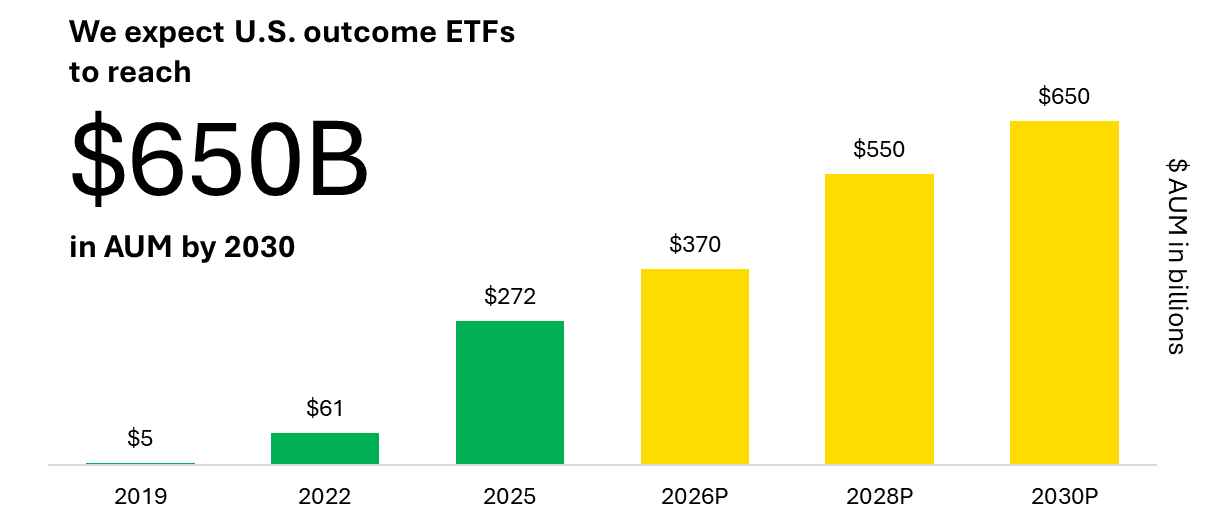
  • Outcome ETFs are designed to align with specific investment goals, like generating income, providing targeted downside protection, or seeking enhanced growth – which investors are increasingly seeking to do. BlackRock forecasts U.S. outcome ETF assets under management will more than double to $650 billion by 2030, from $272 billion in 2025.1
  • The iShares U.S. Large Cap Premium Income Active ETF (BALI) is an example of an outcome ETF, one that targets consistent income with lower volatility than the broader U.S. equity market.

How do outcome ETF income strategies work?

Options strategies might seem complex, but the outcomes they seek to achieve – including income, downside protection or enhanced growth -- can be easier to understand and conveniently pursued with exchange traded funds (ETFs). Enter outcome ETFs.

‘Outcome ETFs’ may be a relatively new phrase, but they are increasingly becoming a vehicle of choice for investors. In 2025, outcome ETF assets under management (AUM) skyrocketed to $272 billion, up from just $5 billion in 2019.2 We believe that adoption will continue to accelerate and forecast U.S. outcome ETF assets under management will more than triple to $650 billion by 2030.3  (Download BlackRock’s report Outcome ETFs – A powerful tool for a changing world to learn more.)

Decorative Graphic

Source: BlackRock, Morningstar as of 12/31/2025. Estimates include scenario calculations based on proprietary research by BlackRock Global Product Solutions. Industry projections assumes the market ecosystem for options will scale proportionately to support the growth of outcome ETFs. These figures are for illustrative purpose only and there is no guarantee the projections will come to pass.

Chart description: Bar graph showing actual and projected assets under management for outcome ETFs from 2019 to 2030.


How can BALI fit into outcome ETF income strategies?

The iShares U.S. Large Cap Premium Income Active ETF (BALI) is an example of an outcome ETF targeting consistent income with lower volatility than the broader U.S. equity market.

This actively managed ETF invests in a basket of large-cap stocks using a proprietary dividend rotation model that incorporates quantitative analysis. The fund then seeks to enhance income by writing monthly call options on the S&P 500 Index.

This allows investors to have some potential upside market participation, while seeking income from two sources: equity dividends and the sale of call options.

BALI seeks to deliver consistent income and lower volatility without needing to overweight certain sectors or styles, making it an attractive consideration for a core equity exposure. Utilizing the data and technology capabilities of BlackRock’s Systematic Active Equities (SAE) platform, BALI employs a systematic approach with a robust risk management framework. (Learn more about SAE, which uses data-driven insights, scientific testing, and advanced computer modelling techniques to construct portfolios.)

How does a call option work?

A call options contract is an agreement between a buyer and seller that gives the purchaser of the option the right to buy a particular asset at a specified future date at an agreed upon price (commonly known as the “strike price”). When the fund writes (sells) a call option, the fund is entitled to receive a premium. Although not perfectly correlated, such call options may have the impact of capping potential gains from the fund’s long position in equity securities. Therefore, to reduce the potential impact of this cap on the potential gains (with actual results dependent on various factors including the degree of options and futures activity over time), the fund will buy futures on a large cap equity index.

Of course, individuals and financial advisors may pursue call options strategies outside of ETFs. But that requires a commitment of time and energy into learning the world of options, as well as ongoing rebalancing and monitoring strategies. The advent of outcome ETFs has created a way to simplify access to options strategies for investors. That’s why we believe that outcome ETFs will increasingly become a vehicle of choice as more investors look for clearer investment outcomes and low-cost ways to implement these strategies.

Download BlackRock’s report Outcome ETFs – A powerful tool for a changing world to learn more about BALI and other outcome ETFs, including the newly launched iShares Nasdaq Premium Income Active ETF (BALQ), which seeks monthly income by investing in Nasdaq-listed companies and writing call options on the Nasdaq-100 Index.

Frequently asked questions

An outcome ETF is an exchange-traded fund designed to deliver a clear outcome. Outcome ETFs use options to help investors pursue specific objectives, including growth, income and downside protection in volatile markets. (Learn more about options and how they work.)

Outcome ETFs may generate income by selling (or “writing”) call options on underlying equities, collecting premiums that can be distributed to investors.

A covered call strategy involves holding an asset and selling call options on it to generate income. Within ETFs, this can be done on multiple assets simultaneously and the income is distributed to investors as a dividend. (Learn more about dividends and how they work.)

Outcome ETFs can help investors pursue specific objectives, including income. Some investors may be looking for income from sources that are less sensitive to interest rates or a company's ability to pay a dividend.

Trade-offs may include capped upside and exposure to equity market risks.

Selling call options generates upfront cash but, in exchange, the fund’s upside may be limited. In a sharply rising market, a fund may lag meaningfully behind the broad market.

Conversely, the fund’s value can fall in a market downturn; while the premiums generated from the sale of call options provide some cushion, they may not fully offset losses if the value of the fund's holdings decline.

The iShares Nasdaq Premium Income Active ETF (BALQ) is an ETF that seeks monthly income by investing in a basket of Nasdaq 100 stocks and writing call options on the Nasdaq 100 Index.

All iShares ETFs are designed to be low-cost, liquid and transparent. iShares offers two ways to generate income with outcome ETFs:

  • Index funds such as the iShares 20+ Year Treasury Bond BuyWrite Strategy ETF (TLTW), which seek to maximize premium income generation.
  • Active funds such as BALI and BALQ, which seek to balance growth and income. BALI and BALQ also leverage the data and technology capabilities of BlackRock’s Systematic Active Equities (SAE) platform, which combine human expertise with quantitative, data-driven techniques to construct portfolios aligned with specific investment objectives across asset classes.

Our solutions also span across equities and fixed income, providing access to income strategies across portfolios.

Photo of Jay Jacobs

Jay Jacobs

U.S. Head of Equity ETFs at BlackRock

Decorative graphic

INCOME ETF COLLECTION

A simplified approach to generating supplemental income

Pursue supplemental income with bonds, dividend stocks, and options strategies through the convenience of an ETF.

Featured funds