Introducing BITA – the iShares Bitcoin Premium Income ETF

Jay Jacobs Jun 17, 2026 Equity

Key takeaways

  • The launch and rapid adoption of bitcoin ETPs demonstrate the significant demand for bitcoin exposure across direct, wealth, and institutional investor channels. Products like IBIT have helped accelerate the adoption of bitcoin as an emerging asset through the familiarity and convenience of the ETP wrapper.
  • At the same time, bitcoin adoption may still be limited with more risk-conscious and income-oriented investor cohorts given the asset does not pay a yield and its relatively elevated volatility profile.
  • iShares is launching the iShares Bitcoin Premium Income ETF (BITA), which seeks to provide meaningful bitcoin exposure while generating income from writing call options on IBIT, which may help reduce BITA’s volatility compared to that of spot bitcoin.
  • We believe BITA represents a significant innovation in expanding bitcoin participation to new investor types.

The iShares Trusts are not an investment company registered under the Investment Company Act of 1940, and therefore are not subject to the same regulatory requirements as mutual funds or ETFs registered under the Investment Company Act of 1940.

BITA

iShares Bitcoin Premium Income ETF

Seeks to track the performance of bitcoin while generating premium income through an actively managed options strategy.

Why bitcoin and premium income?

Bitcoin adoption in traditional investment portfolios has grown substantially in recent years. This was accelerated by the launch of bitcoin ETPs, which provided investors with a convenient and familiar wrapper to gain exposure to this emerging asset. The iShares Bitcoin Trust ETF (IBIT) became the fastest growing ETP ever, reaching $50B after 11 months, eclipsing the previous record of 63 months to reach the same mark.1

Despite this adoption, a significant cohort of investors may still be sidelined due to two primary concerns:

  1. Bitcoin has no intrinsic yield, so investors are wholly dependent on capital appreciation to realize returns.
  2. While Bitcoin’s volatility profile has trended downward over time, it remains elevated compared to most other investment opportunities.

The iShares Bitcoin Premium Income ETF (BITA) seeks to address these two concerns and presents an opportunity to expand investor access to the bitcoin ecosystem for those that seek income and/or the potential for dampened volatility, relative to spot bitcoin.

Potential outcomes vs. spot exposure

Caption:

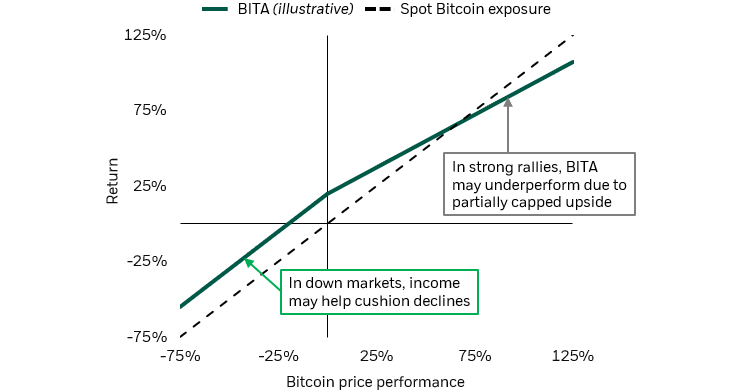
Table shows BITA can outperform when spot bitcoin prices decline, remain flat, or rise modestly, but may underperform when spot bitcoin rises significantly, as upside is partially capped.

Bitcoin declinesIncome can partially offset lossesOutperforms
Bitcoin remains flatIncome can enhance returnsOutperforms
Bitcoin rises modestlyIncome can enhance returnsOutperforms
Bitcoin rises significantlyUpside may be partially cappedUnderperforms

For illustrative purposes only. There is no guarantee of any specific positive outcome.

Chart description: Chart shows BITA may cushion losses in down, flat, or slightly positive markets but it may lag spot bitcoin in strong rallies due to partially capped upside.


How does BITA earn income?

BITA seeks to generate monthly premium income by selling call options on IBIT on approximately 25-35% of the portfolio.

In essence, BITA is selling a portion of its upside participation in bitcoin’s returns for an upfront premium income payment which can be distributed to investors. This has the effect of transforming an asset with zero income, like bitcoin, into an asset that pursues premium income. Premium income ETPs, like BITA, can seek to monetize bitcoin’s elevated volatility and convert it into income by selling IBIT call options.

The income received from options premiums may help to increase returns in down, flat, or moderately positive markets, but will partially dilute returns if bitcoin moves sharply higher. (Learn more about options and how they work.)

01.

Portfolio construction

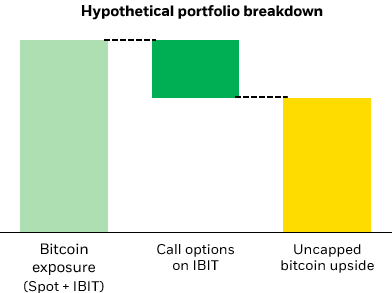
Long bitcoin exposure + overwrite on ~30% of portfolio assets.

Chart shows BITA's portfolio uses long bitcoin & IBIT exposure plus an IBIT call option overwrite on about 30% of the fund's assets.

02.

Weekly laddered overwrite process

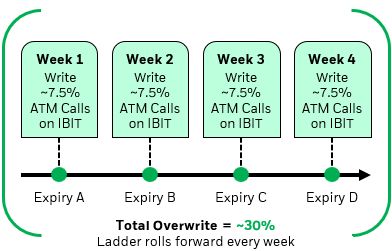
Systematically write ~7.5% of bitcoin exposure each week to target a smooth, recurring income stream.

BITA uses a weekly laddered overwrite process with the strategy systematically writing ~7.5% notional exposure of at-the-money IBIT calls across four weekly expiries, creating a 30% laddered overwrite.

03.

Monthly income

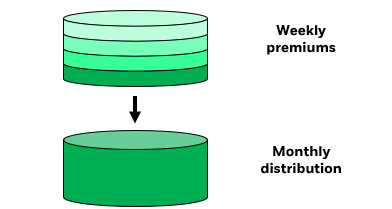
Monthly distributions to shareholders are based on option premiums collected.

Weekly option premiums are collected, and monthly distributions are paid to shareholders based on the option premiums collected.

For illustrative purposes only. BITA seeks to write covered call options on approximately 25-35% of the portfolio’s assets. Actual numbers may vary.

How does BITA balance growth and income?

As with any covered call strategy, there is a tradeoff: investors exchange a portion of an asset’s upside participation for upfront premium income payments. As more upside participation is sold away, more income can be generated. However, BITA’s design seeks to prioritize retaining meaningful participation in bitcoin’s long-term growth potential by capturing a majority of its upside appreciation, while offering a premium income buffer to complement it.

Alternative implementations of premium income strategies may prioritize higher income distributions, but they may forego participation in bitcoin’s potential upside as a result. Our view is that investors overwhelmingly want access to this ecosystem for its long-term growth prospects, but certain investors may need income or the potential for less volatility to catalyze their participation.

Why BITA?

BITA seeks to bridge the gap between bitcoin’s compelling growth opportunity and the needs of income- and risk-conscious investors. It’s designed to retain meaningful participation in bitcoin’s long-term growth potential while generating monthly income from option premiums that may help aid returns in a down, flat, or moderately positive market environment. By seeking to monetize a portion of bitcoin’s elevated volatility through a covered call strategy, BITA pairs bitcoin exposure with a strategy designed to generate premium income, while helping to moderate volatility relative to a spot bitcoin position.

BITA leverages a differentiated partnership structure that we believe to be a more tax-efficient implementation for this strategy compared to a traditional 1940 Act ETF. The partnership enables BITA to hold spot bitcoin (and IBIT) directly for tax-efficient growth with a set of important benefits:

  1. The bitcoin exposure is allowed to compound on a tax deferred basis until the investor decides to exit.
  2. The options benefit from lower 60/40 blended capital gains taxation2,3 as Section 1256 contracts4.
  3. Avoids a requirement to make year-end capital gains distributions.
  4. Capital losses can be passed through and used to offset other investment gains rather than being stuck as tax loss carryforward inside of the ETF.

BITA not only builds on IBIT, the world’s largest and most liquid bitcoin ETP5,  but it also seeks to generate income through selling call options on IBIT, which represents the world’s largest options market on bitcoin.6 BITA brings together BlackRock’s bitcoin and derivatives expertise into a convenient, exchange-traded product that may help to attract a wider range of investors into the bitcoin ecosystem.

Bitcoin Premium Income ETP comparison

Caption:

Table comparing 1940 Act ETF structure vs. a partnership structure (BITA).

Structure1940 Act structurePartnership structure (BITA)
Tax formForm 1099Schedule K-1
Bitcoin exposure7Commonly uses synthetic exposureHolds direct spot bitcoin (& IBIT)
Tax-efficiencyGrowth from synthetic long cannot compound tax-deferred beyond the calendar year. May be taxed at ordinary income or capital gains rates.

A portion of options gains would be treated as ordinary income.3

Potential for large year-end capital gains distributions.


Cannot pass through losses – losses stay in the fund as loss carryforwards.
Growth from spot bitcoin may compound tax deferred until sale. Taxed at capital gains rates.

Options gains taxed at lower 60/40 blended capital gains rate.4

Partnerships are not required to make year-end capital gains distributions.

Can pass through capital losses to offset other investment gains.

Comparison of the 1940 Act ETF structure vs. a partnership structure as it applies to Bitcoin Premium Income ETPs in the market. The above table is for illustrative purposes only. It serves as a general summary and is not exhaustive. Please refer to the relevant prospectus for further details.

FAQs

Yes! BITA gets its long bitcoin exposure by owning spot bitcoin directly and by holding IBIT, the world’s largest and most liquid spot bitcoin ETP.5

If your goal is to get one-for-one exposure to bitcoin, you can purchase it directly or use a bitcoin ETP, like IBIT. If you want bitcoin exposure but are uncomfortable with its full risk profile or you seek income on your investment, BITA seeks to provide exposure to most of bitcoin’s upside while offering the potential for premium income.

BITA seeks to generate income by writing call options on IBIT. BITA intends to make monthly distributions based on the option premiums collected.

A covered call strategy involves holding an asset and selling call options on it to generate premium income. Within ETPs, the premium income can be distributed out to investors on a regular cadence.

A covered call exchanges a portion of the asset’s upside participation for upfront premium income payments. This income may help to increase returns in down, flat, or moderately positive markets, while accepting that it will partially dilute returns if the asset moves sharply higher.

Options do not gain or lose value in a one-for-one relationship with the underlying asset. An option buyer's maximum loss is limited to the premium paid for the option, while the potential value of the option can increase significantly if the underlying asset experiences a large price move. Because larger future price swings increase the chance that an option becomes valuable, options on volatile assets are more expensive and typically generate higher premiums for the seller, all else equal. This is sometimes described as a volatility-driven income approach, where the strategy seeks to monetize market volatility through options-related exposure.

As a result, BITA’s income may fall (rise) if bitcoin’s price volatility declines (rises).

No. Investors in BITA are expected to receive a Schedule K-1 instead of Form 1099. This is due to the partnership structure, which we believe results in a materially more tax-efficient outcome for investors despite requiring a different tax reporting process.

BITA leverages a differentiated partnership structure that we believe to be a more tax-efficient implementation for this strategy compared to an ETF registered under Investment Company Act of 1940 (“1940 Act ETF”). This does, however, require a modestly different tax reporting process. The partnership enables BITA to hold spot bitcoin (and IBIT) directly for tax-efficient growth while selling options on IBIT that benefit from lower 60/40 blended capital gains taxation as Section 1256 contracts. This physical implementation enables the spot bitcoin in the partnership to compound on a tax deferred basis until the investor decides to exit. Partnerships also do not require year-end capital gain distributions, and capital losses can be passed through and used to offset other investment gains rather than being stuck as a tax loss carryforward inside of the ETF.

K-1s are anticipated to be available in March.

Retirement accounts generally are not subject to tax or tax return filing requirements on income generated by a partnership investment unless the Schedule K-1 reports "unrelated business taxable income" — also known as UBTI. Many custodians monitor UBTI and manage any necessary tax filings. Investors interested in holding BITA through a retirement account are encouraged to reach out to their custodian or broker for information on what support they offer. See the “Taxation of U.S. Tax-Exempt Shareholders” in the prospectus for more details.


Photo of Jay Jacobs

Jay Jacobs

Head of U.S. Equity ETFs

Matt Kunke

ETF Product Strategist

Contributor

Brendan Easter

ETF Product Strategist

Contributor

Ashley Saidler

ETF Product Strategist

Contributor