Market Trends | January edition

Stay informed with real-time market trends and expert-driven investment ideas across asset classes and emerging themes.

Markets started the year navigating a range of headlines — from earnings and geopolitics to renewed tariff concerns. Despite that noise, the S&P 500 gained about 2% in January. More importantly, we saw clear signs of market broadening, with small caps and value outperforming.


At the macro level, the backdrop remains constructive. Economic growth momentum has continued, inflation is trending lower, and tariff pass-through has remained limited, giving the Fed room to stay patient even as interest rate cuts are now expected later rather than earlier.


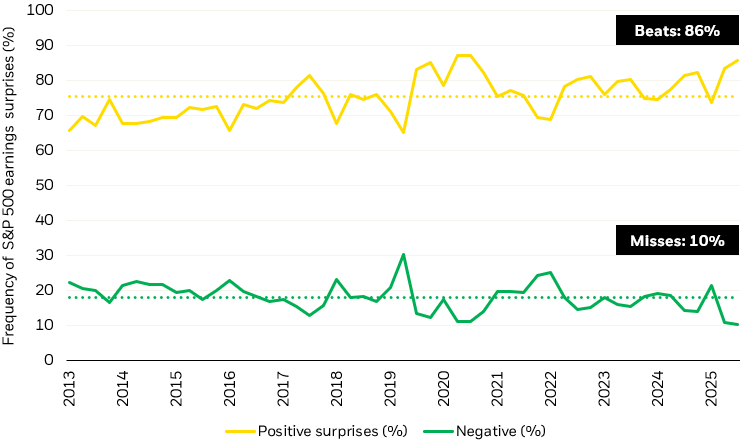
Earnings season is reinforcing this message. The rates at which earnings and sales are beating expectations are running above historical averages. And while mega-cap tech continues to lead growth, all sectors are expected to deliver positive earnings growth — with value winning on acceleration.


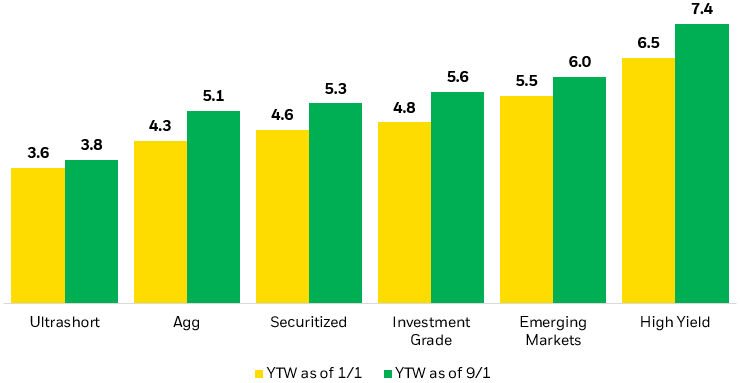
Looking ahead, we believe the cost of staying on the sidelines is rising. We remain constructive on stocks, prefer higher-yielding bonds over cash for income, and see a role for diversifiers like gold and flexible strategies to help improve portfolio outcomes.

Disclosures:


Index performance is for illustrative purposes only. Index performance does not reflect any management fees or expenses. Indexes are unmanaged and one cannot invest directly in an index. Past performance does not guarantee future results.


Investing involves risk, including possible loss of principal.


This material is provided for educational purposes only and is not intended to constitute investment advice or an investment recommendation within the meaning of federal, state or local law. You are solely responsible for evaluating and acting upon the education and information contained in this material. BlackRock will not be liable for direct or incidental loss resulting from applying any of the information obtained from these materials or from any other source mentioned. BlackRock does not render any legal, tax or accounting advice and the education and information contained in this material should not be construed as such. Please consult with a qualified professional for these types of advice.


Prepared by BlackRock Investments, LLC, member FINRA.


© 2026 BlackRock, Inc. or its affiliates. All Rights Reserved. BLACKROCK and iSHARES are trademarks of BlackRock, Inc. or its affiliates. All other trademarks are those of their respective owners.


6P80226-5197559-EXP0227

Video 01:24

Markets started the year navigating a range of headlines — from earnings and geopolitics to renewed tariff concerns. Despite that noise, the S&P 500 gained about 2% in January. More importantly, we saw clear signs of market broadening, with small caps and value outperforming.


At the macro level, the backdrop remains constructive. Economic growth momentum has continued, inflation is trending lower, and tariff pass-through has remained limited, giving the Fed room to stay patient even as interest rate cuts are now expected later rather than earlier.


Earnings season is reinforcing this message. The rates at which earnings and sales are beating expectations are running above historical averages. And while mega-cap tech continues to lead growth, all sectors are expected to deliver positive earnings growth — with value winning on acceleration.


Looking ahead, we believe the cost of staying on the sidelines is rising. We remain constructive on stocks, prefer higher-yielding bonds over cash for income, and see a role for diversifiers like gold and flexible strategies to help improve portfolio outcomes.

Disclosures:


Index performance is for illustrative purposes only. Index performance does not reflect any management fees or expenses. Indexes are unmanaged and one cannot invest directly in an index. Past performance does not guarantee future results.


Investing involves risk, including possible loss of principal.


This material is provided for educational purposes only and is not intended to constitute investment advice or an investment recommendation within the meaning of federal, state or local law. You are solely responsible for evaluating and acting upon the education and information contained in this material. BlackRock will not be liable for direct or incidental loss resulting from applying any of the information obtained from these materials or from any other source mentioned. BlackRock does not render any legal, tax or accounting advice and the education and information contained in this material should not be construed as such. Please consult with a qualified professional for these types of advice.


Prepared by BlackRock Investments, LLC, member FINRA.


© 2026 BlackRock, Inc. or its affiliates. All Rights Reserved. BLACKROCK and iSHARES are trademarks of BlackRock, Inc. or its affiliates. All other trademarks are those of their respective owners.


6P80226-5197559-EXP0227

Geopolitical risk indicator

Line chart showing trends in geopolitical tension, which has risen sharply since early 2025.

Source: BlackRock Investment Institute, as of January 2026.

Notes: The BlackRock Geopolitical Risk Indicator (BGRI) tracks the relative frequency of brokerage reports (via Refinitiv) and financial news stories (Dow Jones News) associated with specific geopolitical risks. We adjust for whether the sentiment in the text of articles is positive or negative. and then assign a score. This score reflects the level of market attention to each risk versus a five-year history. We assign a heavier weight to brokerage reports than other media sources since we want to measure market  attention to any particular risk. not public. As part of the December 2024 update, we removed the Climate policy gridlock risk to introduce a new risk. Global trade protectionism. Forward-looking estimates may not come to pass.

Chart description: Line chart showing trends in geopolitical tension, which has risen sharply since early 2025.


Geopolitical noise & market poise

“As January goes, so goes the year”

If there’s any truth to the old Wall Street adage, 2026 is going to be a wild ride.

Markets kicked off the year digesting the following:

  • Operation Absolute Resolve in Venezuela
  • Mass protests in Iran and a buildup of U.S. forces in the Persian Gulf.
  • Escalating rhetoric around a potential U.S.–Greenland deal — including threats of higher tariffs on European countries.
  • Heightened U.S.–Canadian tensions on display at the World Economic Forum.
  • The President directing $200 billion of agency purchases by GSEs and proposing a 10% credit card interest cap.
  • Fed Chair Jay Powell responding to a subpoena from the DOJ.
  • The potential for a partial government shutdown.
  • A tumbling Japanese yen and higher yields on Japanese government bonds after new Prime Minister Sanae Takaichi’s stimulus proposal.
  • President Trump nominating Kevin Warsh to replace Jay Powell as Fed chair. 

All this in addition to the regular schedule of economic data and Q4 earning season.

Markets displayed remarkable resiliency amid the noise with the S&P 500 eclipsing 7000 for the first time and ending January up 1.4%.1

It was also a record start of the year for ETFs and ETPs, with over $162 billion of inflows in January, double the record set last year. Equity flows skewed toward international markets amid strong outperformance and accelerating GDP forecasts, while fixed income investors leaned into active allocations.2

Market participants mostly looked past geopolitics in part because of the fundamentals. About 28% of the S&P 500’s market cap has reported Q4 earnings and, so far, 10 out of the 11 sectors have topped earnings expectations by roughly 6%, a sign that earnings strength may be broadening beyond tech, as detailed in our 2026 Outlook.

Rise of the rest

The Russell 2000 hit an all-time high as January saw a broadening towards cyclicals and small caps. At one point, the Russell 2000 outperformed the S&P 500 for 14 consecutive sessions, the longest winning streak since May 1996.3

This rally was likely driven by expectations of accelerating growth and further rate cuts. Still, we are cautious because, among other concerns, a large share of the Russell 2000 is unprofitable.4

Russell 2000: % with positive profit margins

Line chart showing the percent of Russell 2000 constituents with positive profit margins, currently hovering just above 50%.

Source: Bloomberg, as of January 29, 2026. Past performance does not guarantee future results.

Chart description: Line chart showing the percent of Russell 2000 constituents with positive profit margins, currently hovering just above 50%.


Loss-making businesses tend to be effectively long-duration assets: their valuation depends heavily on estimated future profits that may be several years out. When long-end yields rise, or credit spreads widen, the present value of those distant cash flows drops — this is one reason rallies led by unprofitable small caps can be fragile.

De-dollarization drama

Gold topped $5,300/oz and silver surged past $110 per ounce before facing strong losses on the last day of the month as the dollar rallied after the new Fed Chair nominee was announced.

The rally in precious metals came amid rising global debt, geopolitical stress, and surging central bank demand for gold and AI‑driven industrial use for silver.

Gold’s move, particularly, rekindled chatter about the “de-dollarization” trade, which was further exacerbated by the dollar falling to its weakest level since 2022. January came to a close with President Trump suggesting he’s comfortable with a weaker dollar, and Treasury Secretary Bessent denying rumors of a joint U.S.-Japanese effort to support the yen.6

Central banks remain strong purchasers of gold

Bar chart showing trends in central bank purchases of gold, which have rising steadily since 2022.

Source: World Gold Council, as of end of Q3, 2025.

Chart description: Bar chart showing trends in central bank purchases of gold, which have rising steadily since 2022.


Central banks, which hold 20% of all mined gold, increased their gold reserves steadily from 2022–25 in what appears to be an effort  to diversify away from the U.S. dollar. The trend shows no signs of slowing: A 2025 survey showed that 95% of central banks expect global gold reserves to rise in 2026 up from 52% in 2021.7 With economies like China and Brazil still holding less than 10% of their reserves in gold, central bank buying should remain a key support driver.8

Silver demand reflects a more balanced mix of investment and industrial usage. About 60% of annual silver consumption is tied to electronics, solar panels and semiconductors.9 The ongoing buildout of data centers, rising power demand from AI workloads, and broader electrification trends add a cyclical and growth-sensitive component to silver.

Learn more about AI and energy in our 2026 Thematic Outlook

Featured products for today's market

Photo of Gargi Pal Chaudhuri

Gargi Pal Chaudhuri

Chief Investment and Portfolio Strategist Americas at BlackRock

Photo of Kristy Akullian, CFA

Kristy Akullian, CFA

Head of iShares Investment Strategy