Income investing for retirement: pursuing income and growth

Ashley Doll Apr 30, 2026 Income

Explore passive income strategies for retirement. Learn about building reliable income in retirement using dividends, bonds, options and ETF income solutions.

Key takeaways

  • Income investing has historically been a key part of retirement planning. But in today’s uncertain markets, an expanded toolkit of income solutions may be necessary.
  • Different sources of income behave differently and may play a distinct role in portfolios. Combining them can potentially create a more resilient income stream.
  • Investors in or near retirement may seek income from dividends, options strategies, short-term bonds and active fixed income via exchange traded funds (ETFs), which offer convenience, low-costs, tax-efficiency, and diversification benefits.

When it comes to planning for retirement, maintaining a comfortable level of income to cover living expenses is top of mind for most investors.

As simple as that sounds, a rapidly evolving market and macroeconomic landscape presents new challenges.

The good news? ETFs can make income investing easy, allowing investors to diversify across a handful of strategies that can help provide the income they seek from their portfolios.

Investors could think of these solutions in four buckets:

Stepping out of cash: Short duration government bonds tend to have limited interest rate and credit risk. Many investors use these exposures to move money out of cash to pursue yield with limited risk.

Seeking to maximize bond income: A number of index products may offer higher yields, such as those with credit exposure. And by investing across a variety of potentially higher yielding segments of the bond market, active managers can pursue higher yield while diversifying their sources.


Seeking dividend income from stocks: Focusing on dividend-paying stocks can help increase yield over broad market benchmarks, potentially helping investors as they pursue both the growth of their assets over time, and generating current income.

Balancing income and growth: Outcome-oriented strategies can use options or other derivatives to generate income and maintain some market participation, potentially helping investors maintain their purchasing power over a long retirement. Income today may not be a single asset class—it’s actually an integrated approach implemented across your whole portfolio.

And building a mix of income sources may be key to helping you meet your retirement goals.

Video 1:49

Learn more about income investing

When it comes to planning for retirement, maintaining a comfortable level of income to cover living expenses is top of mind for most investors.

As simple as that sounds, a rapidly evolving market and macroeconomic landscape presents new challenges.

The good news? ETFs can make income investing easy, allowing investors to diversify across a handful of strategies that can help provide the income they seek from their portfolios.

Investors could think of these solutions in four buckets:

Stepping out of cash: Short duration government bonds tend to have limited interest rate and credit risk. Many investors use these exposures to move money out of cash to pursue yield with limited risk.

Seeking to maximize bond income: A number of index products may offer higher yields, such as those with credit exposure. And by investing across a variety of potentially higher yielding segments of the bond market, active managers can pursue higher yield while diversifying their sources.


Seeking dividend income from stocks: Focusing on dividend-paying stocks can help increase yield over broad market benchmarks, potentially helping investors as they pursue both the growth of their assets over time, and generating current income.

Balancing income and growth: Outcome-oriented strategies can use options or other derivatives to generate income and maintain some market participation, potentially helping investors maintain their purchasing power over a long retirement. Income today may not be a single asset class—it’s actually an integrated approach implemented across your whole portfolio.

And building a mix of income sources may be key to helping you meet your retirement goals.
What's new in income investing today?

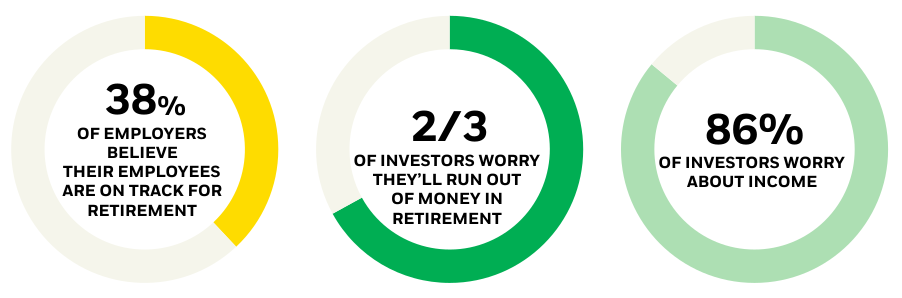
For decades, saving for retirement and income investments have gone hand in hand. But investors are facing new challenges, as traditional retirement plans may simply not be enough. In fact, only 38% of employers believe that the majority of their employees are truly on track for retirement.1 While nearly two-thirds of investors worry that when retirement comes, they’ll run out of money. An astounding 86% of investors say they want guaranteed income.2

3 charts showing investment challenges around retirement

It’s also worth asking if income is simply enough? Many investors are now looking to strike a balance of both income and growth, especially as inflationary pressures are driving expenses higher.

Traditionally, income was sourced from two buckets: bonds and dividend stocks. Today, income can come from additional sources and strategies like premium income ETFs and active fixed income strategies. Investors can access these investments via ETFs, which offer diversification and liquidity.

Seeking dividend income from stocks

Dividends are payments made by a company to its shareholders, most commonly in the form of cash. These dividend payments reward investors who hold the company’s stock, and some companies may pay higher dividends than others. Businesses showing financial maturity and/or stable cash flows tend to offer higher dividends than other companies.

But why does investing in dividends matter when saving for retirement? In a modern portfolio, dividends may provide regular income and diversify sources of returns, especially as many investors are facing concentrations risks due to how much of the U.S. stock market’s return is driven by AI-associated names.3

Dividends also potentially have lower volatility than the broad market. Diversification from bond income is also something to consider, especially as Fed easing may drive down rates, and falling interest rates typically mean bonds and cash may offer less income going forward.

As income opportunities evolve, it’s increasingly important to evaluate income opportunities on an after-tax basis. A key distinction for investors is the difference in taxation between qualified dividend income and interest income from a U.S. federal tax perspective.

  • Qualified dividend income is generally taxed at long-term capital gains rates rather than ordinary income rates.
  • By contrast, income from cash mutual funds and many taxable fixed income instruments is typically taxed as ordinary income.

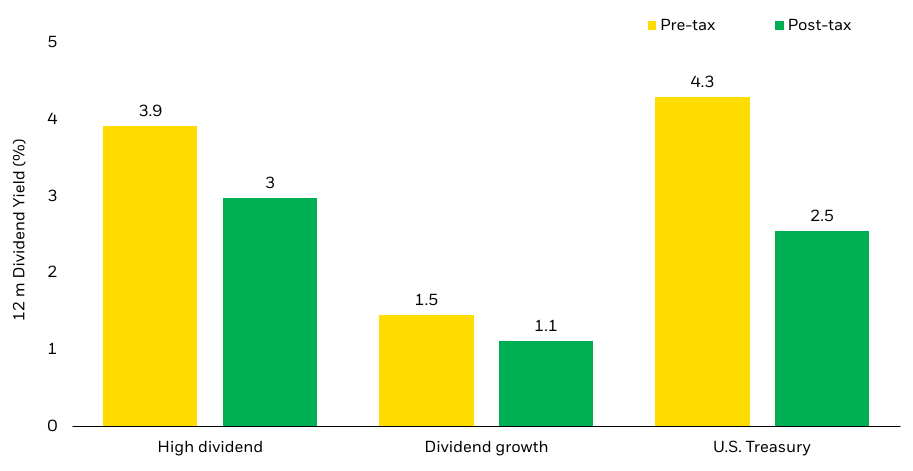
Investment idea: Different types of dividends offer different types of yield and tax benefits as illustrated in the chart below. Dividend growth companies tend to have a sustained history of growing dividends, while High dividends come from companies that are screened for financial health and have a history of paying out relatively high dividends.

Investors interested in dividends as a potential source of yield may consider the iShares Core High Dividend ETF (HDV) while those interested in dividend growth potential may consider the iShares Core Dividend Growth ETF (DGRO). (Learn more about the potential tax advantages of ETFs).

Dividend yields may have improved after-tax outcomes

Chart source: Bloomberg, as of Jan. 16, 2026. Chart by GPS Investment Strategy. High dividend represented 12-month dividend yield by Morningstar Dividend Yield Focus Total Return Index, dividend growth represented by 12-month dividend yield Morningstar U.S. Dividend Growth Total Return Index, cash represented by the Bloomberg 1-3 month Treasury Bill Index. Pre-tax is the yield these exposures provide before paying taxes, post-tax yield is the yield after income/capital gains taxes have been applied. The following tax rates were applied: Short-term (ordinary income) tax rate = 40.8%. Note, this reflects the highest marginal federal income tax rate (37%) plus the 3.8% net investment income tax (NIIT) imposed under the Affordable Care Act, where applicable. Short-term capital gains are taxed as ordinary income. For individuals subject to the NIIT at the highest federal tax rate, long-term capital gains are taxed at a rate of 20% plus the 3.8% net investment income tax for tax year 2025. Income from money market funds is generally taxed as ordinary income at an investor’s marginal tax rate and may be subject to the NIIT. Qualified dividend income is generally taxed at long-term capital gains rates. Shown for illustrative purposes only. This is not meant as a guarantee of any future result or experience.

Chart description: Bar chart showing differences in pre-tax and post-tax yields across different types of dividend investments showing that dividend growth investment yield investments are least effected by tax outcomes.


Balancing income and growth potential with options

Options are contracts between two parties who are willing to buy or sell an investment at a specific price in the future. By selling or writing call options on a stock, bond or other asset held in a portfolio, an investor can trade off upside appreciation for income (Learn more about options). Traditionally there have been barriers to many investors writing options, such as needing special permission on an investment account, as well as ongoing trading and maintenance of these strategies. But today, investors can access options strategies in an ETF wrapper providing convenience, transparency, and the potential for lower fees.

These 'premium income' strategies are designed to offer enhanced income from a unique source that is not predominantly tied to interest rates, credit risk, or corporate cash flows. Different premium income strategies may offer a variety of approaches, shifting the balance between upside participation and growth, or targeting different underlying assets (e.g. US Large Cap Stocks or Long-dated Treasuries).

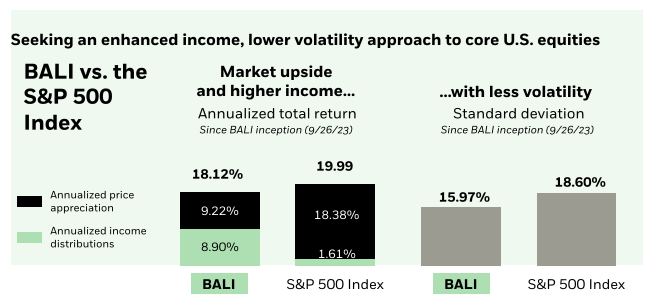
Investment idea: Premium income ETFs such as the iShares U.S. Large Cap Premium Income Active ETF (BALI) seek to enhance monthly income generation through two sources – a dynamic, rotating basket of U.S. large cap stocks with attractive near-term income potential, and option premiums from selling call options on the S&P 500 index. Premium income solutions like BALI can offer enhanced income with the potential for growth to maintain purchasing power, which may help to maintain purchasing power, especially if inflationary pressures remain elevated. As illustrated in the chart below, enhanced income potential doesn’t necessarily have to mean taking on more risks.

Chart comparing BALI with the S&P 500 Index

Chart source: Bloomberg as of 3/31/26 The Distribution Rate represents a single distribution from the fund and does not represent total return. It is calculated by annualizing the most recent distribution, including the income, return of capital, and capital gains distributions, based on the fund’s distribution frequency, and dividing by the prior trading day’s NAV. The most recent distribution (as of 4/1/2026) utilized in this calculation includes an estimated return of capital of 83% for BALI as reported in the most recent 19a-1 Notice. Past distributions are not indicative of future distributions. Morningstar as of 3/31/2026. BALI inception is 9/26/23. Performance annualized on daily total return of the NAV of the fund from 9/27/23 to 3/31/2026. Volatility based on standard deviation which measures the dispersion of returns relative to its mean. Higher standard deviation typically means more risk, while lower standard deviation means less risk. Performance data represents past performance and does not guarantee future results. Investment return and principal value will fluctuate with market conditions and may be lower or higher when you sell your shares. Current performance may differ from the performance shown. For most recent month-end performance and standardized performance visit www.iShares.com/BALI or click the fund card below. Index performance is for illustrative purposes only. Index performance does not reflect any management fees, or expenses. Indexes are unmanaged and one cannot invest directly in an index.


Chart description: Bar chart showing that BALI has a 18.12% annualized total return since inception comprised of 9.22% in annualized price appreciation and 8.90% in annual income distributions- compared to the S&P 500 which has 19.99% annualized return but it's made up almost exclusively (18.38%) by price appreciation. Additionally, BALI has a standard deviation of 15.97%, compared to the S&P 500 at 18.60%.


Moving out of cash: short-term bonds for income

Bonds have long been a staple in investor portfolios and are often the default choice when it comes to seeking to generate income. This income is sourced via payments, known as "coupons", which are paid on a regular schedule. As portions of bond coupons are earned – or “accrued” – each day, they may provide a consistent source of returns in a portfolio.

But even if bonds are the most “popular” income option, we know a large share of investor capital still sits in cash (around $9.2 trillion at the end of 2025).For investors seeking steady bond income while potentially limiting their risks, ultra-short government bonds may be used to move money out of cash. With near-term maturities and government-backed cash flows, these securities can be used to pursue yield with lower risk.

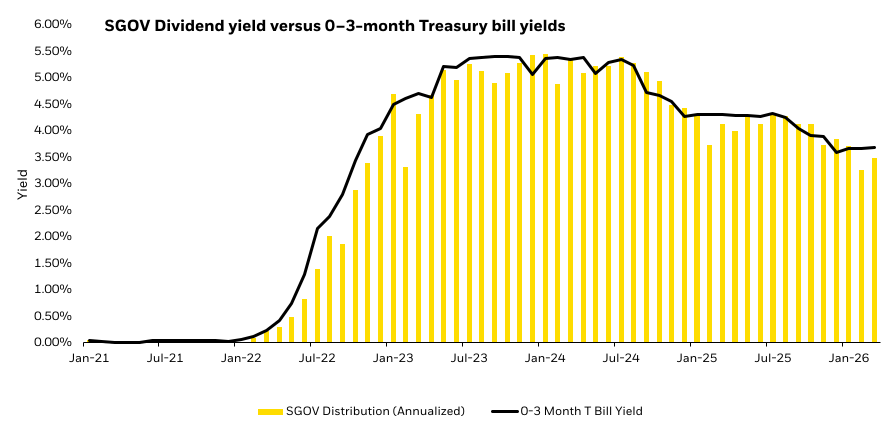
Investment idea: The iShares 0–3 Month Treasury Bond ETF (SGOV) seeks to pay monthly income distributions based on the interest accrued within the portfolio, traditionally these distributions have closely tracked market yields (see chart below). Treasury interest income is generally exempt from state and local income taxes, giving SGOV a potential upper hand relative to fully taxable alternatives.

SGOV distributions have closely tracked market yields

Chart source: Bloomberg, BlackRock as of 3/31/2026. SGOV Distribution (Annualized) refers to the monthly dividend amount, annualized and divided by the fund’s Net Asset Value. 0-3 Month T-Bill Yield refers to the Average Yield to Maturity of the Bloomberg 0-3 Month T-Bill Index. Performance data represents past performance and does not guarantee future results. Investment return and principal value will fluctuate with market conditions and may be lower or higher when you sell your shares. Current performance may differ from the performance shown . For most recent month-end performance, 30-Day SEC yield, and standardized performance visit www.iShares.com/SGOV or click the fund card below. For SGOV’s prospectus, click hereIndex performance is for illustrative purposes only. Index performance does not reflect any management fees or expenses. Indexes are unmanaged and one cannot invest directly in an index.

Chart description: Bar & line chart showing that SGOVs annualized distribution have been largely in line with 0-3 Month T-Bill yields.


Seeking maximum income with active fixed income

On the other end of the fixed income spectrum, bonds backed by company earnings, consumer loans, real estate, or global governments may offer higher amounts of income, albeit with additional risk. Today, we’re facing a generational opportunity in fixed income, as yields have been elevated compared to years past.5 When accessing these riskier bond categories, solutions that invest across the full opportunity set may provide greater diversification, helping to limit volatility compared to any one sector.

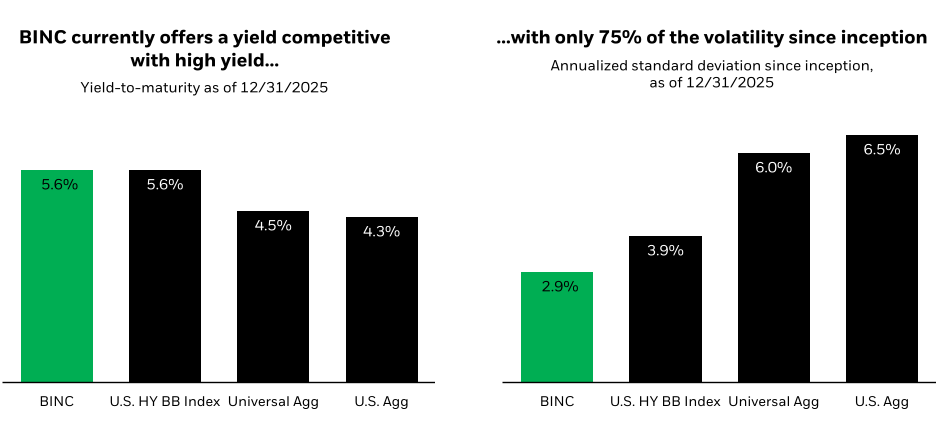
Investment idea: A nimble, actively managed approach can potentially take advantage of a strong yield environment by seeking to provide maximum income in an active and risk-adjusted way. The iShares Flexible Income Active ETF (BINC), for example, aims to maximize long-term income without sacrificing quality or taking on additional risk. This multi-sector approach may also help provide greater diversification vs holding static allocations to higher risk sectors like emerging markets or high yield, without sacrificing quality (see chart below).

BINC seeks to maximize income across all markets

BINC currently offers a yield competitive with high yield with only 75% of the volatility since inception

Chart source: Bloomberg, BlackRock as of 12/31/2025. High yield represented by the Bloomberg U.S. High Yield BB index. Universal Agg is represented by the Bloomberg U.S. Universal Index. U.S. Agg is represented by the Bloomberg U.S. Aggregate Bond Index. BINC was incepted on 5/19/2023. Performance data represents past performance and does not guarantee future results. Investment return and principal value will fluctuate with market conditions and may be lower or higher when you sell your shares. Current performance may differ from the performance shown. For most recent month-end performance, 30-day SEC yield, and standardized performance visit www.iShares.com/BINC or click the fund card below. For BINC’s prospectus, click here. Index performance is for illustrative purposes only. Index performance does not reflect any management fees, transaction costs or expenses. Indexes are unmanaged and one cannot invest directly in an index.


Chart description: Bar chart showcasing BINCs yield to maturity at 5.6% as of 12/31/2025- on par with the U.S. HY BB Index and greater than the yields of the Universal & U.S. Aggs- Additionally, showcasing BINC'S standard volatility since inception is only 2.9% vs 3.9% for the U.S. HY BB Index and 6.0%, 6.5% for the Universal and U.S. Aggs respectively.


Flexible income strategies in retirement

Retirement saving is becoming more complex. Fewer people feel on track for retirement, many fear running out of money, and the vast majority want reliable income streams. Traditional income approaches centered on income from bonds and dividend stocks but rapidly evolving markets have investors looking beyond income alone, toward strategies that also preserve growth.

Investors are now looking access a broader toolkit—expanding beyond traditional instruments into categories like options-based income and active fixed income—potentially through ETFs that simplify diversification. Each income source behaves differently, meaning combining them can help build a more resilient and adaptable portfolio. Tax treatment across different income investments may also be an increasingly important consideration.

Ultimately, retirement income today isn’t about finding a single solution—it’s about constructing a flexible, multi-source strategy. Empowering investors not just to sustain retirement—but to adapt and thrive throughout.

FAQs

Income investing is a strategy focused on generating regular cash flow from investments such as dividends, bonds, and income-focused ETFs.

Common approaches include dividend stocks, bonds, and diversified income ETFs that combine multiple strategies.

Diversifying income sources, maintaining some growth exposure, and focusing on after-tax income can help sustain long-term financial needs.

Dividend stocks can provide steady income, growth potential, diversification, and potential tax advantages.

ETFs offer a simple, diversified way to access income strategies, including dividends, bonds, and options-based approaches.

Inflation reduces purchasing power, making it important to include investments that offer both income and growth.

Ashley Doll

Equity Product Strategist

Tom Fickinger, CFA

Fixed Income Product Strategist

Featured funds