How are ETFs tax efficient?

Key takeaways

  • When investing for retirement, it’s critical to stay focused on after-tax returns. ETFs are generally tax efficient, which can help investors keep more of what they earn.
  • Low turnover and insulation from the actions of other shareholders are keys to the tax efficiency of ETFs.
  • ETFs held 30% of U.S. managed fund assets but accounted for less than 1% of capital gains distributions in 2025.1

You’ve probably learned that keeping fees low can be a big driver of successful investing. And while keeping fees low is important, taxes may actually be more harmful to long-term returns than fund management fees.

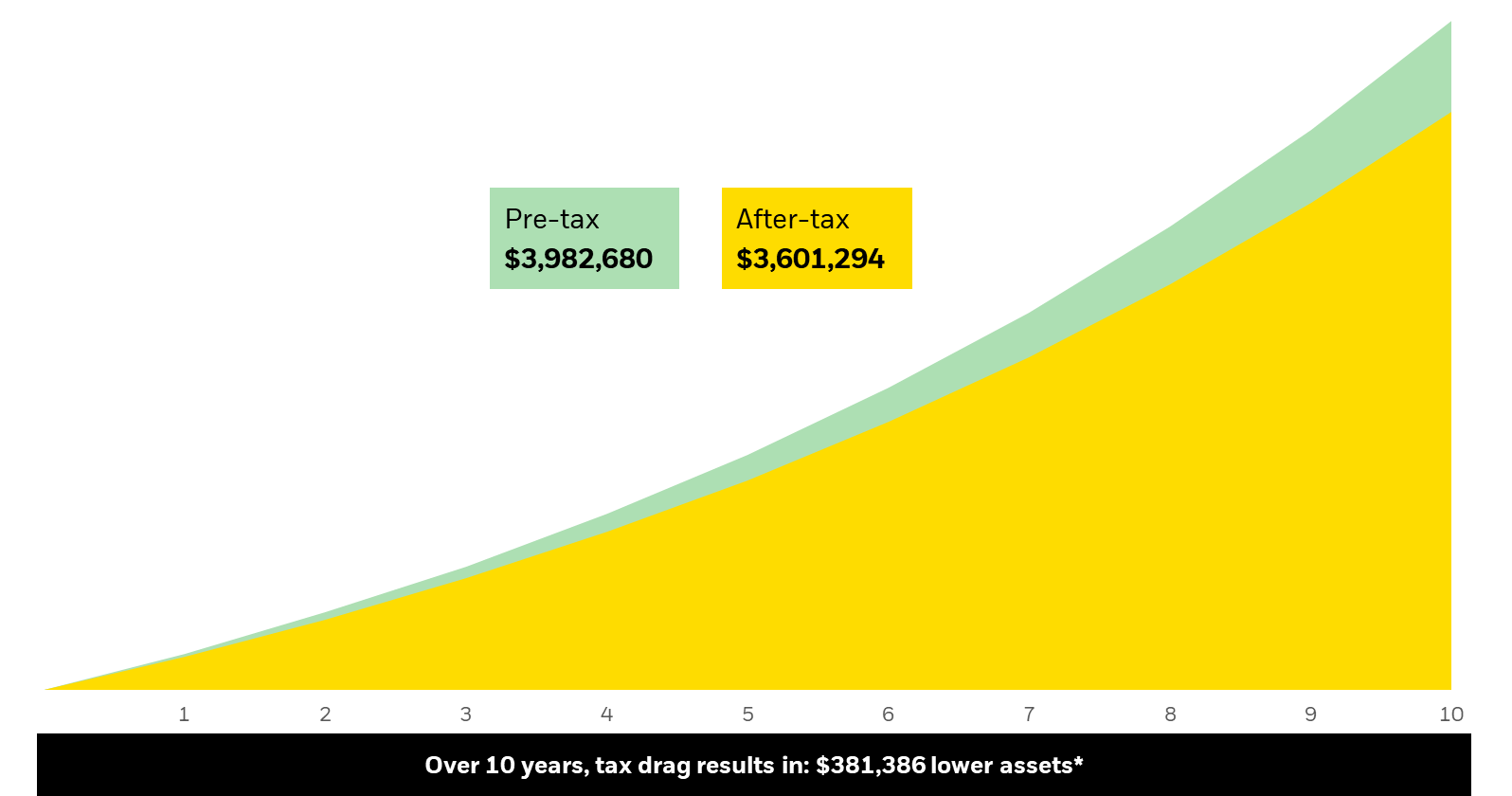
For example, the average annual tax cost for investors using a financial advisor was 1.15% for calendar year 2025, more than triple the average portfolio fee of 0.37%. And while 1.15% may not seem like a big tax burden, a hypothetical $1,000,000 portfolio invested in the U.S. stock market would have suffered a tax drag of over $325,000 over the last decade.3
Fretting over fees? Taxes take the bigger bite

The average investor tax cost for advised portfolios is 3x the average portfolio fee

Chart showing tax drag compounds over ten years

Source: BlackRock as of 12/31/2025. These figures reflect the advisor model data collected by BlackRock over the prior 12 months from 23,931 models. The models are grouped into risk profile cohorts determined by equity weighting. Figures describe the average across all portfolios in the cohort for the metric in question. BlackRock’s proprietary risk model data is supplemented by asset allocation and fund characteristic data from Morningstar. The portfolios analyzed represent a subset of the industry, and not its entirety. As such, there may be certain biases present in the data that reflect the advisors who choose to work with BlackRock to analyze their portfolios. All data is as of 12/31/25 unless otherwise specified.

* Assumes a 14.82% annual rate of return based on 10-yr total return of  S&P 500 Index as of 12/31/25. Assumes that clients are paying taxes out of AUM fees. Average advisory feed of 106bps is based on Morningstar, “2025 Robo-Advisor Landscape” report. Indexes are unmanaged and one cannot invest directly in an index. Past performance does not guarantee future results. For illustrative purposes only.

Chart description: Tax drag compounds over time, dragging down returns. Effect of 1.14% tax drag over 10 years for $1M portfolio*


ETFs can help shield investors from capital gain distributions, or the periodic distributions funds make to shareholders on realized profits from the sale of underlying assets. ETFs held 30% of U.S. managed fund assets at the end of 2025 but accounted for less than 1% of capital gains distributions.4

How are ETFs tax efficient?

Two key reasons explain why ETFs can be so tax efficient: Low turnover and ETF shareholders are insulated from the actions of other investors.

The vast majority of ETFs are index funds, which typically trade less frequently than actively managed funds. Low turnover means fewer sales of stocks that have risen in price, resulting in the generation of fewer realized capital gains. Thus, ETF owners are likely to incur capital gains taxes only when they sell the investment.

In addition, investors buy and sell ETF shares with other investors on an exchange. As a result, the ETF manager doesn't have to sell holdings — potentially creating realized capital gains — to meet investor redemptions. If you're invested in an ETF, you get to decide when to sell, making it easier to avoid those higher short-term capital gains tax rates. For the five years ending 2025, no iShares U.S. style box ETFs distributed a capital gain.5

Certain traditional mutual funds can be tax efficient and, of course, ETF shareholders can incur tax consequences when they sell shares, but that tax consequence is not passed on to other ETF shareholders.

For investments in so-called qualified accounts like a 401(k) or IRA, you’re insulated from the impact of taxation. But for investors with taxable (non-qualified) accounts, owning cost and tax-efficient iShares ETFs can help improve your long-term investment returns, allowing you to keep more of what you earn.

Combining a low turnover strategy with a tax-efficient structure gives you more control over when to pay taxes on your ETF’s gains. And for long-term investors, this can mean more money in your account working for you rather than the IRS.

Where does “tax cost” come from?

Illustration showing how ETF investors are protected from the actions of other shareholders when it comes to capital gains.

Source: Morningstar, as of 12/31/25. Average from 2020-2025. Number of funds includes all funds that incepted on or before 10/31 of each year and excludes any funds that closed on or before 10/31 of each year.


Past distributions not indicative of future distributions. Transactions in shares of ETFs may result in brokerage commissions and will generate tax consequences. All regulated investment companies are obliged to distribute portfolio gains to shareholders.

Chart description: Illustration showing how ETF investors are protected from the actions of other shareholders when it comes to capital gains.


Photo of Daniel Prince, CFA

Daniel Prince, CFA

U.S. Head of iShares Product

Featured funds