Cash alternatives: Seeking stability and income with SGOV

Tom Fickinger, CFA Mar 30, 2026 FIXED INCOME

Key takeaways

  • Investors may consider deploying their idle cash in an effort to protect and grow their purchasing power.
  • Short-term bond ETFs may offer yields that are higher than traditional savings accounts and comparable to money market funds, high yield savings accounts, and other cash alternatives.
  • SGOV, the iShares 0-3 Month Treasury Bond ETF, provides efficient exposure to short-term Treasuries, which can offer stability, liquidity, and income.

Cash alternatives: How to put cash to work with SGOV

Cash is an important part of an investor’s portfolio, as it can be used to cover bills, daily living expenses, and emergencies. However, there can be a cost to holding long-term cash beyond what is needed for these purposes. Inflation, the general increase in prices of goods and services over time, can quietly erode your purchasing power as idle cash may earn less interest than the rate of inflation. On average, Americans earn just 0.39% from the interest from their savings accounts1, which could be a missed opportunity in today’s yield environment (Figure 1).

By actively putting idle cash to work, investors can seek to offset the effects of inflation and potentially generate meaningful short-term returns without taking on significant risk.

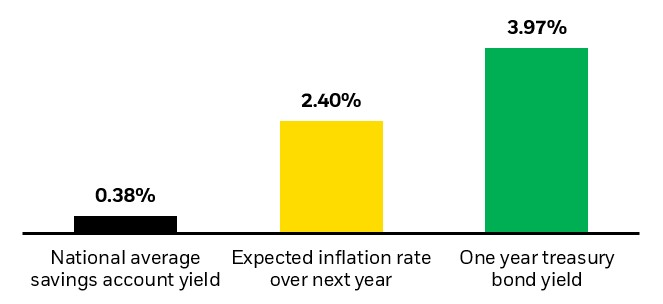
Figure 1: Cash in savings accounts may not keep up with inflation

One-year rates as of December 31, 2025

Bar chart comparing interest rates: national average savings account yield is 0.39%, expected inflation is 2.28%, and one-year Treasury bond yield is 3.47%, showing savings rates lag behind inflation and Treasury yields.

Source: Federal Deposit Insurance Corporation via FRED, Bloomberg, as of 12/31/2025. National average savings account, “cash,” yield is the average of rates paid by all insured depository institutions and credit unions for which data is available, with rates weighted by each institution's share of domestic deposits. Expected inflation refers to the one year breakeven inflation rate, implied by yields on US Treasury bonds and TIPS.

Image description: The chart compares three key rates. The national average savings account yield is 0.39%, well below the expected inflation rate of 2.28%. In contrast, the one-year Treasury bond yield is 3.47%, the highest of the three. The visual highlights how traditional savings accounts may struggle to keep pace with inflation, while Treasury yields offer a higher potential return.


Traditional cash alternatives: pros and cons

Historically, investors may have used high yield savings accounts (HYSAs) and money market funds (MMFs) as places to park their excess cash.2 Both can be effective, but each has its tradeoffs.

  • HYSAs offer daily liquidity and FDIC insurance, a government program which protects up to $250,000 per person for each account at an FDIC-insured bank.3 These can be valuable features for conservative savers. However, rates can fluctuate at the bank’s discretion and may lag market yields, especially when conditions change quickly.
  • MMFs, by contrast, typically track short-term interest rates more directly and have structural guardrails to seek protection against losses. But MMFs are still subject to investment risk and lack FDIC insurance. Plus, certain categories of MMFs may be subject to high minimum investments and potential redemption restrictions during periods of stress.

Why SGOV may be an efficient way to put cash to work

Another option to consider is investing your extra cash in ultra-short Treasury bond ETFs, such as the iShares 0–3 Month Treasury Bond ETF (SGOV). SGOV allocates exclusively to U.S. Treasuries with maturities of three months or less, which have historically been among the lowest-risk instruments available in public markets. When bonds mature, iShares portfolio managers will automatically reinvest the proceeds into new bonds, helping the fund stay fully invested. And along the way, SGOV seeks to pay monthly income distributions based on the interest accrued within the portfolio.

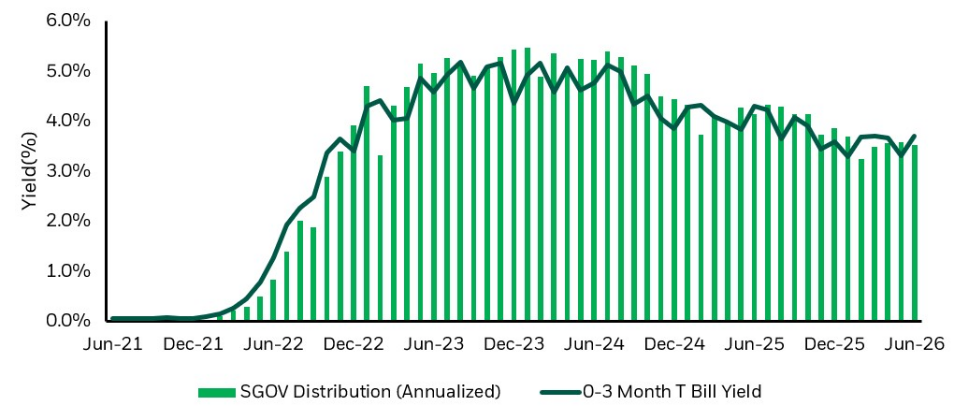
Figure 2: SGOV distributions have closely tracked market yields

SGOV Dividend Yield versus 0-3 Month Treasury Bill yields

Line chart showing SGOV monthly distributions and 3-month U.S. Treasury yields from 2022 to 2024, both rising from near 0% to about 5% and closely tracking each other.

Source: Bloomberg, BlackRock. As of 12/31/2025. SGOV Distribution (Annualized) refers to the monthly dividend amount, annualized and divided by the fund’s Net Asset Value. 0-3 Month T-Bill Yield refers to the Average Yield to Maturity of the Bloomberg 0-3 Month T-Bill Index. Past distributions are not indicative of future distributions. Performance data represents past performance and does not guarantee future results. Investment return and principal value will fluctuate with market conditions and may be lower or higher when you sell your shares. Current performance may differ from the performance shown. For most recent month-end performance see www.iShares.com. For SGOV’s prospectus, click here. Index performance is for illustrative purposes only. Index performance does not reflect any management fees or expenses. Indexes are unmanaged and one cannot invest directly in an index.

Image description: The chart compares SGOV’s monthly distributions with 3-month U.S. Treasury yields from 2022 through 2024. Both start near 0% in early 2022, rise steadily through 2022 and 2023 as rates increase, and reach around 5% by mid-to-late 2023. They remain near that level into 2024 with slight fluctuations.

The two lines move closely together throughout the period, highlighting how SGOV’s distributions have consistently kept pace with changes in short-term Treasury yields.


Potential benefits of SGOV

For investors looking to earn a market-based yield on their extra cash with the transparency, liquidity, and cost benefits of an ETF, SGOV may offer a compelling solution:

  • Easy access: As an ETF, SGOV can be purchased inside a traditional brokerage account with no minimum initial investment. It is available to all investors, unlike certain MMFs that may only be available to institutions sometimes at million-dollar minimums.
  • Liquidity: Investors can buy or sell ETF shares whenever markets are open. SGOV is the largest US Treasury Bond ETF on the market4 and typically has traded more than $1 billion per day on exchange, making it one of the most liquid bond ETFs available.5
  • Tax-advantaged income: Treasury interest income is generally exempt from state and local income taxes, giving SGOV a potential upper hand relative to fully taxable cash alternatives.
  • Low cost: SGOV’s management fee is 0.09%, which is less than half the average fee on retail money market funds.6 That’s $9 per year on a $10,000 investment.

Of course, no option is perfect. SGOV carries market risk and is not FDIC-insured, and as an ETF, its market price can fluctuate modestly around the value of its assets. But for investors willing to take marginal risk in exchange for transparent, tax-advantaged income, SGOV can be an attractive tool for managing extra cash.

Conclusion

Parking cash doesn’t need to mean accepting low returns. By considering short-term Treasury bond ETFs like SGOV alongside savings accounts and money market funds, investors can ensure every dollar is working a little bit harder.

Featured funds

Photo of Tom Fickinger, CFA

Tom Fickinger, CFA

U.S. Fixed Income Investment Product Strategist

Jairo Garcia

Fixed Income Strategist

Contributor