The Nasdaq-100 for long term investors

Jay Jacobs Jul 28, 2026 Equity

Key takeaways

  • The Nasdaq-100 Index provides exposure to companies driving long-term structural changes across the economy such as Apple, Microsoft, and SpaceX, among others.
  • Beyond technology, the Nasdaq-100 includes many companies investors interact with every day — from online shopping and digital communications to healthcare and consumer services.
  • The iShares Nasdaq 100 ETF (IQQ) is designed to provide long-term investors with a simple way to access these companies through one diversified investment. IQQ combines a low share price1 with a tax-efficient ETF structure that may help investors keep more of their money invested and compounding over time.
IQQ

iShares Nasdaq 100 ETF

Seeks to track an index of the largest non-financial companies listed on the Nasdaq based on market capitalization.

What is the Nasdaq-100 Index and why does it matter?

The Nasdaq-100 Index provides exposure to 100 large-cap U.S. companies driving long-term structural trends such as artificial intelligence, digitalization, and healthcare.2 The Nasdaq-100 has become one of the most widely followed equity indexes in the world, and for good reasons. As the economy constantly evolves, so do the companies driving it and many of today's fastest-growing trends are being led by companies in the Nasdaq-100.

These aren't just companies shaping tomorrow's economy; they are behind many of the products and services investors use every day, from smart watches and social media apps to the packages arriving at their door. It's a combination that continues to resonate with investors, with the U.S. large-cap and technology exposure strategies attracting over $270 billion in net inflows year-to-date.3

But for long-term investors, what investments you have exposure to is only part of the equation. How you access those companies matters too.

Why was IQQ designed for long-term investors?

The iShares Nasdaq 100 ETF (IQQ) is designed to make Nasdaq-100 exposure more accessible through a low share price4 and a cost-effective, tax efficient ETF structure built for long-term investing. Over the long term, even small differences in costs may help investors keep more of their returns invested and compounding.

IQQ provides a simple way to access these companies through one ETF. Rather than building separate allocations across multiple sectors or themes, investors gain exposure to a diversified basket of businesses spanning the technology, consumer discretionary, communication services and healthcare sectors.

For long-term investors, exposure is only part of the equation. Long-term investing is about giving your money time to grow. Over decades, the power of compounding can turn small differences — such as investment costs — into meaningful differences in portfolio outcomes. Through IQQ’s cost-effective access, investors may keep more of the index's potential growth over time.

Additionally, holding IQQ in a tax-advantaged account — such as a Traditional IRA, Roth IRA or employer-sponsored retirement plan — may allow investors to defer or potentially avoid taxes on investment growth, depending on the account type. That means more of your money can remain invested and continue compounding over time.

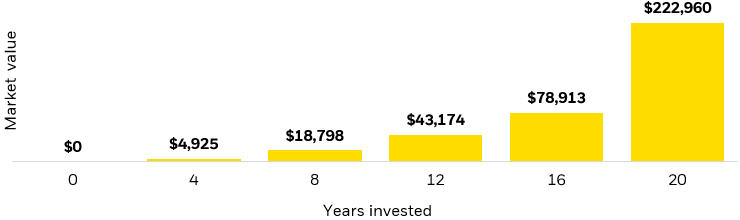
If you invested $100 per month for 20 years in the Nasdaq-100, you would have $222,960 today

Hypothetical growth of $100/month invested in Nasdaq-100 over 20 years.

Bar chart showing hypothetical growth of $100/month invested in Nasdaq-100 over 20 years and includes reinvestment of dividends.

Source: BlackRock analysis of Morningstar Data, based on Nasdaq-100 USD TR index performance between 7/1/2006 – 6/30/2026. Hypothetical performance is for illustrative purposes only. It does not represent real performance and often benefits from hindsight. Since trades were not executed, it cannot reflect market risks like interest rate changes or lack of liquidity, nor does it include trading costs. Many factors affecting actual results cannot be accounted for in hypothetical data, and can adversely affect actual results.

For illustrative purposes only and does not represent any specific investment. Index performance does not reflect any management fees or expenses. Indexes are unmanaged and one cannot invest directly in an index. Past performance does not guarantee future results. Index performance does not represent actual Fund performance. For actual fund performance, please visit www.iShares.com or www.blackrock.com.

Image description: Bar chart showing hypothetical growth of $100/month invested in Nasdaq-100 over 20 years and includes reinvestment of dividends.


Which iShares ETFs provide exposure to Nasdaq-listed stocks?

Different investors can use the Nasdaq-100 in different ways. Some may look for a long-term core growth allocation, while others may want more targeted exposure or income-oriented strategies.

That's why iShares offers a range of Nasdaq-focused ETFs that allow investors to tailor how they access the index. Whether investors are looking for broad Nasdaq-100 exposure through IQQ, more concentrated exposure to the largest companies, or alternative approaches, the iShares Nasdaq suite is designed to meet different portfolio objectives.

Ways to access the Nasdaq

Caption:

Investors can tailor their Nasdaq allocation based on their investment goals, whether prioritizing broad exposure, concentration in leading companies, emerging innovators, or income generation.

TickerFund nameRole
IQQiShares Nasdaq 100 ETFCore Nasdaq-100 exposure
QTOPiShares Nasdaq Top 30 Stocks ETFTargeted mega-cap Nasdaq exposure
QNXTiShares Nasdaq-100 ex Top 30 ETFRising-companies Nasdaq exposure
BALQiShares Nasdaq Premium Income Active ETFMonthly income + Nasdaq participation

Frequently asked questions

The iShares Nasdaq 100 ETF (IQQ) is an exchange-traded fund designed to track the performance of the Nasdaq-100 Index, which includes 100 of the largest non-financial companies listed on the Nasdaq Stock Market.

IQQ gives investors exposure to innovative companies across sectors including technology, consumer, communications, healthcare, and more — all through a single ETF.

The Nasdaq-100 includes many companies that influence how people live, work, shop, communicate, and consume entertainment. The index typically includes large-cap companies across industries such as:

  • Artificial intelligence
  • Cloud computing
  • E-commerce
  • Semiconductors
  • Digital payments
  • Consumer technology
  • Streaming and communications

Investors often use Nasdaq-100 ETFs to gain exposure to companies associated with innovation and long-term growth trends.

IQQ seeks to track the investment results of the Nasdaq-100 Index. The Nasdaq-100 is composed of the 100 largest non-financial companies listed on the Nasdaq Stock Market based on market capitalization.

IQQ is designed for investors seeking long-term exposure to companies associated with innovation, digital transformation, and evolving consumer behavior.

Many investors use Nasdaq-100 ETFs as part of a long-term growth allocation because the index includes companies involved in:

  • Artificial intelligence
  • Semiconductor development
  • Software and cloud infrastructure
  • Digital commerce
  • Consumer platforms
  • Advanced communications

As with any investment, investors should consider their goals, time horizon, and risk tolerance.

Using an ETF to invest in the Nasdaq-100 may offer benefits including:

  • Diversification across companies
  • Simplicity
  • Liquidity
  • Tax efficiency
  • Transparent holdings
  • Lower operational complexity than buying many individual stocks

ETFs may help investors efficiently access broad market themes.

The Nasdaq-100 is an index that tracks the 100 largest non-financial companies by market cap listed on the Nasdaq Stock Market. The S&P 500 is an index that tracks the 500 largest publicly traded U.S. companies by market cap, agnostic of industry or what exchange they’re listed on.

Featured funds

Photo of Jay Jacobs

Jay Jacobs

Head of U.S. Equity ETFs

Jamie Forbes

Equity Strategist

Contributor

Komal Kunwar

Equity Strategist

Contributor