Bond indexing: What it is and 3 ways investors may use it

Karen Veraa-Perry, CFA, Connor Stack Nov 02, 2026 Fixed Income

Key takeaways

  • Fixed income indexing has grown rapidly, with index strategies now representing a significant, fast-growing share of fixed income fund assets.
  • Bond indices and index funds have expanded well beyond “core Agg” exposures, giving investors more ways to build, customize, and express views in fixed income.
  • Rather than building a portfolio bond-by-bond, investors can use one or more index funds to form the core of a strategic fixed-income asset allocation, or as a tool to implement short-term tactical views.
BTOT

iShares Total USD Fixed Income Market ETF

Seek broad bond exposure in a single ETF, designed to help serve as a core holding.

USHY

iShares Broad USD High Yield Corporate Bond ETF

Seek access to high yield corporate bonds for investors focused on income potential.

USLN

iShares Broad USD Floating Rate Loan ETF

Seek exposure to senior loans, which have floating‑rate characteristics that may help manage interest‑rate sensitivity.

What is bond indexing?

Bond indexing is a method of fixed income investing where investors purchase a fund built to track a fixed income benchmark such as the Bloomberg Aggregate Index, which provides broad exposure to the U.S. investment grade bond market, including U.S. Treasuries, agency mortgage-backed securities and corporate bonds. Bond index funds are similar to equity index funds as both seek to track a benchmark. But bond indices are typically far larger — sometimes with thousands of securities, many illiquid, and some never trading — and can change more frequently as bonds mature and new bonds are issued.

At BlackRock, we like to say, “there’s nothing passive about indexing”, and nowhere is that truer than in fixed income.

When bond index funds were first introduced in 19861, it was widely doubted that they could be implemented at scale.

Today, 40% of fixed income fund assets in the U.S. are invested in index strategies, reflecting the significant growth of fixed income indexing over time. Adoption has continued at a rapid pace: over the last three years, approximately 65% of net flows into U.S. fixed income ETFs and mutual funds have gone into index strategies. Yet index fixed income funds still represent a relatively small share of the overall bond market, highlighting the potential runway for continued adoption.

We expect index fixed income adoption to continue growing, supported by a modernized and more liquid bond market, the expansion and evolution of fixed income indices, advances in portfolio management techniques, the growth of efficient investment vehicles such as ETFs, and the expanding ways investors are using index strategies across their portfolios.

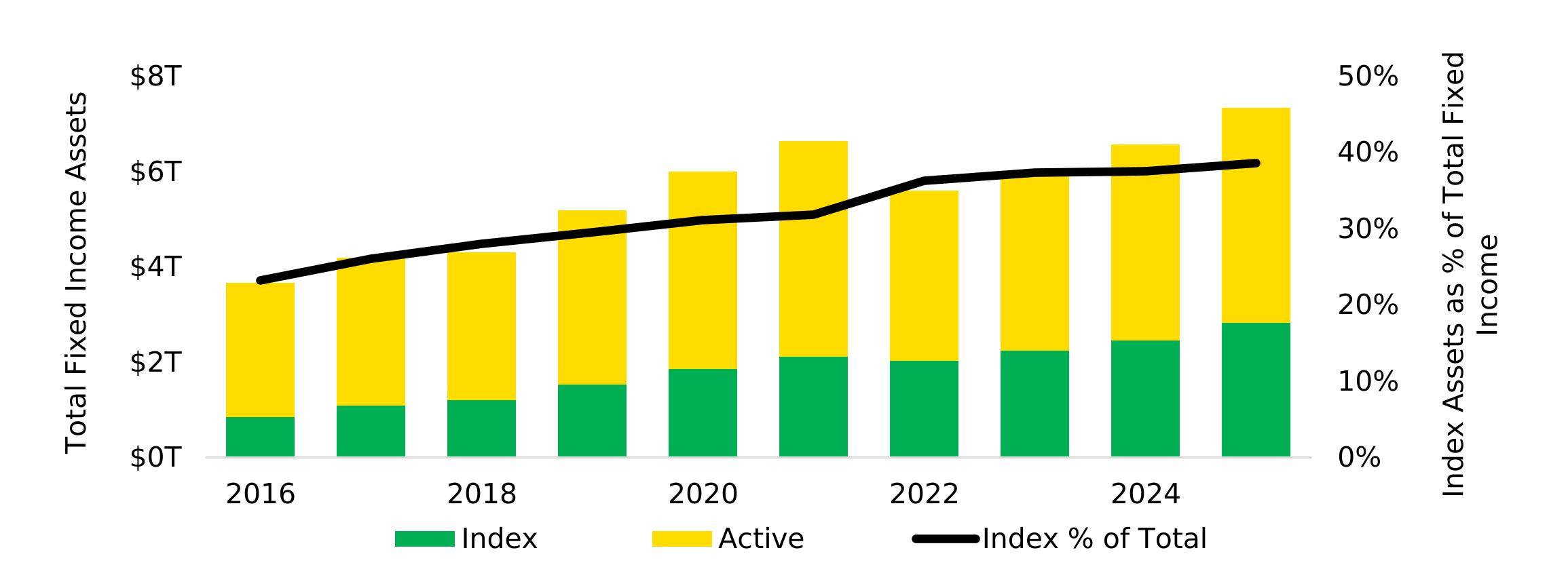
The rapid rise of fixed income index investing

Bar chart illustrating the growth of fixed income fund assets from 2016 to 2025.

Source: Morningstar and Bloomberg, as cited in the accompanying paper, as of December 31, 2025.

Chart description: Bar chart illustrating the growth of fixed income fund assets from 2016 to 2025. The stacked bars show assets invested in active and index fixed income mutual funds and ETFs, while the black line shows index fixed income assets as a percentage of total fixed income fund assets. As of December 31, 2025, index strategies represented approximately 40% of U.S. fixed income fund assets yet remained less than 10% of the overall bond market.


3 ways investors may use fixed income indexing

Index fixed income use cases range from forming the core of a strategic asset allocation, to a tool for implementing short-term tactical active views. Rather than building a portfolio bond-by-bond, investors can use one or more index funds to efficiently seek the following portfolio outcomes:

  • “Own” the market: Many investors use bond index funds as the core of their portfolio — essentially to own the broad fixed income market efficiently. Depending on how an investor defines their core bond market exposure, different multi-sector bond market index funds can serve as a foundational holding. These funds can provide instant exposure to thousands of bonds, including U.S. Treasuries, agency mortgages, and corporate bonds, and may extend into non-core sectors such as emerging markets or bank loans — potentially mirroring the overall market risk profile. Potential benefits include low fees and transparent, reliable exposure.

    Investors interested in a single, broad-based fixed-income holding may consider the iShares Total USD Fixed Income Market ETF (BTOT), which seeks to track the expanded fixed-income index universe in one ETF.
  • “Modify” the market: The menu of fixed income indices available today is extremely granular. There are hundreds of modified multi-sector or single-sector index funds available2, giving investors further control over their portfolios to pursue desired portfolio outcomes. Different investors have different reasons for owning fixed income and can use different index strategies to modify their core allocation accordingly. Whether investors are seeking greater equity diversification, looking to better preserve capital, or optimizing for income, index products can help them pursue these objectives.

    For investors looking to modify a core allocation toward greater income potential, the iShares Broad USD High Yield Corporate Bond ETF (USHY) offers a cost-efficient, broad-based way to add high yield corporate exposure to a portfolio.
  • Express relative market views: In a multi-asset portfolio, investors can overweight or underweight fixed income entirely, seeking to outperform their strategic benchmarks. Within the fixed income portion of a portfolio, investors can use an extensive menu of granular index options to express views on duration (a measure of a bond portfolio's sensitivity to changes in interest rates), position for changes in the yield curve or credit spreads, rotate across sectors, seek higher yields, or move up in credit quality — all with the intention of outperforming the broad, market-cap-weighted fixed income market — all with the intention of outperforming the broad, market cap-weighted fixed income market.

    Investors seeking to express a view through floating-rate income might consider the iShares Broad USD Floating Rate Loan ETF (USLN), which is designed to provided diversified exposure to senior loans.

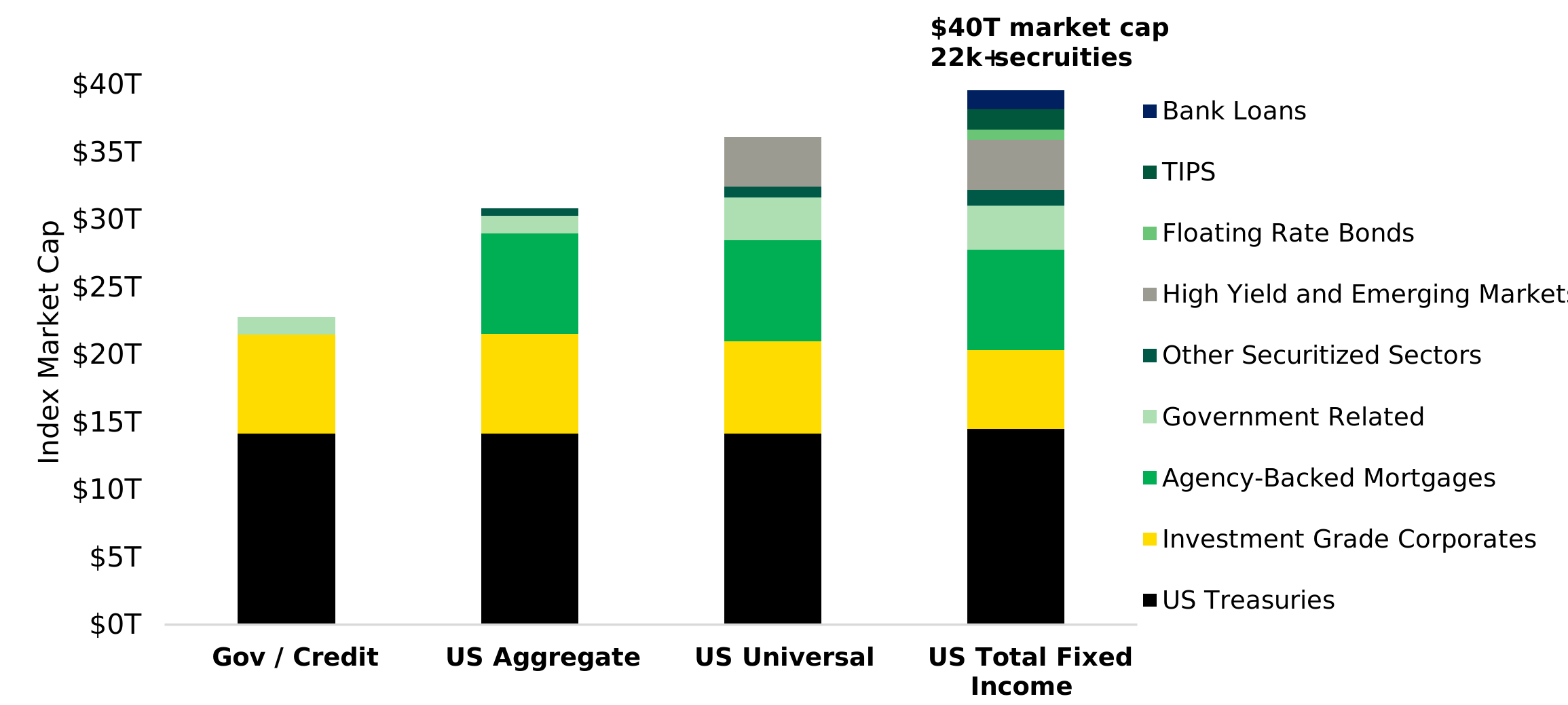
The expansion of the USD index fixed income market

Stacked bar chart comparing the breadth of four major USD fixed income benchmark universes.

Source: BlackRock, as of 12/31/2025. Market capitalization represents the aggregate market value of securities within each respective index. Gov/Credit, US Aggregate, US Universal and US Total Fixed Income represented by their respective Bloomberg Indices. The U.S. Total Fixed Income Index represents approximately $40 trillion in market value across more than 22,000 fixed income securities.

Chart description: Stacked bar chart comparing the breadth of four major USD fixed income benchmark universes. Moving from left to right, each index expands the investable bond market by including additional sectors beyond the prior benchmark. The Bloomberg U.S. Government/Credit Bond Index consists primarily of U.S. Treasuries and investment grade corporate bonds. The Bloomberg U.S. Aggregate Index adds agency mortgage-backed securities to traditional government and investment grade corporate bonds, the Bloomberg U.S. Universal Index further expands into sectors such as high yield and emerging markets, and the Bloomberg U.S. Total Fixed Income Index broadens coverage further to include areas such as TIPS, bank loans, floating-rate bonds, and additional securitized sectors. As of December 31, 2025, the broadest benchmark represents approximately $40 trillion in market value and more than 22,000 securities.


Why does process matter in fixed income indexing?

Equity index funds can often fully replicate their benchmarks. Fixed income is different: benchmarks can include tens of thousands of bonds and may rebalance regularly — so index portfolios often use an approach called stratified sampling to balance precision with trading costs. The goal is to stay closely aligned to the benchmark while thoughtfully managing turnover, liquidity, and transaction costs over time.

Four implementation levers that can matter in fixed income indexing include:

  • Participating in primary issuance to potentially capture new‑issue pricing and reduce secondary trading costs.
  • Continuous but patient rebalancing to avoid crowded month‑end trading and source liquidity opportunistically.
  • Actively navigating credit and index events (e.g., downgrades, restructurings, reclassifications) with discretion on timing and execution.
  • Leveraging scale and diverse liquidity access to help minimize transaction costs in markets where trading can be more expensive than equities.

Conclusion: Indexing as a portfolio foundation

Fixed income indexing today has expanded in sophistication and in how investors use it to meet different objectives. For many investors, indexing is no longer just a low‑cost option — it can be a core building block for resilient, diversified, and operationally efficient fixed-income portfolios, used to own markets, modify exposures, and complement active views.

For a deeper dive into the evolution of fixed income indexing, its growing role in portfolio construction, and the innovations shaping the market, read our full paper, Demystifying Index Fixed Income Investing.

Frequently asked questions

Both bond index mutual funds and bond index ETFs seek to track the same types of fixed income benchmarks. The key difference is structure. Mutual funds transact once daily at end-of-day net asset value (NAV), while ETFs trade on an exchange throughout the trading day. ETFs typically offer intraday liquidity, daily holdings transparency, and, in many cases, lower costs.

Usually not. Because fixed income benchmarks can include tens of thousands of bonds, most index funds use stratified sampling — a representative basket — rather than full replication. Portfolio managers construct a representative portfolio designed to closely track the index's risk and return characteristics while balancing liquidity, turnover, and transaction costs.

Bond indices are far larger and more dynamic than equity indices, with constituents constantly maturing, getting issued, or getting downgraded, which is why bond index construction and rebalancing require more active portfolio management than equities.

Yes. Investors can use index ETFs targeting specific durations, maturities, or floating-rate structures to dial interest rate sensitivity up or down within a portfolio.

Tracking error measures how closely a fund's returns follow its benchmark; in fixed income, a disciplined sampling and rebalancing process is what keeps tracking error low despite not holding every bond.

Both. As covered above, investors can use them to own the broad market, modify a core allocation, or express short-term tactical views — often all three at once across a portfolio.

Many seek to distribute income monthly (more frequently than individual bonds, which typically pay semi-annually), passing through interest collected from the underlying holdings.

Featured funds

Photo of Karen Veraa-Perry, CFA

Karen Veraa-Perry, CFA

Head of U.S. iShares Fixed Income Strategy

Photo of Connor Stack

Connor Statck

Fixed Income Strategy

Jairo Garcia

Fixed Income Strategist

Contributor