Investing in companies across the AI tech stack

Jay Jacobs Jul 20, 2026 Equity

Key takeaways

  • AI’s “tech stack” is composed of infrastructure, intelligence, and agents with each layer playing a different role in the AI story.
  • Different companies across these layers are reshaping the emergence of AI.
  • An actively managed ETF like the iShares A.I. Innovation and Tech Active ETF (BAI), provides hand-picked exposure to companies enabling, developing, and deploying today's most advanced AI technologies.

What is the AI tech stack?

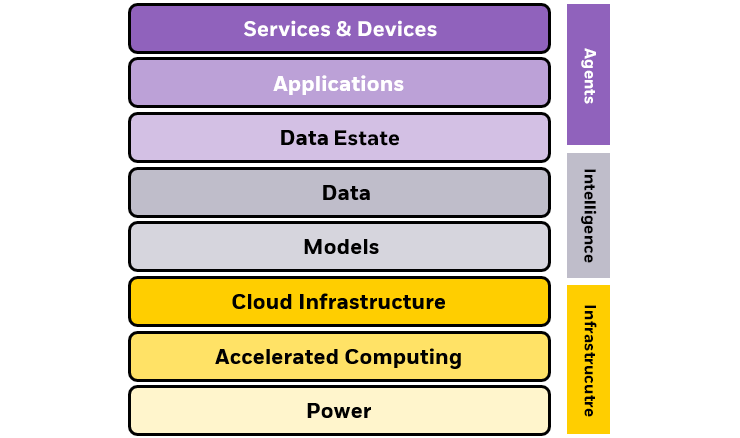
It’s hard to believe that it has only been around four years since the release of ChatGPT ignited a generative AI revolution. In that time, surging AI optimism has catalyzed massive capex in AI infrastructure, with over $5 trillion estimated to be spent by 20301 and remarkable advances beyond simply “text-in-text-out” to much more complex and productive capabilities. AI remains a powerful mega force still in the early innings of its adoption curve with the potential to reshape the economy on a scale comparable to the industrial revolution or rise of the internet. A range of companies are leading this transformation, hailing from various layers across the “AI tech stack” which includes infrastructure, intelligence, and agents.

Each layer of the tech stack plays an important role in AI’s emergence and presents different opportunities for investors. These layers don’t operate in isolation: infrastructure enables intelligence, while intelligence powers agents, and agents generate the real-world data that feds back into model improvement. As the AI ecosystem expands, opportunity may emerge across a wide range of companies working to power, train, secure, and deploy AI, including those tied to data centers, energy infrastructure, advanced computing, software, data, and automation. To delve deeper, we explore what is happening across each layer and how these areas may help shape the future of AI.

The AI stack

Illustration showing the different layers of the AI tech stack across Infrastructure, Intelligence, and Apps & Services.

Source: BlackRock, as of July 2026.

Image description: Illustration showing the different layers of the AI tech stack across Infrastructure, Intelligence, and agents.


What is the AI infrastructure layer?

Infrastructure is a critical component of the AI tech stack, serving as the physical foundation for AI compute used in training large language models and running inference. Think, data centers, but also the power, cooling, networking, storage, and grid connections needed to keep them running.

This layer is becoming increasingly important as AI demand grows and power demand becomes a defining challenge. Worldwide AI infrastructure spending reached $318 billion in 2025, more than double the $153 billion recorded in 2024, and projected spending could reach $700 billion in 2026.2 Meanwhile, current estimates predict that power demand from AI data centers in the U.S. could grow more than 35x, with high-end industry estimates reaching 148 gigawatts by 2030, up from just 4 gigawatts in 2024.3

That means the infrastructure layer is no longer just about computing capacity. It is also about reliable power, cooling, grid connections, cybersecurity, and resilience. As AI becomes embedded in business processes, the systems powering it need to be dependable enough to support real-world workflows at scale. (Learn more about AI and infrastructure)


Imagine: You’re listening to the weather, and a record-breaking heatwave is predicted. Your first thought may be preparing for a potential power outage, but AI-powered grids could detect disruptions to power lines in real time, re-routing electricity without human intervention to spare you and your perishables.

What does the AI intelligence layer do?

The intelligence layer of the AI tech stack encompasses AI models and the unique data sets being used to train and improve them. If infrastructure is what powers AI, intelligence is what makes AI useful.

In the first phase of generative AI, much of the attention centered on model capability: how quickly models could write, code, summarize, search, or reason. The focus is now shifting towards business application: how AI can help companies improve productivity, reduce costs, create new products, and make better decisions.

Early evidence suggests AI is already creating measurable benefits in specific business functions. McKinsey found that while enterprise-wide profit impact remains limited, respondents most commonly report cost benefits from AI in software engineering, manufacturing, and IT. Respondents also report the greatest revenue benefits in marketing and sales, strategy and corporate finance, and product or service development.4

As AI adoption matures, the winners in this layer may not simply be those building the largest models. They may be the companies and platforms that can combine AI capability with proprietary data, distribution, workflow integration, and clear business outcomes.

Imagine: You can walk into a clinic and get a personalized cancer treatment plan within minutes — tailored precisely to your genetic profile and medical history. AI models can make this possible by turning mountains of clinical data into life-saving insights, transforming how doctors treat diseases.

How AI agents turn insights into action

The final layer of the AI tech stack is agents. If infrastructure powers AI, and intelligence turns data into insights, agents are the layer that helps turn those insights into action.

Think of agents as AI-powered systems that can reason, act, and execute tasks across digital and physical environments. Earlier AI tools were often used to summarize, draft, search, or answer questions. Agents are designed to go further. They can help coordinate workflows across software systems, customer service, research, compliance, supply chains, commerce, and other business processes. Interest in agents is already high, but adoption is still early — 62% of organizations in a survey found that they are at least experimenting with AI agents, while 23% report scaling agentic AI somewhere in the enterprise. However, no more than 10% of respondents report scaling agents in any individual business function.5

Agents are not just another AI feature; they may represent a new interface for software. Instead of users moving between multiple applications to complete a task, agents could help coordinate the steps across those applications.

Studies predict 33% of enterprise software applications to include agentic AI by 2028, up from less than 1% in 2024.6


Imagine: You can chat with an AI assistant about a birthday gift idea, and within seconds, it finds the perfect item, checks inventory, and completes your purchase — all without you lifting a finger. Ecommerce integration with AI chatbots like ChatGPT is turning casual conversations into seamless transactions.

Conclusion

As AI continues to evolve and change the way we view technology, so must the way in which we invest in it. The AI tech stack remains a useful framework. Infrastructure powers AI. Intelligence makes AI useful. Agents bring AI into workflows. Investing dynamically across the layers of the AI tech stack could be key to capturing the full investment opportunity in the AI theme.

While the most visible AI breakthroughs and largest companies in the space tend to capture headlines, we believe there are under-the-radar players in AI that represent some of the most compelling opportunities. An actively managed ETF like the iShares A.I. Innovation and Tech Active ETF (BAI), provides hand-picked exposure to companies enabling, developing, and deploying today's most advanced AI technologies.

Frequently asked questions

Investors may get exposure to AI companies beyond mega-cap tech companies by investing in individual securities or funds that are unconstrained by market-cap. The iShares A.I. Innovation and Tech Active ETF (BAI), for example, invests in a concentrated portfolio of global AI and technology equities across all market capitalizations, chosen through bottom-up, research-driven fundamental investing.

BAI is the iShares A.I. Innovation and Tech Active ETF, an actively managed exchange-traded fund (ETF) that invests in a concentrated portfolio of global companies in the enablement, development, utilization and/or deployment of AI technology or products or services that leverage AI technology.

BAI invests in global AI and technology equities across all market capitalizations, chosen through bottom-up, research-driven fundamental investing.

AI-focused ETFs provide exposure to companies which may be positioned to benefit from long-term growth in artificial intelligence, across multiple industries. ETFs like BAI enable investors to seek diversified exposure to the AI theme without having to select individual stocks.

BAI provides exposure to companies across the global AI ecosystem, including:

  • Semiconductor and hardware
  • Cloud infrastructure
  • AI applications, services and software
  • AI power

Holdings may change any time as part of active portfolio management and market conditions. The fund holds approximately 50 securities, and allocations can be adjusted as investment views evolve.

  • BAI focuses specifically on artificial intelligence and advanced technology themes.
  • Broader technology or innovation ETFs may include companies not directly tied to AI and may be index-based rather than actively managed.
  • BAI is designed for investors seeking long-term growth-potential and exposure to AI and advanced technology themes.
  • Because BAI is concentrated in AI and other advanced technology stocks, it may experience periodic bouts of volatility.

BAI can be used as a thematic allocation within a diversified equity portfolio, complementing broader market exposure with targeted AI growth-potential.

The most current information — such as top 10 holdings — is available at iShares.com/BAI or in the official iShares BAI ETF fact sheet, which include holdings, performance, fees, and risk information.

Investors can invest through traditional brokerage platforms where they can also purchase stocks, bonds, and other ETFs.

As AI continues to evolve and change the way we view technology, so must the way in which we invest in it. Investing dynamically across the different layers of the AI tech stack could be key to capturing the full investment opportunity in the AI theme. While the largest names in the space tend to make headlines, we believe there are under-the-radar players in AI that represent some of the most compelling opportunities. An actively managed ETF like the iShares A.I. Innovation and Tech Active ETF (BAI), provides hand-picked exposure to companies enabling, developing, and deploying today's most advanced AI technologies.

Featured funds

Photo of Jay Jacobs

Jay Jacobs

Head of U.S. Equity ETFs

Ashley Doll

Equity Strategist

Contributor

Komal Kunwar

Equity Strategist

Contributor