Are we in an AI bubble the same way we were in the dot-com bubble?
Stock prices are near all-time highs. There’s enormous capital investment in infrastructure for demand that hasn't fully arrived yet. And suppliers are helping finance the customers who then spend that money back with them.
If you're looking for reasons to think we're going through a dot-com-like bubble happen again, you can probably find them.
So, let's take the comparison seriously — and then look at what the evidence actually shows.
I'm Faye Witherall, an Investment Strategist at BlackRock.
Our view is that AI stocks are not in a bubble. And that’s because we think this period looks fundamentally different from 2000 across three factors that help distinguish a boom from a bubble:
Valuations. The relationship between supply and demand. And just how early we think we actually are on the AI infrastructure build-out.
Let’s start with valuations.
At the peak of the dot-com boom, the four largest tech leaders of early 2000 — Microsoft, Cisco, Intel and Oracle — traded at nearly 70 times their two-year forward earnings.
Today, the four biggest AI hyperscalers — Microsoft, Alphabet, Amazon and Meta — trade at an average of about 18 times two-year forward earnings.2 Not the same bubble-like conditions that were in place during the dot-com boom.
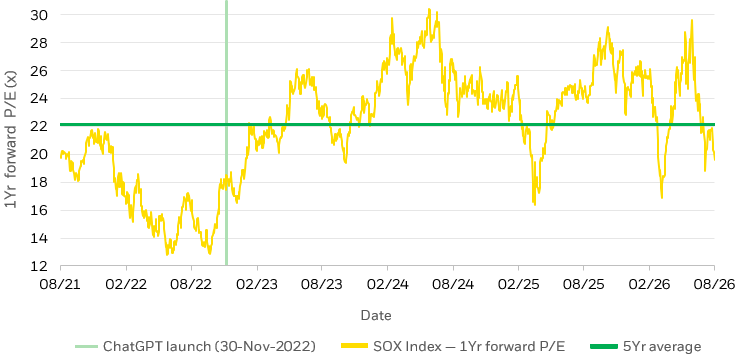
What about semiconductors? It might come as a surprise to many that what is now the world’s largest industry, ranked by market cap, is cheaper than its been in nearly 4 years (outside of 2 short-lived dips in April ’25 and April ’26. The rally in semis has been an earnings rally.
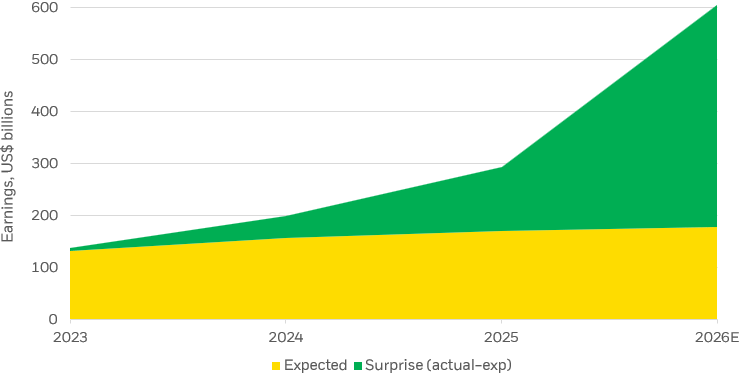
Prices are higher today mainly because companies are earning much more, not because investors are willing to pay more for the same earnings. That distinction matters:
Back then: Prices ran ahead of profits.
But today: Profits have been doing the work.
Now let’s look at demand versus supply.
Here's the part of the dot-com comparison that gets the direction backwards.
In the late 1990s, years of broadband capacity were built before the demand to use it existed. Infrastructure waited for customers.
Today it's inverted. Demand is waiting for infrastructure.
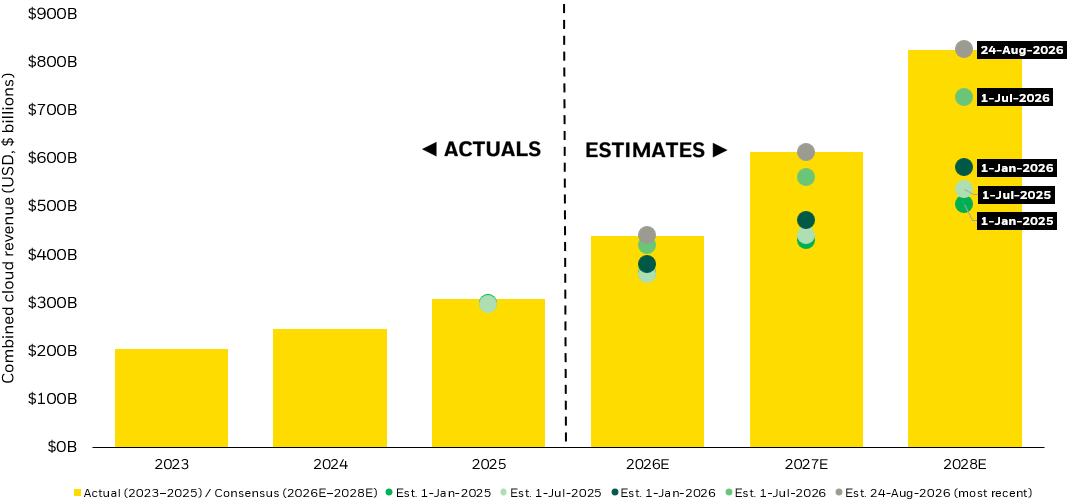
Start with revenue. Together, that is more than $100 billion a year from products that didn’t exist four years ago. For scale, only one software company out there that currently brings in more than $100 billion in annual revenue: Microsoft.
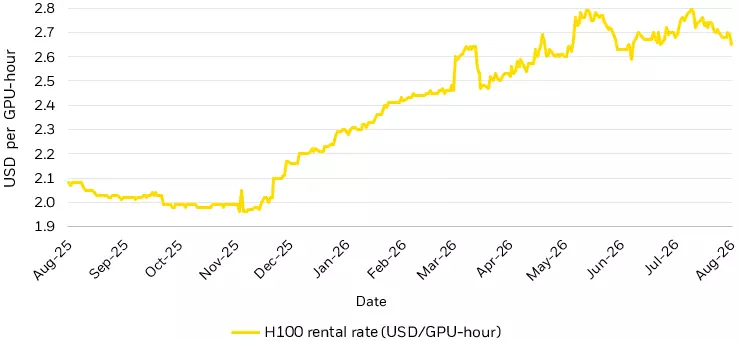
Another place to look is hardware pricing. Rental prices for NVIDIA GPUs have risen this year, even on chips that are about three years old. In technology markets, older hardware is supposed to get cheaper. The value of your used car doesn’t typically increase.
What’s happening right now is not normal. Aging hardware gets more expensive because demand is outrunning the industry's ability to build new capacity.
So, put simply:
Back then: Supply was built ahead of demand.
But today: Demand has been outrunning supply — and paying up front to secure it.
Capacity is scarce enough that customers are signing multi-year prepaid commitments just to lock in chips and data-center space.
And finally, we look at timing: how early are we?
This difference is the one that's easiest to miss, because AI already feels ubiquitous.
Consider what today's AI mostly does: it produces text and code. The frontier models available right now were built on infrastructure decisions made roughly two years ago. Investment has scaled enormously since then, which could mean the models arriving over the next few years could be substantially more capable than anything currently in use.
People often say: "Today's AI is the worst AI you will ever use."
And adoption is earlier than the headlines suggest. Widely available. Not yet deeply embedded in how companies operate.
We believe the economic applications with the most value attached — transportation, manufacturing, healthcare, scientific research — are largely ahead of us.
So, again, are we in an AI bubble the same way we were in the dot-com bubble?
We don’t believe we are. But there are real risks that we’re watching:
● Power constraints. The social and regulatory impact.
● Funding dynamics for AI infrastructure
● Increasing use of leverages strategies
● And Open-source models
The future is highly uncertain. But we still see tremendous opportunity in both the near-term and long-term when it comes to AI.
In our view, the bigger risk for investors is underestimating how large and how durable AI capital spending turns out to be.
So to recap, the three biggest differences that we think distinguish a boom from a bubble, and that makes today’s AI boom fundamentally different from the dot com bubble are:
Valuations, which are a fraction of dot-com peaks, and they're supported by real earnings.
Demand, which is running ahead of supply rather than trailing behind it.
And timing, where we think the technology's biggest applications are still in front of us.
That's why, in our view, this isn't a replay of 2000.
For investors looking at the theme, we spotlight two iShares ETF options: BAI, the iShares A.I. Innovation and Tech Active ETF, an actively managed concentrated portfolio of global AI and tech equities across market caps, selected through bottom-up fundamental research. And ARTY, the iShares Future AI & Tech ETF, which targets the full AI value chain — generative AI, data and infrastructure, software and services.
Explore our analysis below and bring us your questions directly on Reddit, at r/iShares.
Disclosures:
Carefully consider the Funds' investment objectives, risk factors, and charges and expenses before investing. This and other information can be found in the Funds' prospectuses or, if available, the summary prospectuses which may be obtained by visiting www.iShares.com or www.blackrock.com. Read the prospectus carefully before investing.
Investing involves risk, including possible loss of principal.
Funds that concentrate investments in specific industries, sectors, markets or asset classes may underperform or be more volatile than other industries, sectors, markets or asset classes and the general securities market. Technology companies may be subject to severe competition and product obsolescence. AI technology relies on large data sets, which can lead to inaccuracies. Companies in AI face competition, rapid obsolescence, and depend on demand from various industries. Regulatory scrutiny could limit AI development, with data collection facing closer examination and potential fines. Country-specific regulations could also impact AI and big data companies.
International investing involves risks, including risks related to foreign currency, limited liquidity, less government regulation and the possibility of substantial volatility due to adverse political, economic or other developments. These risks often are heightened for investments in emerging/developing markets and in concentrations of single countries.
Actively managed funds do not seek to replicate the performance of a specified index, may have higher portfolio turnover, and may charge higher fees than index funds due to increased trading and research expenses. There is no guarantee that an active fund will meet its investment objective.
This material represents an assessment of the market environment as of the date indicated; is subject to change; and is not intended to be a forecast of future events or a guarantee of future results. The opinions expressed are as of the date indicated and may change as subsequent conditions vary. The information and opinions contained in this material are derived from proprietary and nonproprietary sources deemed by BlackRock to be reliable, are not necessarily all-inclusive and are not guaranteed as to accuracy. As such, no warranty of accuracy or reliability is given and no responsibility arising in any other way for errors and omissions (including responsibility to any person by reason of negligence) is accepted by BlackRock, its officers, employees or agents. This material may contain “forward-looking” information that is not purely historical in nature. Such information may include, among other things, projections and forecasts. There is no guarantee that any of these views will come to pass. Reliance upon information in this material is at the sole discretion of the viewer.
The Funds are distributed by BlackRock Investments, LLC (together with its affiliates, “BlackRock”).
© 2026 BlackRock, Inc. or its affiliates. All Rights Reserved. BLACKROCK and iSHARES are trademarks of BlackRock, Inc. or its affiliates. All other trademarks are those of their respective owners.
MKTG0926-MH-5885659-EXP0927