Lower costs can help your money grow faster
Every investment charges fees. Even small differences in costs can add up over many years because the money you save stays invested instead of going toward expenses.
Episode 106 “How Should I Start Investing?” (May 1, 2026)
Anna: Hey Joy, how much was that sandwich?
Co-Worker 1: About 8 dollars.
Anna: Eight dollars a day means… you’re spending about 250 dollars a month on lunch. Over the last 20 years, if you’d invested that 250 dollars a month — your sandwich money — into the S&P 500, about how much would you have today?
A. About 60,000 dollars
B. Over 100,000 dollars
C. Just over a quarter of a million dollars
Co-Worker 1: Hmmmm, A?
Anna: Believe it or not, the answer is actually C, over a quarter of a million dollars. Even your lunch money can lead to impressive long-term growth.
On Screen Source Text:
BlackRock as of 12/31/25, based on a hypothetical investment in the S&P 500 Index and assumes an initial investment of $1 with monthly deposits over 20 years. Does not include any fees and expenses.
Index performance is for illustrative purposes only. Index performance does not reflect any management fees or expenses. Indexes are unmanaged and one cannot invest directly in an index. Past performance does not guarantee future results. Index performance does not represent iShares funds performance. For fund performance, visit iShares.com.
II. Host Intro
Investing — we know it’s important, but getting started can feel overwhelming. How do you begin? Where should you put your money? And when is the “right” time? Getting started might be simpler than you think. Today we’re digging in to show how you can turn your seeds into sunflowers.
I’m Anna Nerys. Around here, there are No Bad Questions. Be sure to like and subscribe, and ask away.
So, how do you start investing?
III. Top Line
First off, let’s dispel the myth that you need a lot of money to start investing. Even small, regular contributions can become something substantial. Here’s how: Many brokerage accounts offer fractional investing, which lets you buy part of a share instead of a full one and still experience growth. For example, the iShares Core S&P 500 ETF, which spreads your investment across the entire S&P 500, costs more than 600 dollars per share… But with fractional investing, you can still invest as low as 1 dollar a month — and let the power of compounding work for you. Compounding is when your returns start making their own returns, creating a snowball effect to increase your growth. I’ll put a link below to our episode on Long-Term Investing where we go deeper on compounding, but to illustrate the point.
Take a look at this: Over the last 20 years, if you’d invested that 1 dollar a month in the S&P 500, your 240 dollar total contribution would have increased to 1,100 dollars today. That’s impactful growth. Now take a look at what happens when the contribution increases: 10 dollars a month would become 10,700 dollars. 100 dollars a month would turn into 108,000 dollars. And 500 dollars a month? That would have grown to 584,000 dollars today!
On screen source text:
BlackRock as of 12/31/25, based on a hypothetical investment in the S&P 500 Index and assumes an initial investment of $1 with monthly deposits over 20 years. Does not include any fees and expenses. Index performance is for illustrative purposes only. Index performance does not reflect any management fees or expenses. Indexes are unmanaged and one cannot invest directly in an index. Past performance does not guarantee future results. Index performance does not represent iShares funds performance. For fund performance, visit iShares.com.
Now that we’ve established you can start investing with any amount, the next thing you need to do is figure out the right way for YOU to access the market. There are a couple of traditional paths for this:
You could hire an ADVISOR – this is a person or organization that makes and manages investments on your behalf. They often have a wealth of experience and can provide insights, advice, and a comprehensive or customized approach to your goals. And you pay for that service.
Another option is SELF-DIRECTED INVESTING – this is exactly what it sounds like: you’re doing the research, making picks, and investing yourself. I know that can sound intimidating, but we’ve come a long way from this: These days you can easily sign up and manage everything through an online brokerage platform or even an app on your phone. The good news is: you get total control of what you invest in. But you’re also the one responsible for the decisions.
Don’t worry. If self-directed investing sounds like the right path for you, there’s a simple way to start. Before we get to that, let’s make sure these options take root.
IV. Analogy
You can think of starting to invest like starting a garden.
You could hire a gardener to turn that patch of dirt into a full-fledged forest. They’ll select the plants, handle the work, and maintain that garden — and you pay them for that service. That’s an advisor. On the other hand, maybe you’ve got a green thumb. You do a little research, figure out your budget, and visit the local nursery, picking one plant at a time or taking home a wheelbarrow full of seedlings. This is self-directed investing.
If this sounds like you, the important thing to remember is: you don’t have to do everything at once, you just have to get started – and it doesn’t need to be an expensive start, it can be as low-cost as a single packet of seeds. As time goes on, and you watch your garden grow – you’ll start to get a sense for what’s thriving and what needs pruning — and you can keep adding and expanding your plot as you go.
So what should you plant?
V. Action
That can depend on what kind of garden you’re hoping to grow. For many investors, a simple place to begin is broad diversification. That’s where ETFs can help. An ETF bundles many investments into one purchase. Instead of buying one stock, you buy an ETF that holds a basket of stocks.
iShares ETFs are built by a team of experts at BlackRock and are designed to provide exposure across markets, sectors, or themes. It’s like starting with a mix of seeds instead of relying on just one seed to take root. And remember, you don’t need to buy a whole share to benefit thanks to fractional investing.
If you’re curious about ETFs, we have a full episode breaking them down. You can also read more on iShares.com. And of course, the biggest tip for starting investing, or gardening, is to begin. The longer you do it, the more time it has to grow and flourish.
VI. Disclaimer
Investing carries risk. Before you put your money into anything — even a super cute trowel — you should give it careful consideration. Always do your homework. I’ll drop some links below where you can learn more.
VII. Outro
The best time to plant a tree was 20 years ago. The second best time is now. The same is true for investing. Time is one of your most powerful tools… but only if you use it. Good luck on your journey, and be sure to like, subscribe, and come back for more nutrient-rich information on all the trending financial topics you need to know about. And remember, when it comes to investing, there are No Bad Questions.
Spoken disclosure:
Visit www.iShares.com to view a prospectus, which includes investment objectives, risks, fees, expenses and other information that you should read and consider carefully before investing. Investing involves risk, including possible loss of principal.
Written disclosure:
Carefully consider the Funds' investment objectives, risk factors, and charges and expenses before investing. This and other information can be found in the Funds' prospectuses or, if available, the summary prospectuses which may be obtained by visiting www.iShares.com or www.blackrock.com. Read the prospectus carefully before investing.
Investing involves risk, including possible loss of principal.
This material is provided for educational purposes only and is not intended to constitute investment advice or an investment recommendation within the meaning of federal, state or local law. You are solely responsible for evaluating and acting upon the education and information contained in this material. BlackRock will not be liable for direct or incidental loss resulting from applying any of the information obtained from these materials or from any other source mentioned. BlackRock does not render any legal, tax or accounting advice and the education and information contained in this material should not be construed as such. Please consult with a qualified professional for these types of advice.
This material contains general information only and does not take into account an individual's financial circumstances. This information should not be relied upon as a primary basis for an investment decision. Rather, an assessment should be made as to whether the information is appropriate in individual circumstances and consideration should be given to talking to a financial professional before making an investment decision.
Diversification may not protect against market risk or loss of principal. Transactions in shares of ETFs may result in brokerage commissions and may generate tax consequences. All regulated investment companies are obliged to distribute portfolio gains to shareholders. The Funds are distributed by BlackRock Investments, LLC (together with its affiliates, “BlackRock”).
© 2026 BlackRock, Inc. or its affiliates. All Rights Reserved. BLACKROCK and iSHARES are trademarks of BlackRock, Inc. or its affiliates. All other trademarks are those of their respective owners.
RO: 5441369
Whether you are investing for retirement or seeking to build wealth, iShares ETFs make it easy and cost-effective to help you to achieve your financial goals.
Episode 106 “How Should I Start Investing?” (May 1, 2026)
Anna: Hey Joy, how much was that sandwich?
Co-Worker 1: About 8 dollars.
Anna: Eight dollars a day means… you’re spending about 250 dollars a month on lunch. Over the last 20 years, if you’d invested that 250 dollars a month — your sandwich money — into the S&P 500, about how much would you have today?
A. About 60,000 dollars
B. Over 100,000 dollars
C. Just over a quarter of a million dollars
Co-Worker 1: Hmmmm, A?
Anna: Believe it or not, the answer is actually C, over a quarter of a million dollars. Even your lunch money can lead to impressive long-term growth.
On Screen Source Text:
BlackRock as of 12/31/25, based on a hypothetical investment in the S&P 500 Index and assumes an initial investment of $1 with monthly deposits over 20 years. Does not include any fees and expenses.
Index performance is for illustrative purposes only. Index performance does not reflect any management fees or expenses. Indexes are unmanaged and one cannot invest directly in an index. Past performance does not guarantee future results. Index performance does not represent iShares funds performance. For fund performance, visit iShares.com.
II. Host Intro
Investing — we know it’s important, but getting started can feel overwhelming. How do you begin? Where should you put your money? And when is the “right” time? Getting started might be simpler than you think. Today we’re digging in to show how you can turn your seeds into sunflowers.
I’m Anna Nerys. Around here, there are No Bad Questions. Be sure to like and subscribe, and ask away.
So, how do you start investing?
III. Top Line
First off, let’s dispel the myth that you need a lot of money to start investing. Even small, regular contributions can become something substantial. Here’s how: Many brokerage accounts offer fractional investing, which lets you buy part of a share instead of a full one and still experience growth. For example, the iShares Core S&P 500 ETF, which spreads your investment across the entire S&P 500, costs more than 600 dollars per share… But with fractional investing, you can still invest as low as 1 dollar a month — and let the power of compounding work for you. Compounding is when your returns start making their own returns, creating a snowball effect to increase your growth. I’ll put a link below to our episode on Long-Term Investing where we go deeper on compounding, but to illustrate the point.
Take a look at this: Over the last 20 years, if you’d invested that 1 dollar a month in the S&P 500, your 240 dollar total contribution would have increased to 1,100 dollars today. That’s impactful growth. Now take a look at what happens when the contribution increases: 10 dollars a month would become 10,700 dollars. 100 dollars a month would turn into 108,000 dollars. And 500 dollars a month? That would have grown to 584,000 dollars today!
On screen source text:
BlackRock as of 12/31/25, based on a hypothetical investment in the S&P 500 Index and assumes an initial investment of $1 with monthly deposits over 20 years. Does not include any fees and expenses. Index performance is for illustrative purposes only. Index performance does not reflect any management fees or expenses. Indexes are unmanaged and one cannot invest directly in an index. Past performance does not guarantee future results. Index performance does not represent iShares funds performance. For fund performance, visit iShares.com.
Now that we’ve established you can start investing with any amount, the next thing you need to do is figure out the right way for YOU to access the market. There are a couple of traditional paths for this:
You could hire an ADVISOR – this is a person or organization that makes and manages investments on your behalf. They often have a wealth of experience and can provide insights, advice, and a comprehensive or customized approach to your goals. And you pay for that service.
Another option is SELF-DIRECTED INVESTING – this is exactly what it sounds like: you’re doing the research, making picks, and investing yourself. I know that can sound intimidating, but we’ve come a long way from this: These days you can easily sign up and manage everything through an online brokerage platform or even an app on your phone. The good news is: you get total control of what you invest in. But you’re also the one responsible for the decisions.
Don’t worry. If self-directed investing sounds like the right path for you, there’s a simple way to start. Before we get to that, let’s make sure these options take root.
IV. Analogy
You can think of starting to invest like starting a garden.
You could hire a gardener to turn that patch of dirt into a full-fledged forest. They’ll select the plants, handle the work, and maintain that garden — and you pay them for that service. That’s an advisor. On the other hand, maybe you’ve got a green thumb. You do a little research, figure out your budget, and visit the local nursery, picking one plant at a time or taking home a wheelbarrow full of seedlings. This is self-directed investing.
If this sounds like you, the important thing to remember is: you don’t have to do everything at once, you just have to get started – and it doesn’t need to be an expensive start, it can be as low-cost as a single packet of seeds. As time goes on, and you watch your garden grow – you’ll start to get a sense for what’s thriving and what needs pruning — and you can keep adding and expanding your plot as you go.
So what should you plant?
V. Action
That can depend on what kind of garden you’re hoping to grow. For many investors, a simple place to begin is broad diversification. That’s where ETFs can help. An ETF bundles many investments into one purchase. Instead of buying one stock, you buy an ETF that holds a basket of stocks.
iShares ETFs are built by a team of experts at BlackRock and are designed to provide exposure across markets, sectors, or themes. It’s like starting with a mix of seeds instead of relying on just one seed to take root. And remember, you don’t need to buy a whole share to benefit thanks to fractional investing.
If you’re curious about ETFs, we have a full episode breaking them down. You can also read more on iShares.com. And of course, the biggest tip for starting investing, or gardening, is to begin. The longer you do it, the more time it has to grow and flourish.
VI. Disclaimer
Investing carries risk. Before you put your money into anything — even a super cute trowel — you should give it careful consideration. Always do your homework. I’ll drop some links below where you can learn more.
VII. Outro
The best time to plant a tree was 20 years ago. The second best time is now. The same is true for investing. Time is one of your most powerful tools… but only if you use it. Good luck on your journey, and be sure to like, subscribe, and come back for more nutrient-rich information on all the trending financial topics you need to know about. And remember, when it comes to investing, there are No Bad Questions.
Spoken disclosure:
Visit www.iShares.com to view a prospectus, which includes investment objectives, risks, fees, expenses and other information that you should read and consider carefully before investing. Investing involves risk, including possible loss of principal.
Written disclosure:
Carefully consider the Funds' investment objectives, risk factors, and charges and expenses before investing. This and other information can be found in the Funds' prospectuses or, if available, the summary prospectuses which may be obtained by visiting www.iShares.com or www.blackrock.com. Read the prospectus carefully before investing.
Investing involves risk, including possible loss of principal.
This material is provided for educational purposes only and is not intended to constitute investment advice or an investment recommendation within the meaning of federal, state or local law. You are solely responsible for evaluating and acting upon the education and information contained in this material. BlackRock will not be liable for direct or incidental loss resulting from applying any of the information obtained from these materials or from any other source mentioned. BlackRock does not render any legal, tax or accounting advice and the education and information contained in this material should not be construed as such. Please consult with a qualified professional for these types of advice.
This material contains general information only and does not take into account an individual's financial circumstances. This information should not be relied upon as a primary basis for an investment decision. Rather, an assessment should be made as to whether the information is appropriate in individual circumstances and consideration should be given to talking to a financial professional before making an investment decision.
Diversification may not protect against market risk or loss of principal. Transactions in shares of ETFs may result in brokerage commissions and may generate tax consequences. All regulated investment companies are obliged to distribute portfolio gains to shareholders. The Funds are distributed by BlackRock Investments, LLC (together with its affiliates, “BlackRock”).
© 2026 BlackRock, Inc. or its affiliates. All Rights Reserved. BLACKROCK and iSHARES are trademarks of BlackRock, Inc. or its affiliates. All other trademarks are those of their respective owners.
RO: 5441369
Our Core ETF product line-up simplifies our offering of over 300+ ETFs to the basic building blocks of an investment portfolio. With just a handful of funds you can create a low-cost, diversified set of holdings.

Low cost
iShares Core ETFs are low cost and help you invest more of your hard earned money.

Competitive performance
iShares Core ETFs have offered competitive performance for over 20 years.1

Tax efficient
Over the past 5 years, iShares Core equity stylebox ETFs have not distributed any capital gains.2
iShares Core S&P Total US Stock Market ETF
Start investing with broad exposure to the U.S. stock market.
iShares Total USD Fixed Income Market ETF
Access the full U.S. bond market through a single, diversified ETF.
You can’t invest directly on iShares.com, but we can guide you through the steps to get started.

Open an investment account
To invest in iShares ETFs, you’ll need to open an investment account with a bank or an online trading platform.

Select the funds
Browse ETFs on your platform and select the funds that match your goals. You might be interested in investing in a certain industry, region or theme.

Decide how you want to invest
Determine how much and how often you want to invest. You can set up a regular investment plan or make a one-time investment.
ETFs can help make investing simpler by keeping more of your money working for you overtime. Here are three reasons many long-term investors choose broad market ETFs.
Every investment charges fees. Even small differences in costs can add up over many years because the money you save stays invested instead of going toward expenses.
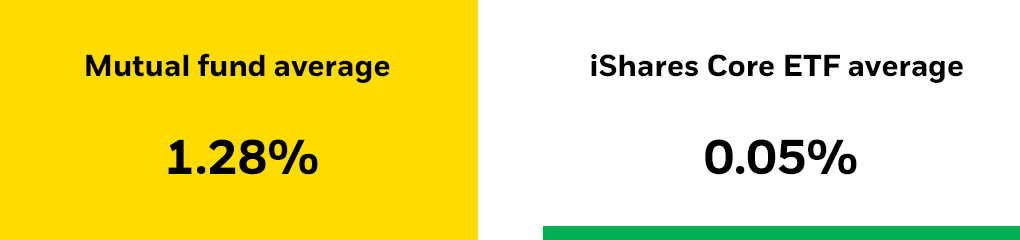
Source: Morningstar, as of 6/30/2026. Comparison is between the average Prospectus Net Expense Ratio for the iShares Core ETFs (0.05%) and actively managed open-end mutual funds in the 9 style box Morningstar categories using the oldest share class to avoid duplicates (1.28%).
Performance data represents past performance and does not guarantee future results. Investment return and principal value will fluctuate with market conditions and may be lower or higher when you sell your shares. Current performance may differ from the performance shown. For most recent month-end performance and standardized performance, click on the fund ticker above.
Chart description: Bar chart of comparing net expense ratios of active open-ended mutual funds average to iShares Core ETFs.
Historically, broad market index ETFs have delivered competitive long-term returns by tracking the market rather than trying to beat it. While past performance doesn't guarantee future results, long-term investing has rewarded patient investors.
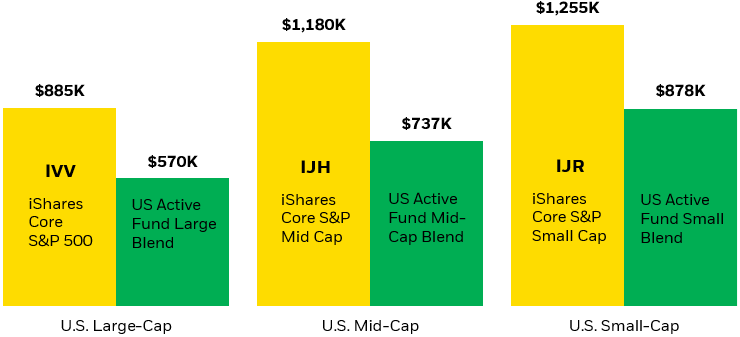
Source: Morningstar, as of 6/30/2026. The chart above reflects a hypothetical $10,000 investment and assumes reinvestment of dividends and capital gains. Fund expenses, including management fees and other expenses were deducted. The three active categories shown (US Active Fund Large Blend, US Active Fund Mid-Cap Blend, and US Active Fund Small Blend) are averages calculated by Morningstar that represent the equally weighted return for all actively managed mutual funds in the respective Morningstar Category.
Performance data represents past performance and does not guarantee future results. Investment return and principal value will fluctuate with market conditions and may be lower or higher when you sell your shares. Current performance may differ from the performance shown. For most recent month end performance and standardized performance, click here.
Chart description: Bar chart of hypothetical growth of $10,000 over 20 years where iShares Equity ETFs outperform US mutual fund averages.
Some mutual funds distribute capital gains even if you haven't sold your investment. Because of how many ETFs are structured, they have historically distributed fewer taxable capital gains.
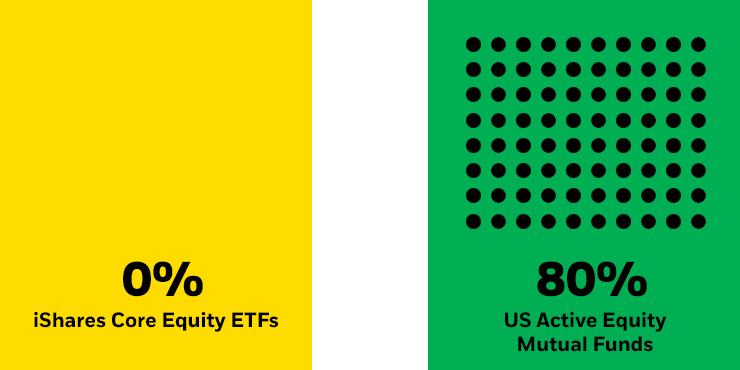
Source: BlackRock as of 12/31/2025; Morningstar average of years 2019 to 2025 as of 12/31/2025. US Active Equity Mutual Funds represented by the oldest share class of each Active Open-End Equity Mutual Fund available in the United States incepted before 10/31 in each year and excludes funds that closed before 10/31 in each year, as of 12/31/2025.
Past distributions are not indicative of future distributions.
Chart description: Illustrative chart showing that 0% of iShares Core Equity ETFs paid capital gains vs 80% of US active equity mutual funds paid capital gains.
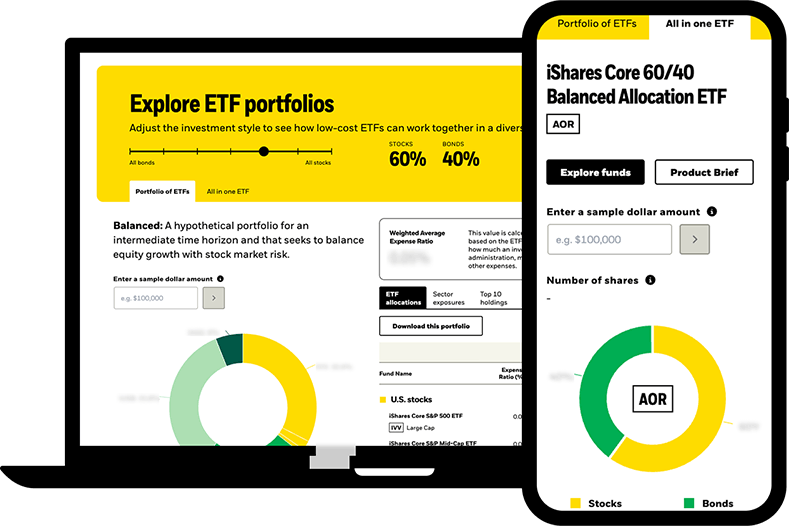
INVESTOR TOOL
See how iShares Core ETFs work together as the building blocks for a low-cost, diversified portfolio in iShares Portfolio Builder.
Three easy ways to create a portfolio using iShares Core ETFs.
Our Funds
ASSET CLASS
ETFs BY EXPOSURE
Investment Strategies
EXPLORE NOW
GET STARTED
GO FURTHER
FEATURED FUNDS
Insights
PORTFOLIO INSIGHTS
MARKET INSIGHTS
Education
EXPLORE NOW
INVESTING 101
ETF EDUCATION
INVESTMENT STRATEGIES & ASSET CLASSES
RETIREMENT SOLUTIONS
Resources
About Us
GET TO KNOW iSHARES
© 2026 BlackRock, Inc. All rights reserved.
1 Source: Morningstar as of 6/30/2026.The iShares Core Aggressive Allocation ETF (AOA) 1-, 5-, and 10-year ranking in the US Fund Global Allocation category is 36%, 16% and 19% out of 51, 19, and 18 funds respectively. The iShares Core S&P 500 ETF (IVV) 1-, 5-, and 10-year ranking in the US Fund Large Blend category is 33%, 20% and 18% out of 378, 236, and 153 funds respectively. The iShares Core S&P Small-Cap ETF (IJR) 1-, 5-, and 10-year ranking in the US Fund Small Blend category is 39%, 62% and 48% out of 230, 343, and 225 funds respectively. The iShares Core S&P US Value ETF (IUSV) 1-, 5-, and 10-year ranking in the US Fund Large Value category is 67%, 39% and 39% out of 728, 369, and 347 funds respectively. The iShares Core S&P Total US Stock Mkt ETF (ITOT) 1-, 5-, and 10-year ranking in the US Fund Large Blend category is 26%, 48% and 36% out of 308, 532, and 331 funds respectively. The iShares Core S&P Mid-Cap ETF (IJH) 1-, 5-, and 10-year ranking in the US Fund Mid-Cap Blend category is 37%, 40% and 41% out of 144, 134, and 99 funds respectively. The iShares Core Moderate Allocation ETF (AOM) 1-, 5-, and 10-year ranking in the US Fund Moderately Conservative Allocation category is 46%, 23% and 31% out of 95, 44, and 62 funds respectively. The iShares Core S&P US Growth ETF (IUSG) 1-, 5-, and 10-year ranking in the US Fund Large Growth category is 22%, 19% and 26% out of 165, 115, and 193 funds respectively. The iShares Core MSCI EAFE ETF (IEFA) 1-, 5-, and 10-year ranking in the US Fund Foreign Large Blend category is 61%, 44% and 45% out of 403, 253, and 232 funds respectively. The iShares Core US Aggregate Bond ETF (AGG) 1-, 5-, and 10-year ranking in the US Fund Intermediate Core Bond category is 42%, 42% and 55% out of 173, 165, and 192 funds respectively. The iShares Core US REIT ETF (USRT) 1-, 5-, and 10-year ranking in the US Fund Real Estate category is 12%, 4% and 26% out of 22, 6, and 50 funds respectively. The iShares Core Growth Allocation ETF (AOR) 1-, 5-, and 10-year ranking in the US Fund Moderate Allocation category is 55%, 32% and 26% out of 197, 118, and 89 funds respectively. The iShares Core MSCI Total Intl Stk ETF (IXUS) 1-, 5-, and 10-year ranking in the US Fund Foreign Large Blend category is 21%, 46% and 33% out of 136, 265, and 173 funds respectively. The iShares Core 1-5 Year USD Bond ETF (ISTB) 1-, 5-, and 10-year ranking in the US Fund Short-Term Bond category is 69%, 78% and 63% out of 322, 362, and 249 funds respectively. The iShares Core MSCI Emerging Markets ETF (IEMG) 1-, 5-, and 10-year ranking in the US Fund Diversified Emerging Mkts category is 54%, 41% and 38% out of 396, 225, and 223 funds respectively. The iShares Core Conservative Allocation ETF (AOK) 1-, 5-, and 10-year ranking in the US Fund Moderately Conservative Allocation category is 25%, 23% and 12% out of 17, 13, and 9 funds respectively. The iShares Core 10+ Year USD Bond ETF (ILTB) 1-, 5-, and 10-year ranking in the US Fund Long-Term Bond category is 48%, 83% and 78% out of 20, 27, and 24 funds respectively. The iShares Core High Dividend ETF (HDV) 1-, 5-, and 10-year ranking in the US Fund Large Value category is 54%, 40% and 92% out of 578, 374, and 883 funds respectively. The iShares Core Dividend ETF (DIVB) 1-, 5-, and 10-year ranking in the US Fund Large Value category is 26%, 18% and 0% out of 254, 168, and 0 funds respectively. The iShares Core Dividend Growth ETF (DGRO) 1-, 5-, and 10-year ranking in the US Fund Large Value category is 51%, 42% and 12% out of 553, 394, and 94 funds respectively. The iShares Core International Aggt Bd ETF (IAGG) 1-, 5-, and 10-year ranking in the US Fund Global Bond-USD Hedged category is 71%, 29% and 36% out of 80, 25, and 30 funds respectively. The iShares Core MSCI Intl Dev Mkts ETF (IDEV) 1-, 5-, and 10-year ranking in the US Fund Foreign Large Blend category is 53%, 35% and 0% out of 362, 207, and 0 funds respectively. The iShares Core Total USD Bond Market ETF (IUSB) 1-, 5-, and 10-year ranking in the US Fund Intermediate Core-Plus Bond category is 46%, 52% and 63% out of 239, 208, and 263 funds respectively. The iShares Core MSCI Europe ETF (IEUR) 1-, 5-, and 10-year ranking in the US Fund Europe Stock category is 67%, 64% and 53% out of 37, 40, and 26 funds respectively. The iShares Core MSCI Pacific ETF (IPAC) 1-, 5-, and 10-year ranking in the US Fund Diversified Pacific/Asia category is 46%, 48% and 40% out of 51, 53, and 42 funds respectively. The iShares Core 5-10 Year USD Bond ETF (IMTB) 1-, 5-, and 10-year ranking in the US Fund Intermediate Core-Plus Bond category is 14%, 39% and -% out of 73, 143, and - funds respectively. The iShares Total USD Fixed Income Market ETF (BTOT) 1-, 5-, and 10-year ranking in the US Fund Multisector Bond category is -%, -% and -% out of -, -, and - funds respectively. Past performance is no guarantee of future results.
2 As of December 31, 2025.
Carefully consider the Funds' investment objectives, risk factors, and charges and expenses before investing. This and other information can be found in the Funds' prospectuses or, if available, the summary prospectuses, which may be obtained by visiting the iShares Fund and BlackRock Fund prospectus pages. Read the prospectus carefully before investing.
Investing involves risk, including possible loss of principal.
Transactions in shares of ETFs may result in brokerage commissions and will generate tax consequences. All regulated investment companies are obliged to distribute portfolio gains to shareholders.
Diversification and asset allocation may not protect against market risk or loss of principal.
The strategies discussed are strictly for illustrative and educational purposes and are not a recommendation, offer or solicitation to buy or sell any securities or to adopt any investment strategy. There is no guarantee that any strategies discussed will be effective.
No proprietary technology or asset allocation model is a guarantee against loss of principal. There can be no assurance that an investment strategy based on the tools will be successful.
The Funds are distributed by BlackRock Investments, LLC (together with its affiliates, "BlackRock").
The iShares Funds are not sponsored, endorsed, issued, sold or promoted by Bloomberg, BlackRock Index Services, LLC, Cboe Global Indices, LLC, Cohen & Steers, European Public Real Estate Association (“EPRA® ”), FTSE International Limited (“FTSE”), ICE Data Indices, LLC, Nasdaq, Inc., NSE Indices Ltd, JPMorgan, JPX Group, London Stock Exchange Group (“LSEG”), MSCI Inc., Markit Indices Limited, Morningstar, Inc., Nasdaq, Inc., National Association of Real Estate Investment Trusts (“NAREIT”), Nikkei, Inc., Russell, S&P Dow Jones Indices LLC or STOXX Ltd. None of these companies make any representation regarding the advisability of investing in the Funds. With the exception of BlackRock Index Services, LLC, who is an affiliate, BlackRock Investments, LLC is not affiliated with the companies listed above.
Neither FTSE, LSEG, nor NAREIT makes any warranty regarding the FTSE Nareit Equity REITS Index, FTSE Nareit All Residential Capped Index or FTSE Nareit All Mortgage Capped Index. Neither FTSE, EPRA, LSEG, nor NAREIT makes any warranty regarding the FTSE EPRA Nareit Developed ex-U.S. Index, FTSE EPRA Nareit Developed Green Target Index or FTSE EPRA Nareit Global REITs Index. “FTSE®” is a trademark of London Stock Exchange Group companies and is used by FTSE under license.
© 2026 BlackRock, Inc or its affiliates. All Rights Reserved. BLACKROCK, iSHARES, iBONDS, LIFEPATH, ALADDIN, THE MARKET IS YOURS and the iShares Core Graphic are trademarks of BlackRock, Inc. or its affiliates. All other trademarks are those of their respective owners.
MKTG0926-MH-5883860-EXP0927