In Market Wrap, we look back at the events of the past month and outline what's on our radar for the month ahead.
Market Wrap
Key takeaways
01.
Geopolitical uncertainty continues
Geopolitical uncertainty in the Middle East remains elevated as the conflict draws in more regional actors, although diplomatic efforts are continuing. In the UK, Andy Burnham has taken office as Prime Minister.
02.
Tech stays in the spotlight
Tech, financials, healthcare and energy have been among the sectors reporting the strongest revenues and profits in the latest earnings season. New AI models added to the debate around AI competition and tech spending.
03.
Events on our radar
Investors will likely continue to monitor developments in the Middle East and their potential second-round effects on energy prices, inflation and interest rate policy.
Capital at risk. The value of investments and the income from them can fall as well as rise and are not guaranteed. Investors may not get back the amount originally invested.
Geopolitical uncertainty continues
- Geopolitical uncertainty in the Middle East remains elevated as US-Iran tensions continue to contribute to regional instability. Periods of diplomatic progress have been followed by renewed escalation, while attacks by the Yemen-based Houthis have increased the risk of disruption to shipping through the Red Sea and other key trade routes.
- Oil prices have remained sensitive to these developments, and traffic through the Strait of Hormuz remains below pre-crisis levels.¹ Even so, financial markets have remained relatively resilient, helped in part by stronger-than-expected company earnings.
- Major developed market central banks continue to monitor the impact of geopolitical developments and energy prices on inflation, while stressing that future interest rate decisions will remain guided by incoming economic data. In the UK, Andy Burnham’s arrival as Prime Minister was broadly well received, supported by expectations of continued restraint around the government’s budget and borrowing levels.
Tech stays in the spotlight
- One notable development was the launch of Moonshot AI’s Kimi K3 model, which added to the debate over whether increasingly capable, lower-cost models could intensify competition among today’s industry leaders. This could have potentially contributed to volatility across semiconductor shares. More broadly, technology companies continue to face scrutiny, particularly where investor expectations for growth and returns on AI spending are already high.
- However, appetite remains strong for advanced memory chips used in AI infrastructure – particularly high-bandwidth memory (HBM), which can help to reduce data bottlenecks, making it increasingly important for demanding AI workloads. Forecasts estimate HBM demand could grow at a compound annual rate of around 40% through 2030, compared with about 21% for standard dynamic random-access memory (DRAM) chips.2 See our iShares Outlook for more on our views on semiconductors.
- More broadly, earnings season – when companies report their latest profits and outlooks – has highlighted the importance of profitability and cash generation, with investors generally punishing weaker-than-expected results more heavily than they’ve rewarded positive surprises. Even so, US technology companies delivered strong results overall, while financials, healthcare and energy were also among the stronger-performing sectors across the US and Europe.³
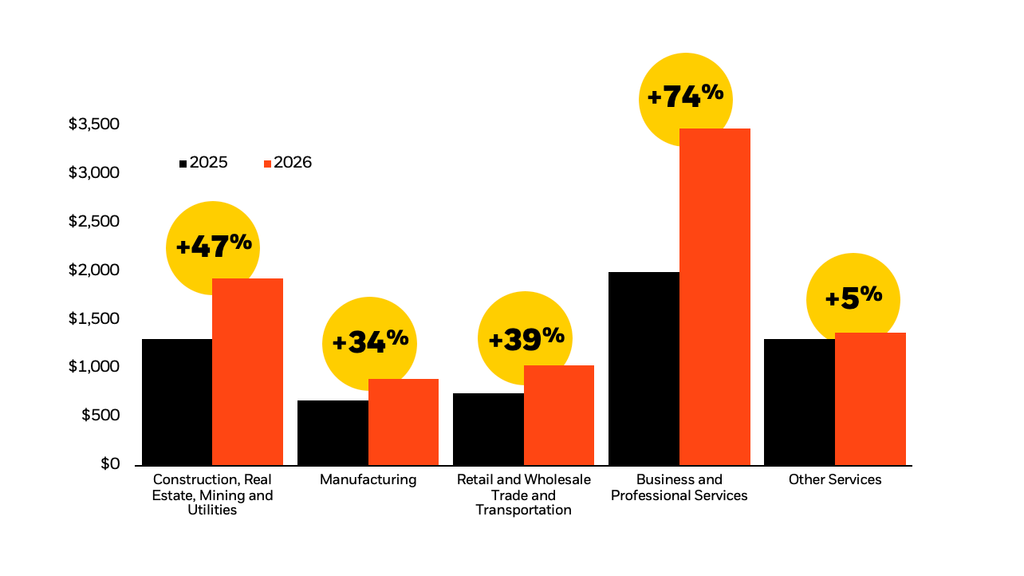
AI spending per employee is rising fast
Mean $ per employee2
Source:
Federal Reserve Bank of Atlanta, "How Much Are Firms Spending on AI (and What Will Happen to Headcounts)?," Policy Hub, May 2026; based on the Atlanta Fed Survey of Business Uncertainty. Figures represent mean AI spending per employee (USD), by select industry, for 2025 and 2026; industry averages are winsorized at the 99th percentile. 2026 figures reflect firms' anticipated spending. Percentages reflect the year-over-year change in mean AI spending per employee from 2025 to 2026.
Events on our radar
Looking ahead, we continue to monitor developments in the Middle East and how central banks assess any second-round inflation effects, particularly whether higher energy prices begin to feed into wages, services and broader price pressures.
Performance of financial markets, 2021-2026 YTD
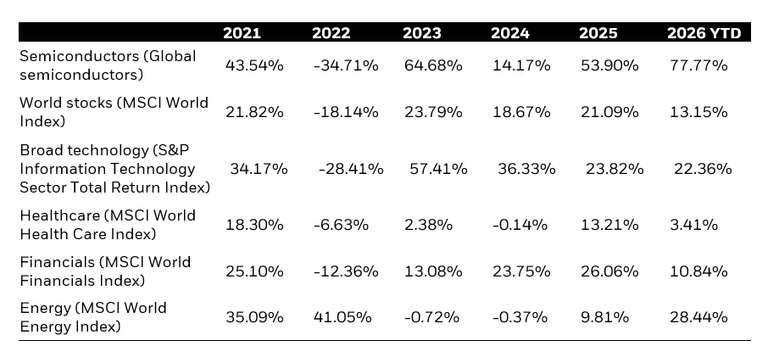
The figures shown relate to past performance. Past performance is not a reliable indicator of current or future results. Index performance returns do not reflect any management fees, transaction costs or expenses. Indices are unmanaged and one cannot invest directly in an index. Source: Bloomberg, as of 31 July 2026.