iShares iBonds ETFs

Bond ETFs with a set maturity date, designed to help you invest for specific future goals.

What are iBonds ETFs?

iBonds ETFs are bond exchange-traded funds (ETFs) that mature in a specific calendar year. Each iBonds ETF invests in a diversified group of bonds that all mature around the same time and makes a final payment when the ETF reaches maturity.

They are designed to combine features of individual bonds and bond ETFs. Like an individual bond, an iBonds ETF has a clear maturity date. Like an ETF, it offers diversification across many bonds and can be bought and sold on an exchange.

This structure can help investors plan ahead for known future needs, such as funding education costs, supplementing retirement income, or managing long‑term savings goals.

Capital at risk. The value of investments and the income from them can fall as well as rise and are not guaranteed. Investors may not get back the amount originally invested.


Image of woman holding a shopping bag

Investment grade corporate iBonds ETFs

Explore iBonds € and $ investment grade corporate ETFs with maturities through 2036 and 2037, offering exposure to corporate bonds to help plan investments around future dates.

Image of glass office buildings

€ Crossover Corporate iBonds ETFs

Explore iBonds € Crossover Corporate ETFs, which invest in a mix of investment grade and higher‑risk corporate bonds that all mature in the same year.

Image of a person holding coins in their hand.

$ Corporate high yield iBonds ETFs

Explore iBonds $ High Yield Corporate ETFs, investing in higher‑risk corporate bonds with a set maturity year and potential for higher income, but greater volatility.

of articles

What are iBonds ETFs designed to do?

Icon of a clock

Mature like a bond

Each iBonds ETF has a set maturity date and aims to make a final payment when it reaches that date, similar to an individual bond.

Icon of two circular arrows.

Trade like a stock

iBonds ETFs can be bought and sold on an exchange during their lifetime, giving flexibility if your circumstances or goals change.

Icon of a jar.

Diversify like a fund

Each ETF invests in many bonds within a specific market and maturity year, helping spread risk across issuers. Diversification does not remove the risk of losses.

Diversification and asset allocation may not fully protect you from market risk.

Benefits of iBonds ETFs

iBonds ETFs are designed to give investors clearer visibility over bond maturity dates while maintaining the flexibility of an ETF.

Diversification icon

Easily access bonds

iBonds ETFs provide easy access to bonds, with one trade, you gain exposure to a selection of bonds and could generate regular income.

Risk icon

Be flexible

iBonds ETFs are available in a range of maturities, so you can choose how long you want to invest your money for. If your needs change, so can your investment. You can buy or sell iBonds ETFs at any time on the stock exchange.

Euro icon

Diversify at low cost

iBonds ETF provide exposure to a selection of bonds across various regions and parts of the bond market, at relatively low cost.

Sanings icon

Match expected cash flows

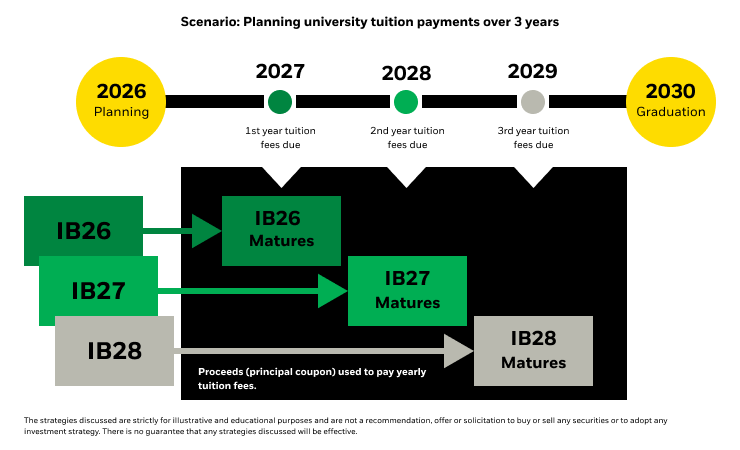
iBonds ETFs mature at a specific date. So, investors could expect a final payment at maturity, which could help fund life stage planning, such as buying a car or a house, college tuition or retirement.

iBonds ETFs combine features of individual bonds and traditional bond ETFs by offering a set maturity date alongside diversification and exchange trading.

As with all bond investments, key risks include interest rate risk and credit risk. Bond prices typically fall when interest rates rise, and there is a risk that bond issuers may not be able to make payments. This means the value of an iBonds ETF can change before maturity, and returns are not guaranteed.

When you invest in an iBonds ETF

When you are ready to purchase an iBonds ETF, we have tools to help you understand the estimated net acquisition yield of the fund. It’s an estimate of how much money you may make per year, after fees and today’s price, if you hold the ETF until maturity.

On each iBonds ETFs product page, the Estimated Net Acquisition Yield Calculator can provide a yield estimate if you enter a projected market price.

During the life of the iBonds ETF

iBonds ETFs aim to provide returns through regular income payments. The value of the ETF can rise or fall during this period.

When the iBonds ETF matures

  • iBonds ETF terminate in December of the year in the fund’s name.
  • In the final months when the bonds in the portfolio mature, the fund's holdings transition to cash and cash equivalents.
  • On or around the maturity date of the fund, the ETF delists from the exchange.
  • Final payment paid to shareholders (This includes the initial investment along with any income generated by the ETF, minus fees and expenses)

iShares iBonds ETF line up

The iBonds ETF range covers different types of bond markets, allowing investors to choose options that match their investment goals and risk preferences.
Certain products on this page track MSCI and Bloomberg indices.

€ Investment grade corporate
$ High Yield corporate

Looking for ideas on how to use iBonds ETFs?

For investors planning for important life events, such as purchasing a home or funding college tuition, investing in an iBonds ETF that matures on or before the anticipated expense date can ensure their money is working for them, rather than sitting on the sidelines.

Graph showing how to use iBonds
Bridge

Fixed income investing

Explore how evolving market conditions are shaping fixed income portfolio construction.

For more information on the final payment see the below section on ‘when the iBonds ETF matures'.